19 June, 2014

Letter from NYC (35) 2014 (7): The BIG Shindo Monbrison Report


Pics show unit of reader AA. Click to enlarge.

Letter from NYC (35) 2014 (7): The BIG Shindo Monbrison Report
Review: Shindo Monbrison (old version), Part I 

Addendum (10/28/17): Part II (vs Manley 300B preamp) and Part III (large phonoamp and preamp comparison) have been published.

Revised 30/06/14 New Info from reader PR added.

It is amazing that, aside from a brief mention in my 2011 retrospective, I have not written more about the Shindo Monbrison, one of my reference preamplifiers. I am glad finally I am redressing the problem. Since that post, I have received some feedback from readers, so first some consolidation, and revision of what I had posted before, then some new material.

My Shindo Monbrison I actually acquired this older version (serial number 153) in 2010!. The fellow who sold it to me claimed it was the unit reviewed in 6moons , and it certainly looked the same on the outside. Contrary to the seller's statement on the unit's health, all the tubes that came with the unit were almost completely spent. Fortunately the ECL84/6DX8 used in the linestage of my unit were inexpensive and available on Ebay, while I already had good EF86's (used in the phono stage) in stock. After re-tubing, the sound was, as I wrote, "...quite dramatic, with great presence, a good match for horns."

Tube Compliment - Mystery?

Initial Assessment I had no problem with 6moons reviewer Jules Coleman's sonic assessment, but it did seem to me he made some mistakes in describing the tubes and what they do (his description in italics, my comments in bold face):
  • "...Beginning on the left immediately behind the power switch, there is a chamber that holds the power transformer, a 6X4 rectifier, a 6BM8 pentode/triode voltage regulator and a smoothing capacitor bank..." Correct.
  • "...Along the rear behind the input jacks is yet another chamber running left to right that houses the ECC82 twin-triode line stage tube, another 6BM8 for line stage voltage regulation, two EF86 mesh plate phono tubes (one per channel), another 6BM8 for phono stage voltage regulation..." The 1x ECC82 and 2x EF86 are correct, but they are all positioned closely together by the PHONO inputs, so I think the ECC82 is NOT for the line stage, rather for the phono section. And the 2 other tubes are ECL84, not 6BM8/ECL82. Also these 2 ECL84s are close together and clearly far away from the other 3 phono section tubes, so both are for the LINE section, one for each channel (see pic above).
First Reader Feedback Soon after my post reader Ron from Germany was very nice in sending me emails (Jan 2012) on this old version:

"...I listen with this preamp (comparable "old" version) very happy for quite a while...The tube compliment of the latest version of the old casing version should be 2x EF86 Phono; 1x ECC82 / 12AU7 Line; 2x ECL82 / 6BM8 Line; 1x 6X4 / EZ90 Rectifier; 1x ECL82 / 6BM8 Regulation...I thought the actual (current) Monbrison with "window" in the front panel uses ECL94 not ECL84? I don't now if they are exchangable. All the old Monbrison I saw here in Germany and that are used by the people I know, all use ECL82. Only the very first Monbrison units have a completely other circuit with usual double triodes..." 

My Reply "...I thank you so much for contributing! These rare gears and old versions need more info. I wrote an addendum in my article:

Addendum 09/01/12 Reader Ron from Germany was very nice in sending me an email on this old version: "...I listen with this preamp (comparable "old" version) very happy for quite a while...The tube compliment of the latest version of the old casing version should be 2x EF86 Phono; 1x ECC82 / 12AU7 Line; 2x ECL82 / 6BM8 Line; 1x 6X4 / EZ90 Rectifier; 1x ECL82 / 6BM8 Regulation. Maybe the previous owner changed tubes by himself..."
So, it could be that Shindo changed something here or the previous owner had had his unit modified. Now, this raises the question on why mine uses the ECL84/6DX8 (close to the current version's ECL94) instead of ECL82/6BM8 (both are similar triode-pentode tubes, but they have different pin-outs). It is possible Shindo changed from ECL82 to the similar ECL94 because the former got more expensive and the latter is still quite cheap. At the least, re-wiring of the tube sockets would be necessary for proper operation. When I get back I'd check the soldering. Shindo is well known to change parts without notice and for variations between units. The mystery shall not be solved in a while.


P.S. I did check after I got back to NYC and my unit showed NO sign of rewiring.


Second Reader Feedback Then I got emails from reader AA in Bangladesh (Feb 2012):

Email 1 "...I have bought a pre-owned Shindo Monbrison...looks like to be the exactly the same version you have. And you are absolutely right that 6moons was wrong about the tube complements, and its good to know your one and my one is not one off. My one uses the following tubes:
2 x Tungsram EF83 mesh plates - EF86 is a direct replacement and will provide more gain;1 x Philips 6189W (12AU7 / ECC82); 2 x ECL84 (unknown brand); 1 x Brimar 6X4;1 x ECL82 (unknown brand).
Most of the tubes in my pre-amp is also spent. The phono tubes are extremely microphonic and has hum/noise. One of the ECL84 is meshed and provides less gain then the other causing channel imbalance.
Could you kindly let me know what tubes (brands) originally came with you Monbrison? and which ECL84 and EF86 you have installed now?..."

My Reply "...It is wonderful to receive your mail that clears up things! I'd like to ask you for permission to post your comment as well as the pics in the article...

I am not sure what brand of ECL84 and EF86 they were.
Not Tele for sure. Likely German RFT or Siemens.

The line ECL84 is not demanding. Any brand will work well. I got some Mullards (labelled RCA/GE) for nothing and they are fine. The phono EF86 demands more. I have some RFTs and they hum a little in my system, but then my speakers are >100 db.
.."

Email2 "...I have ordered the following tubes from ebay: 2 x Valvo EF83; 2 x Valvo EF86; 2 x Telefunken ECL84; 1 x Telefunken ECL82; 1 x Siemens EZ90

Since my pre came with Tungsram EF83 mesh plates installed, I'd like to see what difference it will have with EF86. Studying the tube data, the tube pinouts are exactly same and the 86 should provide more gain.

I have seen another Monbrison series II got sold on ebay.de recently (highest bid 3900 Euros) and could clearly see pair of Siemens ECL84 installed. Also I have seen someone in Germany selling NOS unplayed backup set of tubes for Shindo Monbrison (but the seller's advertisement was expired dated 2011):Valvo ECL 84; Tungsram EF86; Telefunken.ECL82; RCA 6X4; Tungsram ECC82.

So I'm guessing, Siemens and Telefunkens being German and having a reputation of being very accurate and clinical, were used in the ECL 84 and ECL 82 positions. But the ECC82, I'm preferring a 1960s Mullard and the EF86 probably needs to be also very high quality and preferably a mesh plate. Also note the new Monbrison uses a Telefunken ECL94S which seems to be a fantasy tube relabeled ECL80 series by Ken Shindo.

BTW, I think all Shindo Monbrison series II has the same tube complements and 6moons was responsible for making people believe otherwise. Unfortunately I am afraid your German friend was wrong as well in reporting other Monbrisons using 3 x ECL 82.

...As much as I love this unit, its a bit frustrating with the hum and channel imbalance issue. I am waiting for the tubes that I ordered, and then I should be able to report back in details..."

I think Reader AA's emails strengthen some of my beliefs - at least our units are the same! I'd love to hear more from him! Or from ANY Shindo Monbrison user for that matter!

Third Reader Feedback Then I got emails from reader PR in the UK (Jun 2014):

"...I have recently bought an old-style Monbrison, serial number 160. I can confirm the valve complement to be: 1x 6X4 (Philips); 1x ECL82 (Mazda); 2x ECL84 (Philips); 1x ECC82 (no markings, brand unknown); 2x EF83 (Telefunken)...Works well ..."

This again agrees with what reader AA and I have! PR's unit also has serial number very close to mine.

Short Note on Monbrison (?Current Version) 
The next and ?current version of the Monbrison not only has a different look, but also different tubes. Jeff Day at 6moons reviewed it, listed the tube complement ("...two Telefunken ECL94S, two 12AU7, two 12AT7 and two 6X4WA..."), but unlike the previous review by Jules Coleman avoided remarking on what the tubes do. The dagogo review provided more details: "...The power supply is tube rectified, in this case with two 6X4 tubes where the old Monbrison had only one. The preamp is equipped with 4 line inputs and two phono inputs; one phono input is for MM cartridges and the other for moving coil, utilizing custom amorphous core step up transformers. There are a total of four twin-triode tubes in the phono stage, one pair in each channel, and the linestage tubes are genuine NOS Telefunken ECL94S’. These are the tubes on display in the ‘window’ on the front of the Monbrison..."

Research on earlier Monbrison 
For this article I re-researched the Monbrison. There is not much still but When I did an image search I uncovered some interesting things. Most intriguing is a French thread - I can read a little French so was able to find some info and translate it here:

Imagepic borrowed from thread
 
homecinema-fr thread on Shindo This is a long thread, but around page 24 (on my computer) muse92 posted both pics and tube compliment of his Monbrison. You will notice from the pic that the positions of the line and phono tubes are very different. His tube complement is "...2 x 12AX7 JAN Philips; 2 x 12AU7 Mullard; 1 x 6X4 USA; 1 x  6BM8/ECL82..." He thinks "...the 2 x 12AU7 are for the line section and the 2 x 12AX7 for the phono section..."

muse92 also asked what is the tube complement for the "1st version", as he has read (just like us) contradictions on the internet.

To which riesling replied: "...Il s'agit d'un Monbrison produit très probablement avant 2000, donc dans la version précédant celle avec les EF86 dans la partie phono.Il possède un transformateur en entrée et un transformateur Lundahl en sortie.Le 6X4 et le ECL82 (ou 6BM8) règlent l'alimentation.Les ECC82 (12AU7) sont dans la partie line (donc CD), les ECC83 (12AX7) dans la partie phono..." Basically he confirmed what muse92 said, that "..It is a Monbrison probably before 2000, so the version before the one with the EF86 in the phono section. It has a transformer input and a Lundahl transformer output.The 6X4 and ECL82 (or 6BM8) regulate power supply. The ECC82 (12AU7) are in the line section (ie CD), the ECC83 (12AX7) in the phono section..." riesling again: "...On peut appeler cette version la première version, celle avec les tubes EF86 la deuxième version. La version III est celle avec la fenêtre et le bouton vert (la dernière à être commercialisée en Europe). Le modèle actuellement vendu en Asie et aux Etats-Unis (fenêtre et bouton noir) est alors la IVe version..." "...We can call this version the first version, the one with the EF86 tubes the second version. Version III is the one with the window and the green button (the last to be sold in Europe). Then the fourth version is the model currently sold in Asia and the United States (window and black button)..."

Then there were some musings on the sonic differences between versions. Both persons knew someone who preferred the older versions, but let us not go further.

My Summation on the Tubes in the Various Versions of Monbrison
  • Variations Typical of Shindo san, the long-running Monbrison has had many iterations. Keep in mind Shindo has also been known to one-off modify/add/subtract features for clients.
  • Power Supply In my version (also the one that readers AA and PR have) and the version before mine (perhaps the one muse92 has) 1 x 6X4 does the rectification and 1 x ECL82/6BM8 provides regulation. The next (?current) version doubles the 6X4 and dispenses with the ECL82 regulation.
  • Line Section In my version 2 x ECL84 are used. In the next (?current) version 2 x (similar) ECL94S do the same job and are displayed in a window. In the version before mine (muse92) 2 x ECC82/12AU7 are used.
  • Phono Section In my version, the phono section uses (likely definitely) 2 x EF83/86 (still not sure which one is stock) and also uses (I judge likely, by topography) 1 x ECC82/12AU7. The next (?current) version uses 2 x ECC82/12AU7 and 2 x ECC83/12AX7. The version before mine (muse92) uses 2 x ECC83/12AX7.
  • ?Possible Variations/Reader Ron in Germany As mentioned above, Ron had a unit very much like mine (and AA's), except that in his opinion: (a) the 1 x ECC82/12AU7 is for the line section and (b) 2 x ECL82 are used also in the line section instead of the ECL84. After reflections and subsequent info from AA and my research info from the French thread I have my doubts: (a) the usual line section does NOT need that many tubes; the ECL82/6BM8 is a triode-pentode with high gain, so I don't think the ECC82/12AU7 is needed; (b) the ECL family tubes look alike, and can be easily mistaken; (c) since I haven't found anything else that corroborates Ron's assertions, and since no pics show anything like he described, for now, grateful as I was for his response, I have to discount his assertions. That said, I do think it is not impossible that certain units in Germany were wired for ECL82/6BM8 (different pinout from ECL84) and I'd love anyone to have such a unit to come forward with some pics! But until then, I have deleted the addendum to my original post, and THIS post represents my current thoughts. The only other source that reported so many ECL82/6BM8 is the original 6moons review by Jules Coleman cited above, but I do think he was seriously remiss in multiple ways.
My Sonic Impressions
  •  Having spent so much time on structural matters, I shall be brief. What I said before,
    "...quite dramatic, with great presence, a good match for horns...", sums it up. If you look, I have two reference systems, with two different preamps, but I can tell you the Shindo Monbrison is my favorite. It sounds big and airy, goes to the heart directly, without fuss, and partners well everything I throw at it. The phono section in particular is versatile and exemplary. If you need more description, I'd urge you to read Art Dudley's various comments on Shindo in Stereophile; he can say it better than I can.
  • Good as it is, I do think (as does Dudley) the Lundahl SUTs in the Shindo can be bettered (as related in my article on Cinemag). So, the tubed MM section is the star.
  • Original tubes frequently have an oval silver label with "SLC" inscribed on it. These are good tubes.

  • The tubes, especially the EF86's, can be noisy (maybe EF83 would be better?) and need some care (as AA also experienced).
  • It gets very hot; I keep the lid open.
  • Dudley thinks Shindo preamps are best placed on a wood platform, without any tweaks, but my Monbrison distinctly benefits from placement on Vibrapods (link here) (perhaps because my shelf is far from sturdy).
Postscript: This article is long in the making, but I hope I have finally added something to the Monbrison literature. I bet there may be future revisions. I'd love to hear from other readers and owners. I envision a Part II, where I'd attempt to contrast the Shindo with my Manley 300B preamp - they are very different!

    10 June, 2014

    Brief Review: Belden 1694A and Canare L-5CFB 75 ohm cables

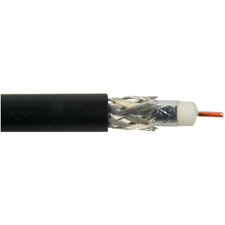
    Belden 1694A HD/SDI 18AWG RG6 Serial Digital Coaxial Cable pic: Belden 1694A

    Letter from NYC (34) 2014 (6): Belden, Canare
    Brief Review: Belden 1694A and Canare L-5CFB 75 ohm cables
    Brief Review: Belkin PureAV Coaxial Digital Cable, Part II
    Review: Ensemble Dirondo and Dichrono HiDac, Part IV

    Revised Dec 26, 2014 (Part C added, see last part of article)
    Revised June 18, 2014 (Part B added, see second half of article)

    Part A
    This article continues my saga of testing out digital cables for my Ensemble  (last installment here).

    After the surprisingly good result I got from my Belkin coaxial I was eager to test out 2 cables I had bought a long time ago. Opting for BNC connection, I finally got some BNC connectors and assembled them. But not without encountering some headaches.

    Caution on BNC connectors: there are so many types. Aside from the rarer solder-on and screw-on types, most are crimp-on types of various diameter and construction, designed to fit various RG type cables. The Belden and Canare under discussion are both RG-6 types. I made the error of buying RG-59 connectors (Parts Express), and they prove not a good fit and I had to improvise the assembly. So, make sure you get the right RG type connector.


    Canare L-5CFB 75 Ohm Digital Video Coaxial Cable RG-6 Type 984ft Roll - Black-by-Canare pic: Canare L-5CFB

    Canare L-5CFB (official pdf)
    Belden 1694A (official pdf)

    Both are stiff RG-6 types, and the diameter is a little too big for the cable to thread through the RG59 connectors that I got.

    The Belden 1694A has a long history and is a well proven favorite of professionals and DIYers alike. I got it in the USA, where it typically retails for less than $1/ft. After some hard work I finally improvised the assembly with my misfit RG-59 connectors.

    The Canare L-5CFB is perhaps somewhat lesser known, but I have always had good sound from this company's offerings (see the 2T2S interconnect). I actually got this in HK, from the great people at 工程有限公司(深水埗欽州街66号).I happened to have a pair of screw-on connectors so fitting was easy, but if you buy anew, I'd advise you to use Canare's own connectors.

    So both cables were assembled without solder.

    Sonic Characteristics (Belden vs Canare vs Belkin)
    • Even not run-in, I was shocked by the Belden 1694A's superb transparency, easily a notch or two above the Canare L-5CFB and the Belkin PureAV (coaxial). This is easily the best link the Ensemble setup has enjoyed.
    • The Belden 1694A's transparency comes at no cost that I can detect. It is superbly musical, with utterly natural treble, a huge soundstage, excellent dynamics and rhythm.
    • Although lacking the last degree of transparency, the Canare L-5CFB is very musical and natural sounding, possibly an even better match with a DAC that is on the bright side. I also wonder if my screw-on connector is of lesser quality (nickel type, not as polished) or if it requires more run-in. I have left it connected and will be watchful.
    • In many ways the Belkin coaxial is still excellent and resemble the Canare L-5CFB, but now I can confirm my previous minor reservations (..."Belkin's treble lacks just the ultimate in extension and air; the mid-bass is just a tad too full on certain material and the midrange is slightly recessed...").
    • If forced to compare, the Belden 1694A comes out on top; the Canare L-5CFB second, and the Belkin PureAV a very closed third. But the Belkin can save you the hassle of DIY. In conclusion, all three are incredible bargains.
    Part B
    After the article was posted, I was delighted to have heard from an old friend, gbronn/GaryB, who contributed the very useful info below:

    There are several sources for pre-made cables using Belden 1694a or Canare L-5CFB so people can avoid having to add their own connectors.  One place that is very popular is Blue Jeans Cable.

    I've bought 1694a from them and it's reasonably good but only if you are using BNC connectors on both ends.  When I mixed BNC on one end and RCA on the other I thought it was pretty bad.  I've heard others report that mixed BNC and RCA is always bad and that if you can't do BNC on both ends then RCA on both ends is better than mixed.  But I haven't tried this myself.

    Markertek also sells premade cables using Belden 1694a, Canare L-5CF and others that I like. Search for BNC to BNC video cables.  Here a direct links for Belden 1694a and Canare L-5CF cables

    My favorite cable these days is RG179, which is a very thin 75ohm coax.  Markertek sells a premade version with high quality Trompeter BNC connectors.

    It's worth playing with the length of digital cables as well.  Try a 15ft or 25ft cable.  You'll be surprised to find that long cables often sound better.  The thin RG179 is good for this since it's easier to coil up and hide, unlike bulkier cables.


    Part C
    Recently, during a visit to my friend WSS (here) I got the feeling something is not optimal with his digital setup. Later, I made a Belden 1694A cable for him and also lent him my trusted Kimber D-60. He invited a bunch of friends to the shootout (I was not present) and all declared Belden the winner over even the mighty Kimber, not to mention the resident AN UK digital cable.


    08 June, 2014

    Book Recommendation: The Ultimate Digital Music

    The Ultimate Digital Music Guide: The Best Way to Store, Organize, and Play Digital MusicBook Recommendation: The Ultimate Digital Music
    Letter from NYC (33) 2014 (5): Book Recommendation


    I used to be an avid reader, but I don't read too many books these days. Once in a while however I make sure I browse the shelves of the library. This time I picked up 4 books; I cannot hope to read through them all, but they have given me great satisfaction.

    This book is the only one that is audio-related. And on CAS, a topic I am not particularly enthused about, though I use it on occasion.

    The writing style of author Michael Miller is impeccably lucid. It is straightforward and well organized. A perfect example of a how-to book that maintains interest. Whether you read every line or skip-read (as I do) you will not be disappointed, or bored.

    This is a minor miracle, considering that the first few chapters are on general matters. It is a sure sign of good writing that a chapter on legal ramifications of download is not only informative but makes surprisingly absorbing reading!

    I cannot recommend this book enough. At discounted prices on the net, it is a must-have if you think about getting into CAS. It will give you a better perspective than most writings on CAS you can find on the net, and perspective is one thing most lacking on the net (we are talking about both people who write and people who read)!

    Talk Vinyl: Denon DL-102 Part III


    Click pics to enlarge. L: Denon DL-102 on top; note 2 cartridge leads inserted into each pin. R: Added weights at the end of the armtube and on the headshell.

    Letter from NYC(32)2014(4) 
    Talk Vinyl: Denon DL-102, Part III
    Talk Vinyl: Mono Replay IV

    Those interested may want to read the previous installments in this series: Denon DL-102 Part I; Denon DL-102/Mono Replay Part II

    Technics SL-1200MkII redux
    The Denon DL-102 had been on my Thorens TD-309 since the last installment of the series. This time, after enjoying a few mono records on it, I decided to tackle another project - to install the Denon DL-301 MkII onto the Thorens. The DL-102 had to come out and I installed it again on my Technics. There is a simple reason for this: each cartridge lead on my Linn/Ittok and Clearaudio Concept is dressed in the back with heat-shrink's. The true mono Denon DL-102 is not the easiest to install; it needs to have 2 cartridge leads inserted into each cartridge pin; the easiest way to accomplish this is with the usual cheap cartridge leads that have crimped-on connectors. The connector that goes in first needs a little bending for it to be pushed further in so as to make room for the one in the back (see pic). Someone had asked before how to do it, and I hope the pic explains it.

    As it is, the counterweight of the arm of the Technics SL-1200 is just enough to balance the very heavy Denon DL-102. A quick alignment and I was treated to better sound than I had remembered! In fact, not far behind when it was on the Thorens. The cartridge is more open then before, with more air on top. I am sure, after a relatively long period, the cartridge is finally fully run-in. So beware, the sound of the Denon DL-102 takes a long time to come into its own, so be patient and reserve your judgement. A little further improvements resulted after I added weights (see pic: an obsolete Italian gettone in the back; a Japanese coin on top of the headshell, both affixed with blue-tac).

    Now, I won't go into details, but I am quite satisfied with the setup as it is. After some playing, the Decca ffss III arrived (see last article) and the Denon DL-102 was taken out. So I was able to compare the two cartridges and here are some observations:
    • the Denon DL-102 is richer in the midband. In many ways, it is somewhat more neutral than the Decca ffss III, which has a lingering leanness.
    • the Decca ffss III has the faster and cleaner leading edge and transients, but the Denon DL-102 is quite good in these parameters too.
    • overall, the performance of the Denon DL-102 is rock solid, but the Decca ffss III is just s little special.
    • until I acquire a Decca of some sort, the Denon DL-102 shall remain my mono reference. It is now back on the Technics.
    • the exercise also renewed (again) my respect for the Technics. What a go-to turntable!

    06 June, 2014

    Talk Vinyl: Decca ffss MkIII


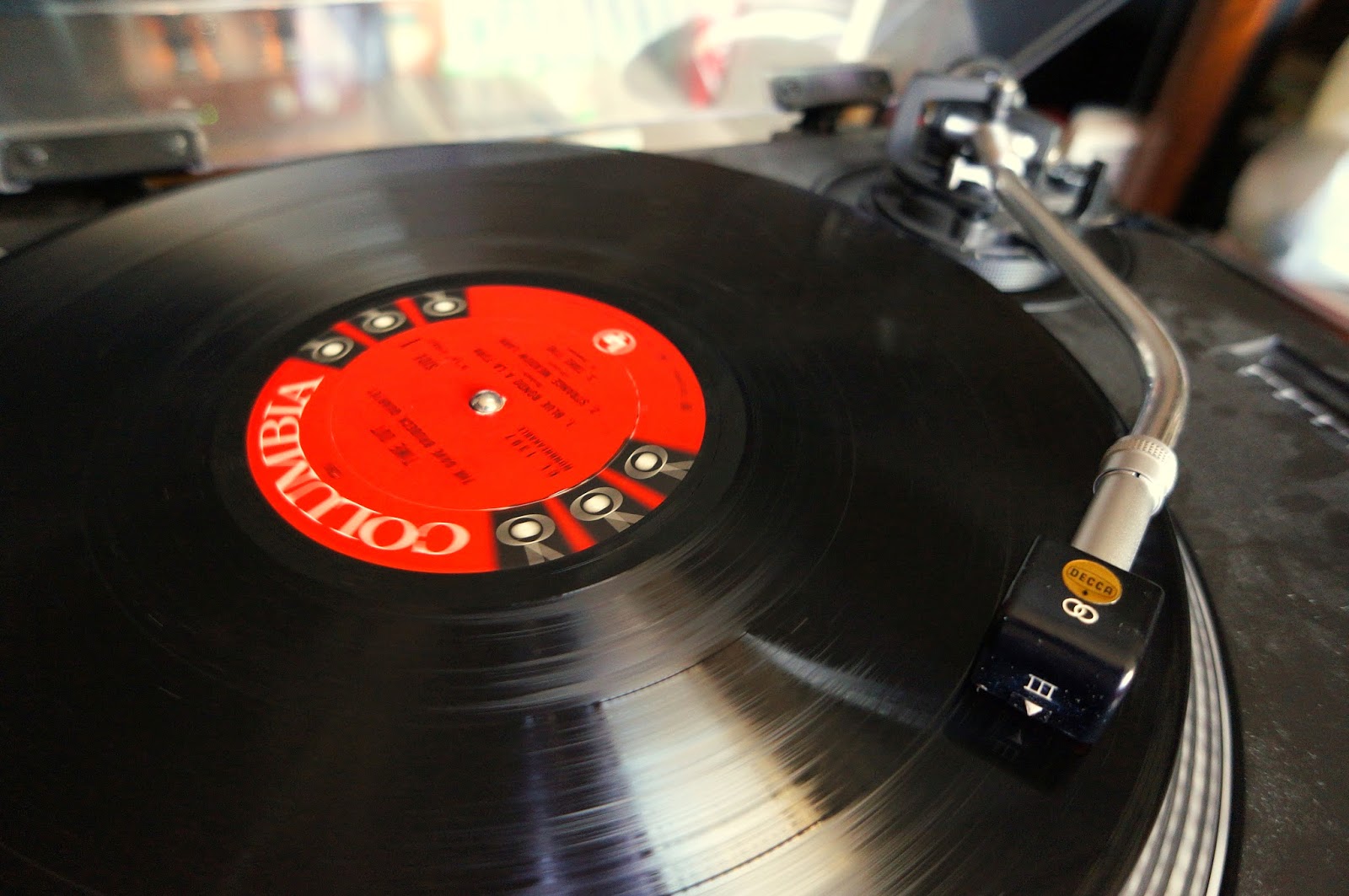
    Click pics to enlarge.Note the adaptor.Time Out mono six-eye on the platter.

    Letter from NYC(31)2014(3):
    Talk Vinyl: Decca ffss MkIII Cartridge, Part I
    Talk Vinyl: Mono Replay III
    Talk Vinyl: Take Five (Time Out), do you know it?

    Editor's Note: this article came about because my good friend shidi recently got the vintage Decca ffss MkIII cartridge AND the Dave Brubeck Time Out mono 6-eye LP, which he made the mistake of sending to my NYC home - well, he may not be getting them back! :-)

    Background on Decca Cartridges Due to its unusual design, the history of Decca cartridges is inextricable linked to Decca tonearms and adaptors, so it is not straightforward but not unduly difficult to trace. Info can be rather piecemeal on the internet. A search reveals a lot buried in various forums, notably Lencoheaven, but if you don't have the time, start with the current manufacturer's concise history of Decca Cartridges and this somewhat rhapsodic but informative article by Philip Holmes. Also informative are two reviews of current models by enjoythemusic (Super Gold, Jubilee) and hifipig (Jubilee) that include some history and technical info.

    My previous experience has been limited. Certainly, although I have always wanted one, I had never got around to it. In HK, as elsewhere, there are Decca fans and while I heard some reasonable performances, they pale next to my best experience, indeed one of the very best ever, at AL's place in NYC (Decca SC4E), chronicled here.

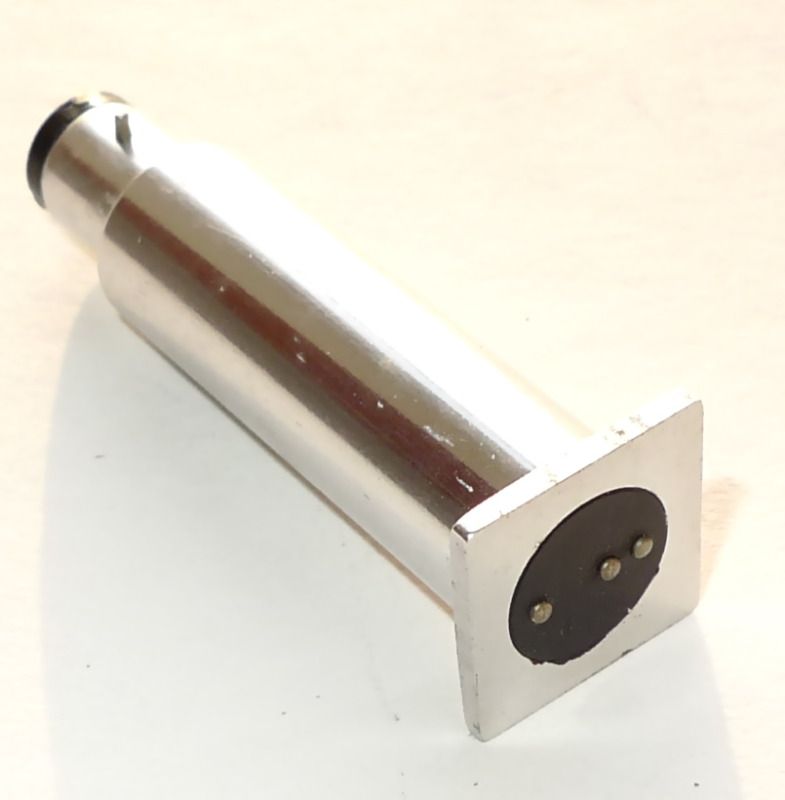
    R. Against the correctly aligned Denon DL-102 (top) the Decca is short by at least 1 cm; L. close-up of adaptor. 

    Decca ffss MkIII, make-shift setup. Never heard of Baerwald!
    Warning: Perfectionists and TT setup freaks should stop here. You have been warned!

    Considering its age, the Decca ffss III cartridge arrived in amazingly fine shape, together with an SME-type adaptor (3-pin connection to the cartridge, which has a common ground pin only; 4-pin out to the tonearm), so I was able to fit it on the lowest of my turntables, while it happens all my reference TTs all have fixed headshells (Garrard/SME 3009R; LP12/Ittok LVII; Clearaudio Concept, Thorens TD-309).Perfectionist will frown upon the so-so built quality of the adpator, but it comes handy.

    I'd like to slip in here a word of caution: the adaptor fits very snugly onto the cartridge; you must have a firm hand when you try to detach it - otherwise one slip and you'll damage the stylus.

    Note absence of cantilever.

    Turntable 1 Technics SL-1200 MkII
    Since I happened to have the Technics running with the Denon DL-102 mono in the reference system (shall be covered in the next article), I simply swapped it out for the Decca ffss III.

    Now, as you see in the middle pic, the Decca with adaptor is short by at least 1 cm, and there is no way to move it forward. I reckon if installed on an SME arm with removable headshell one can move the entire tonearm forward and if the hole was centered well achieve alignment. Too bad my SME 3009 has fixed headshell!So, forget about Baerwald and all that for the moment!

    Phonoamp: Parasound JC3 or ZPhono USB (reports to come)/iFi iPhono
    Preamp: Manley Neo-classic 300B
    Amp: Wavac MD-811
    Speakers: YL 4-way horns

    AA Little Time Out The first LP I played was the mono Time Out.It only took a few notes for me to recognize the Decca's well known qualities: Clean leading edge and fast transients. Morello was most obviously showcased - the drums were tight and tuneful; the cymbals positively shimmered, with great harmonic faithfulness. Even Brubeck's piano, which I have never found well-recorded or tonally alluring, came through clearer than usual. But the Decca is not just about speed; it effortlessly unearthed a myriad of details and rhythmic felicities.

    Like many others, I have long used the Take Five track as a test (search this blog for Take Five and you will see many mentions). Morello's long drum solo serves as a most accurate means of assessing a system's transient response, microdynamics and rhythmic exactitude. But this is also one of the tracks that I morbidly fear on home visits.

    Me, the long suffering audiophile Given the popularity of this track, you can imagine the uncountable number of times I had to suffer through it on home visits in HK. More often than not, particularly in the case of tube users (especially vintage types), when the saxophone cuts out and the spotlight is on the drums, the proceedings become so lethargic that each return of the bass drum just drags me further into that audiophile quicksand known as boredom. And in HK, audiophiles are in general not sensitive to rhythm and pace. They simply don't get the intricacies of the drum solo, instead patiently waiting for the saxophone's return; by then it is too late for me, all energy drained out of my body, too weak to go on and time for, yes, time out! Yes, home visits can be hell when Take Five is played.

    For me, a successful replay of this track must reveal how Morello varies his beat, his touch: the varying force of each strike and the speed of withdrawal that the drummer uses to color his playing. Now, this is not the most coloristic of compositions, but whatever color there is must be revealed for the whole to have rhythmic finesse, to draw one into the music. What I previously wrote on the YBA DAC's plaback of this track also sums it up: "...All of a sudden, you can hear all the stressed beats effortlessly. This kind of replay enlivens a track like Take Five from Brubeck's Time Out. Focusing on Morello's drums, the bad CD player can make the strong beats only that little louder than the weak ones; the average CD player gives you an approximation of the playing; but the truly outstanding player, like the YBA (or an old Naim, say the CD2), makes you aware of the infinite dynamic shading and brings out the full flow. Whatever the CD, the YBA delivers the music in spades..."

    Material like this is better on vinyl and well nigh tailor made for the Decca. I suspect the Decca's mono lineage also makes it uniquely suitable. You will need a very very good cartridge to match the Decca's performance: to cite an example, my Air Tight PC-1 is even better all-around, but that is a very expensive cartridge!

    Turntable 2 Audio-Technica AT-PL120
    You will recognize this as the TT in my Casual System, which gets as much actual use these days as the reference system - reason why I installed the Decca on it.

    Preamp: Audio Research SP-9
    Amp: McIntsoh MC-2200
    Speakers: Linn Kan I

    This turntable, clone of the above Technics, great value as it is, is the least of my TTs, yet in the latest iteration of the Casual System the performance of the Decca was astonishing.

    Although limited in the bass and not full-range, the quality and refinement of replay in many ways equals that of the system 1. I played more LPs on this system, and no matter it is violin or piano or orchestral material I was very satisfied. I would guess the tubed phonostage (albeit a hybrid) proved synergistic with the somewhat lean Decca (see below)

    More details on Decca ffss III Sound Quality
    • as mentioned, fast transients, clean leading edge; great rhythm and pace.
    • Excellent detail retrieval, including hall sound and air around instruments.
    • On both TTs, there is a somewhat LEAN quality. At first I thought perhaps the direct drives are partly responsible, but then just before installing the Decca on the Technics I was using the Denon DL-102, and there was no such problem. I consulted my friend AL (mentioned earlier), who owned just about every Decca's, and he told me this is indeed so. Usually we frown when we hear "lean", but this is not the case here - the sound is unfailingly musical, and cushioned by bags of air. This isn't the peaky treble that we find in many MC's, just a slight pallor in texture, so to speak. But I can imagine, with lesser electronics, the leanness and fast transient of the Decca can cause problems.
    • Now, if you have read this far you may be wondering why I haven't said more on the misalignment when used in the ordinary tonearm. That is because all else pales in the face of excellence. Yes, there is definitely mistracking, especially at the beginning. But the occasional distortion was tolerable and, even with big orchestral climaxes the needle did not jump out of the groove, as many have reported. If you ask me, I'd say the mono lineage of the cartridge makes alignment not so critical. In any case, both AL and I believe alignment requirement for cartridges in general is not as stringent as portrayed by many.
    • On the one hand, I am sure a proper arm would get even more out of the Decca; on the other, I rather think, as usual, many of the "woes" of the Decca's to be exaggerations. It is easy to get good sound if your system is balanced. The modern Decca's can be fitted with adapters ("pods") that allow mounting on any arm.
    • The sound of the Decca has nothing in common with the only other moving-iron design that I know about, the Grado. Hence, I think the absence of cantilever is the most important factor for the Decca sound. This leads me to think the modern Decca models would sound very much like the old ones, only with less headache.
    • Not surprisingly, given its lineage, the Decca is equally adept at playing mono than stereo. With the Decca, unless you are a perfectionist, you may not really need a dedicated mono cartridge. 
    More later...

    24 May, 2014

    Letter from NYC (29) 2014 (1): Ensemble, Belkin

    Letter from NYC (30) 2014 (2): Ensemble, Belkin
    Brief Review: Belkin PureAV Coaxial Digital Cable, Part I
    Review: Ensemble Dirondo and Dichrono HiDac, Part III

    Beauty and the Beast
    This article reflects well the admittedly somewhat split personality of Cheaptubeaudio. On the one hand, we have the luxurious Ensemble separates, on the other the cheap Belkin. As to which is the Beauty and which is the Beast I shall leave it to you. Let me tell you though, I am always thrilled whenever I come across something cheap that works way beyond expectation! In this article, limelight is on the Belkin!

    I don't think Belkin got any mention in the hifi press until the advent of computer audio. I first noticed it when TAS gave favorable comments to its Gold USB cable. Indeed in one of their USB cable surveys it left many "hifi" brands in the dust. And that is the one I use for CAS.

    Belkin PureAV Coaxial Cable I knew nothing about it, but last year ordered one for $3 (clearance item) when I was shopping at Parts Express. I didn't try it out until recently, since my Ensemble Gigaflux BNC cable was giving me trouble (I had to connect it in reverse for it to lock, can someone tell me why?). I tried a few others, but they all did not sound quite right. A month ago I connected the Belkin and, as they say, the rest is history.The Belkin is somewhat stiff like the usual 75-ohm RG coaxial cables, and its connectors are molded types. In other words, not visually impressive, but...

    First, a recap in italics of the Ensemble, copied from Part II of its review:


    pic borrowed from the net; click for source

    Ensemble Dirondo Drive + Dichrono HiDac 

    This is my one of my reference digital sources and it is a shame I haven't given it detailed treatment before! The DAC may have been discontinued as the Official Website only lists the Drive and the integrated CDP, but everything else is the same.

    For a good description, read this Positive Feeback favorable review. Note that the reviewer uses gears that are more in keeping with my preferences, like Audio Note CD players and EAR amplification, and my feelings parallel his. To be complete, you should also know there is a considerably less enthusiastic review in 6moons, but I do think the reviewer was seriously remiss there, as happens so often in that site, which though frequently informative, seems more keen on tasting plats du jour than maintaining any long term philosophy, and I have never been impressed by the system integration of their reviewers.


    From previous introduction (Part I) I have always admired Ensemble products for their refined sound. In HK, quite a few people I know are still using their older (non-Sondoro) gears. You shall find diverse opinion on this combo on the internet. For me, it takes in-depth listening to reveal the beauty of this set. Delivering exceptional details that never call attention to themselves, they really don't stand out immediately. Partnered with the wrong gears they could even sound just a little less full in body than some, but when done right show a fleshy presence which together with great rhythmic sophistication and dynamic exactitude deliver the illusion of a live event. Talking about dynamic accuracy, let us examine the last track, Stimela (the coal train) of this much abused Hugh Masekela album, Hope. In the opening, the drummer's insistent bangs mimick the sound of a train. Most digital playbacks would homogenize the multiple hits and give you only a sense of a small crescendo. Not so the Ensemble combo, which uncannily deliver a sense of gradual, and powerful, increase in sound. Not only that, about a third of the way, one of the hits is actually less forceful than what had gone before; this is not well rendered usually, but clear as day with the Ensemble combo.

    Is the Ensemble combo the best I have? Perhaps in some tonal area my Theta/SFD-2 combo can give them a run for the money, but there is little question that the Ensemble set belong with the best (and better most for musicality). I use their own Gigaflux BNC cable (which I happen to have) and the DAC uses an Ensemble power cord (I don't have another one for the transport).

    The Ensemble has some upsampling options which I shall perhaps cover later, but right now I am using the 48kHz setting, so the CDs are upsampled a little.


    Part II Suffice to say the Ensemble duo is a greatly nuanced player in my system. Yes, if you are not careful the sound can turn a little bright, as obviously happened to some reviewers. But if you do it right, you are rewarded with a truly crystalline, scintillating sound that has nonpareil rhythm and pace. All the subtle inflections of music pour forth. I did not really do any extensive comparison, but the combo quickly put down my Rega Apollo and Meridian 506-24. Also, I compared the transport section of the Rega (very good) and the Dirondo Drive was obviously more savvy in its handling of microdynamics and rhythm. Most of the time I did not bother to upsample, using the redbook 44.1. I used the BNC input and Ensemble's own Gigaflux digital cable was better than everything else I had. As a tube man I did not try its preamp function.


    Ensemble Part III With the Belkin the following were observed in my reference system:
    • With the exception of the Ensemble Gigaflux, the Belkin is that rare cable that does not impart the Ensemble too white a character.
    •  Like the Gigaflux, the Belkin does not hype details, but is smooth throughout the frequency range and rich in midrange. I actually think it resolves a little more than the Gigaflux.
    • the Belkin's leading edge is superior to most hifi cables. It has good speed yet sounds deliciously elastic.
    • although Belkin's treble lacks just the ultimate in extension and air, it more than makes up for it with good speed and transient performance. Also, the refinement and richness of the treble is simply marvelous! Strings are silky, but not lacking in harmonics and never over-sweet. As a corollary, the rhythm and pace is admirable.
    • I am not entirely sure on this, but I think the Belkin's mid-bass is possibly just a tad too full on certain material, but most of the time the perceived bass is exciting! With classical material, everything is right; with pop and jazz, one is never sure whether it is the recording or the playback.
    • the midrange is possibly slightly recessed.
    • the hall sound is well captured.
    • Back to the Ensemble: with the Belkin in place, I ave re-assessed the various over-sampling options. Much to my surprise, now I prefer upsampling to 96 kHz (the Ensemble is not 192 ready): the sound is a little more spacious and more composed. This has pluses and minuses; instruments gain a little more air and space around them, but vocals become slightly recessed.
    • Musical examples that substantiate some of the above. On both Van Morrison's Moondance and Linda Ronstadt's Canciones de mi Padre, the instruments move just that little bit to the fore, and the singer steps back a little. I find myself bathed in all sorts of instrumental details and rhythmic felicities that I haven't noticed before, but pure vocal aficionados may object a little.
    The exercise renewed my enthusiasm for the Ensemble system. It is even better than I thought. Great job! BUT, bravo Belkin!

    In a coming article the Belkin shall face off Belden and Canare! 

    Letter from NYC (29) 2014 (1): Reevaluations and Re-considerations

    Fauré: Quintettes
    Letter from NYC (29) 2014 (1): Reevaluations and Re-considerations

    Friends, it's that time of the year again. In NYC I have (just) a little more time to listen to music. Plus the fact that I buy fewer things now, and it adds up to more time spent on the reference gears that I already have. And that is not only a good thing, it is a necessity!

    With so many years of gear rotation and labor (arrrgh!) under the belt, I am usually rather quick in identifying imbalances and deficiencies.But like any mortal I do make mistakes in judgement. There are many reasons for that. Some gears have secrets that do not reveal themselves easily; others even require you to rethink. But more than those, the biggest obstacles are our own day-to-day logic and prejudices that have little to do with audio - as an example, who'd think a given company's less expensive product is better than its flagship brethren?

    I have a tendency to write less on my reference gears, instead focusing usually on what triggers my imagination du jour. In the coming articles this shall hopefully be redressed. Many of the gears that I have only briefly written about (like Manley 300B preamp, Shindo Monbrison) shall receive more extensive treatments that they deserve. I shall also dig deeper in worthwhile ongoing projects (like Denon DL-102). Watch this space.

    In light of what I have just written about, it is only fitting that I recommend an album that has lately fascinated me. Faure's music is layered, sophisticated and elusive. Few performances are successful, so this album came as a revelation! Not every musician is equipped to convey beauty and unearth hidden emotions. I am sure you can empathize - not every audiophile is sensitive to beauty and the emotional component of music, the essence of which the reproduction equipment must capture to qualify as high-fidelity.