10 May, 2016

CD Recommendations - Classical

CD Recommendations - Classical (Click on pic for reviews/details)
CD I am Playing
The name Sokolov is enough. Content also filmed.

CD
Excellent new works comissioned by Gabetta.
CD
Incomparable Dvorak from Panocha Quartet, Suk Trio and friends.
CD
First rate performances from names new to me.

CD
Great pianist at the service of music

CD
Top choice for the War Sonatas
 
CD 
Sterling production from these forces, as usual. Unusual world music material.
CD
Bravura performances highly suited to the genre.

CD/LPs I am playing now
 I have never heard of Gottfried Finger before, but this magnificent Viol disc certainly changes that!

CD

Stylish readings of under-rated music; superb recorded sound.
 
CD

Best set of Bach's solo violin works I have heard in a LONG time! Watch this name!
 
CD
Surprisingly mature playing and interpretation from a young violinist!
CD
Superbly played piano CD; never a boring moment! Ranks with the very bests.
 
CD
One of the most sympathetic Rachmaninov pianists I have heard in a while.
CD
Unknown music wonderfully performed.
 
CD
A must for violin lovers, in excellent mono sound.
 
CD
A great example of non-sentimental yet exciting Mahler. Beautifully recorded.
CD
Ultra sophisticated playing that turns these little gems into masterpieces.

CD
The best solo violin disc I have heard in a long long time. A MUST!

CD
Stunning second installment in this double cycle.
 
CD
Fantastic! Bach on the Accordion and Bandoneon, aided by some friends. Have been listening non-stop.

CD
Hilary Hahn has been contributing to the violin repertoire with comissions and stimulating partnerships. This is not something to go through in one sitting but many pieces are very fine.


CD/LPs I am playing now
Stunningly recorded recital, beautiful playing; must-buy!
CD

Mostly mono, but well re-mastered. Sublime Playing!

CD
Lola Bobesco is much underated. Her fluid playing makes the Viotti surprisingly captive. Wonderful!

SACD

SACD
Stylish accounts
CD I am Playing
Controversial performance full of details that should be heard at least once.
 
SACD I am Playing
Wonderful original instrument Beethoven cycle.
SACD
Wonderful performance and recording.

SACD I am playing
Good performance and excellent recording. 
SACD
Superb! Lucid readings and the usual pristine sound from Channel Classics
SACD
refreshing reading of one of my favorite pieces
SACD
Gergiev gives his usual pointed reading with his band

04 May, 2016

Rare Cartridges: Nagatron Ribbon, Stax Electrostatic

Smorgasbord: Versa Dynamics 1.0 under Walker Proscenium Gold Signature; Foreground: Technics SP-10/Stax/Electrostatic. Middle, right: Garrard 301/Ikeda 407/Nagatron ribbon; center, amp for Stax; left, Garrard 401/SME3012/Nagatron Induced Magnet. Click pics to enlarge.

Letter from NYC (54) 2016 (10): Heroic Analogue Efforts
Rare Cartridges: Nagatron, Stax

(Article finished in HK). For me, this is a special article. Not many are privileged to get to hear even one rare analogue legend, not to mention several in one morning. But my friend Andy basically did a "presentation" for me, and I am damn impressed! Thanks to the old souls who keep the flame alive! In an era of hyperbole's (generously applied to each new generation of "super" cartridges), re-visits to an older era should be mandatory.
 
I had first arranged to take my Empire and Shure cartridges to Andy's place for a listen. As it would be a lot easier to have an arm with a removable headshell, I asked Andy to make one available. Imagine my surprise when I walked in to see so many turntables, armed with RARE cartridges. Pics here are indeed worth a thousand words...

We did not listen to the Versa Dynamics 1.0 under the Walker Proscenium Gold Signature (with Stanton 380, reported previously). For associated equipment, see the link.

Garrard 301/Ikeda 407/Nagatron (Jeweltone) HV-9100 Ribbon
Nagatron Ribbon (0.04 mv output) was connected through a dedicated 1:100 transformer (Nagatron Z Coupler).


Garrard 401/SME3012/Nagatron 360CE Induced Magnet
 SME 3012 (converted from SME 3009) with damping trough


About Nagatron I found some of Andy's postings in vinylengine. Attached below.

"...Nagatronics was active in the heydays of the vinyl era. They marketed in America a full line of phono cartridges made in Japan by Nagaoka during the 70s and 80s. Nagatron as a brand is now mainly remembered by their induced magnet cartridges which, imho, can still hold their own sonically against many high-price phono cartridges currently available.

Nagatron's flagship cartridge was not an induced magnet type but was of an "exotic" ribbon design. Instead of a magnet, a piece of iron, or a coil in the magnetic field, there is a strip of ribbon. According to Nagatron, the ribbon design offers the highest degree in linearity of all the magnetic phono cartridges. The penalty, however, is in the output level. It is around 0.04mv, a magnitude lower than the current low-output MCs, therefore, requiring a high-gain transformer or head amp to work properly into a normal preamplifier.

There is also this lencoheaven thread (where the pics of the HV9100 below come from)


Sonic Notes HV-9100 I absolutely adored the Ribbon HV-9100! Although working in a different way, its sound did remind one of the ribbon planar's clear, pristine presentation, but sans the undesirable peakiness. An open window; marvelous! 360CE As for the Induced Magnet 360CE, the sound was softer, but eminently enjoyable. Part of this may be attributable to the more mellow damped SME arm (as compared to the Ikeda). In any case, the sound was still excellent and hard to fault!

Andy told me Nagatron lost its shirt developing the amplification/transformer for the ultra-low output cartridges. Admirable heroes of hifi! I am sure there will be more Nagatron in  my analogue future!

Technics SP-10/Stax UA-7 and CPX Electrostatic Cartridge
Stax CPX electrostatic cartridge is connected to the Stax UA-7 arm via a dedicated arm tube.Stax Electrostatic is fed through the Stax POD-Xe, a tubed oscillator/de-modulator unit with a bypassable 10db solid state booster amp.


More on Stax Here is a vinylengine gallery that has a lot more pics for the Stax (and Nagatron) stuff covered in this article. Enjoy! Personally I am a huge Stax fan. Their earphones are still unrivaled imho. Hence I was very eager to hear this setup. Sound The sound was still very respectable, but the midrange and lower treble were not quite fully fleshed out and not quite as good as the Nagatron ribbon. We even tried bypassing the booster amp with my iFi iTube buffer (6 db gain setting) but there was not much difference. I suspect the more "direct" direct-drive may be a culprit here. But I'd love to hear this cartridge in another setting.

19 April, 2016

Shure SC35C, BAT P5, ARC PH1, Shindo


Review: Shure SC35C Cartridge, Part II
Letter from NYC (53) 2016 (9)
Review: BAT VK-P5
Vinyl Talk: MM vs MC, Part I
Phonoamp Shootout: BAT P5 vs ARC PH1 vs Musical Surroundings Phonomena II vs Parasound JC3

Note: At first I was perplexed that I got terrible results from the Shure SC35C (see Review: Shure SC35C, Part I), but I now know why. Read on.

Shure SC35C
Puzzling First Impression Almost a year ago, I read a Stereophile article by Herb Reichert, in which he (like others on the net) praises the evergreen $35 DJ Shure SC35C cartridge, used on a Pioneer direct-drive PLX-1000 (his review of the TT here). Now, HR is a seasoned reviewer (though now on the cheap), and the Pioneer he uses is almost the same thing as my AT-PL120 (I suspect they have the same OEM). As he got curious about the Shure, I did too. I bought one from Amazon and enlisted my idling Pioneer PL-10 for the purpose. As stated in my Note and the link above, the result I got was terrible. Frankly, I have never heard a worse sounding setup.

Rejuvenation/Culprit Revealed Still perplexed by the result, this time around I decided to shift the SC35C to my Audio-Technica AT-PL120 for a second chance. As I took off the cartridge leads on the Pioneer headshell, I noticed that they have deteriorated quite a bit, with clip barely hanging on. I installed it on the AT-PL120 and was immediately captivated. Yes, it was a little rough at first, but now I could hear the potential (more sonic notes down below). There! Cartridge Leads are easily damaged with time and during manipulation, and any poor connection adversely affects the sound. The degree of damage the leads did still amazes me.

I added the AT-PL120/Shure SC35C to my reference System II. As I have 2 Thorens tables fighting for the Shindo Monbrisson's 2 phono inputs, I needed to add a phono amp anyway, I used the opportunity for a little fitting.

BAT VK-P5
This is an older model, a super-bargain at current second-hand prices. As you can see from the pic, its battleship built and topology bears great resemblance to its current offerings, including the current flagship VK-P12SE (just rave-reviewed in the current May/June 2016 TAS). If you compare, the more expensive offerings differ little in topology, more in component grade and added options, like input transformers (I prefer my own) and output transformers. The P5 uses 8x6DJ8 and 2x6SN7. I have all old stock tubes in them.

The P5 is highly configurable. The maximum (high) gain of 56 db is a little low for very low output cartridges (like my Denon DL-304), but the low gain is a highish 50 db. One can further trim two pots to attenuate another 6 db (44 db). Two dip-switches allow for loading and capacitative adjustments.

For some reason, I have never formally written this up. Perhaps it is because I have previously only used it in balanced mode with the BAT VK-3i preamp, not my usual connection (RCA, as I use SET amps). My previous experience, with Air Tight PC-1 and with Koetsu Black, was very positive, and so is completely at odds with the surprisingly negative review on 10audio (usually this site is OK) and more in keeping with Toneaudio (summary only; more details in its review of the similar P6).

Compared to some other big names, BAT gears are less popular. I think this is due to their insistence on balanced topology. While the preamps have concessions to RCA's, the P5 phono amp does not; there is only a single pair of balanced output, necessitating the use of adaptors when used with non-balanced gears.

Audio Research (ARC) PH1 There is not much info on the net. For an introduction, see my previous experience.

Parasound JC3 Previously reviewed extensively (see here).

Musical Surroundings Phonomena II (see here).

System:
Analog Rig: Audio-Technica AT-PL120/Shure SC35C (and other after-market styli)
Preamp: Shindo Monbrisson (has MM stage)
Amp: Wavac MD-811
Loudspeakers: YL Audio 4-way horns
Phonoamps: Musical Surroundings Phonomena II; Parasound JC3; BAT VK-P5, ARC PH-1
XLR to RCA Cable: Gotham GAC-2/1 and DGS-1

Sonic Impressions
  • Shure SC35C (new stock) Compliance This is a very low compliance cartridge, and my low-medium mass arms are theoretically not optimal (I added a headshell weight). You can press on the stylus and it hardly budges, maybe great for child-proofing? VTF Recommended tracking force is 4-5 gm, and I use 4.5 with no problem. Output As we shall see, the high output of 5mV proved problematic to my system with high efficiency loudspeakers. Initial Sound/Run-In As soon as I mounted the SC35C in the AT-PL120, everything just snapped into focus. Force, colour, everything just exploded. Initially the sound was rather coarse at the top, but it started to smooth out after 20 hours. Likely not fully run in yet even as of this writing.
  • SC35C + Shindo Monbrisson Trying the other phono amps made me realize the presentation of Shindo's MM section - a somewhat softer presentation and narrower stage. But it was perfect for the rather long run-in period. The Shindo tamed the edge of the SC35C (it is important to remember my horns magnify such things) and for the initial period that was what I used. Unusually for me, but highly appropriate for MM, I played many rock and pop records. Even early on, the SC35C took well to rock and the male voices: Willy DeVille's Miracle, Leonard Cohen's Songs of Love and Hate, Dylan's Nashville Skyline and Pink Floyd's The Wall were all rendered with unforced dynamic swing, a fast, clean and powerful bass. On these rock/pop LPs the SC35C outperforms my MC's, and its ease of delivery is just admirable. Only when I played the period instrument Bach Violin Concerti (La Petit Bande; Proarte) or digitally recorded Linda Ronstadt For Sentimental Reasons was some residual upper midrange glare revealed. Of course, with MC's vocals and instrumental details are more nuanced, but the Shure is satisfying enough and rhythmically even more urgent.
  • SC35C + Phonomena II Like before, I had no luck with this one. I tried the various capacitance valued but none was able to change the sterile sound. Nothing offensive and neat, but not inspiring either, and that is a no no for LPs. Abandoned again.
  • SC35C + ARC PH-1 Now, this is more like it. The soundstage expanded in width and depth significantly. Bags of air was accompanied by a little over-the-top treble. To smooth out the sound, I resorted to an old Audioquest Ruby, a solid core cable. That did it perfectly. It shows once again that solid cores can sometimes work when stranded prove unsatisfactory. It also shows that one should consider what the vintage item was paired during its time. For the ARC PH-1, it was likely the era of Monster and MIT, old models that were not so transparent.
  • SC35C + Parasound JC3 or BAT VK-P5 Parasound JC3 Previously I had only availed myself of its excellent high-gain MC stage. I was surprised that the (47 db gain) MM sound was equally impeccably detailed, quiet and smooth. Just like the ARC PH-1, as compared to the Shindo, the soundstage width and depth both expanded. Tonally and dynamically a very even performer. This is a full balanced design. BAT VK-P5 The sound is very detailed and with a wide and deep soundstage. Surprisingly for a tubed unit, the transient attack is very fast and dynamics superlative. The unit also needs an hour to sound its best. As this is tube, there is a little more harmonics, but overall the sound is rather neutral, with just a hint of tube bloom; hence I can see why some tube people may not like this. I tried all of the capacitance options but the basic sound remained the same. As the output of the SC35C is a high 5mV, I used the lowest gain of 44 db by trimming the pots all the way down (see above). Parasound vs BAT Compared to the Parasound (even higher 47 db gain), the BAT subjectively sounds like the gain is too high, and the sound becomes just a little wilder/bright with certain styli. I interpret this to mean the BAT VK-P5 is more dynamic than the Parasound. Part of this is also due to its fast transient attack, again subjectively faster than the Parasound. Put it another way, the solid state Parasound veers towards the warm of tubes, whereas the tubed BAT tends not to be tubey. For BAT, I think it is somewhat unusual to be in the position of having insufficient gain for very low output MC's but seemingly too much gain for high output MM's. Hum Like when I had the Raos mono cartridge (here), both the Parasound and BAT have a grounding issue that I could not get rid of. When the music is playing, it is low enough to be inaudible, but one can just hear it during quiet passages. Maybe the fully balanced phonoamp deos not work well with unbalanced downstream gears?
  • Aftermarket Styli Old Stock 766-D7 (SS35C) I first tried this when the Shindo was used. The sound was somewhat veiled and too smooth. However, with the Parasound and BAT, the sound blossomed with a natural balance. It is a little more refined than the stock, but the stock has a stronger and more projected midrange (particularly evident with male voices). Pfanstiel 4766-D7 The box says Switzerland SS35C, 0.7 mil con., but the seller advertised it as N35X, which was why I bought it. Out of the box I knew something was different. The stylus is much more compliant. Indeed, at 4.5 gm, the belly of the cartridge was almost sweeping the record. I then tried 1.5 gm (like an N35X) and it worked very well, without tracking errors! The stylus looks conical, but it s behaving like an elliptical. Maybe the suspension has deteriorated? I don't know. In any case, the sound is very clear, more airy, extended and refined on top than the stock cartridge. Not withstanding the curious difference in compliance of the Pfanstiel, I have to say all three styli sound more similar than different.
Conclusion The SC35C is wildly good and cheap. It does many things better than even an expensive MC (like effortless bass) and makes one seriously wonder why one should spend more than $40. As a result of this, I have also embarked on a project of rejuvenating my Empire's (2000E/III and 2000Z) and I also took them to listen at Andy's setup. So more later as we delve deeper into MM vs MC.

13 April, 2016

Letter from NYC (52) 2016 (8): More Rare Birds

Tannoy Westminster Thanks to arrangement by Paul, and dedicated driver Philip, two Sundays ago we got to visit again Jimmy's system. Look at this pair!


The host's listening room is one of the most luxurious I have seen; I love the decoration, and all that wood! Even the equipment racks are beautiful solid wood (from Ebay).

Sources are an Oracle CDP fed into an MBL DAC for CD and a Lumin for digital files (we much preferred the CDP to CAS). Preamp is Conrad-Johnson GAT. Mono amps (one just glimpsed behind right speaker) are massive so-called "WE" (like these that our friend Simon has), each of which employs a bank of 8x 300B tubes. Sound was a lot better than a previous visit 3-4 years ago. We attributed the marked improvement to his new CJ preamp (old one was Audio Space 300 preamp) and also the Field Coil Line-Magnetic Supertweeters (power supplies seen to the left of the Oracle CDP and right of the CJ preamp).

The Westminster (older version, foam surround) used with the Line-Magnetic has a very different sound than on its own. Treble is airier and bass is more controlled. A very sculptured sound that we liked, though perhaps not for the Tannoy traditionalist.

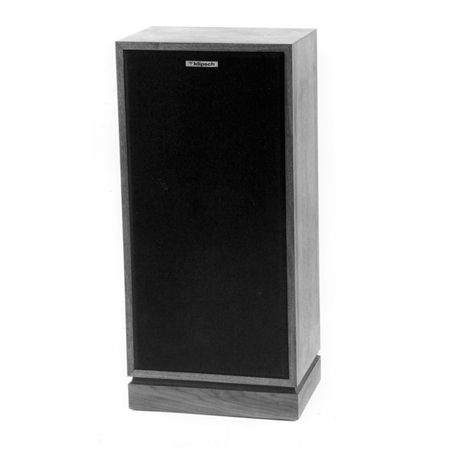
Klipsch Forte Then I went to Philip's new house on Long Island where I heard and tweaked things a little. The setup is very simple, McIntosh MX-110/MC-225, a dependable combo. His basement is a vast and bare space, really too large for audio comfort. The Forte still sounded very good and much like the Quartet I have heard before (interestingly, both setups were a little lean). Philip just got a pair of Spendor SP-100, which I look forward to auditioning. Incidentally, as the Forte's sometimes dip low in impedance (Stereo Review, Pg 1, Pg 2), one should try all the output taps, including the 4-ohm. Which one will sound the best will likely be system dependent.

Focal/JM Lab Nova Utopia (Stereophile Review) Last Sunday I went with Paul to visit 台山華 . He had just moved to a smaller house. Equipment has not changed: Jadis CDP, Audio Note M6 preamp and Pass Lab X-250 amp. The current space for audio is small, about 200 ft, but has some sidewall reinforcement. Sound, including the bass, was surprisingly much improved over his old cavernous space, which lacked wall reenforcement. Once again, this shows the effect of the room is of paramount importance. This experience makes me ponder on Philip's setup above...

It was among the best JM Lab sound I have heard, and I have heard a lot, including the current flagship. Fast and crisp, and with good control, we played many CD's while sipping tea and chatting. It was gratifying to hear that the host has gotten totally bored with audiophile discs and now listens to more and more classicals, all on his own.

Happy Listening to you all!

12 April, 2016

Review: iFi iTube


Review: iFi iTube
Letter from NYC (51) 2016 (7): Buffered

iFi iTube vs Schiit Saga (and Elekit TU-8500) here.

Note on Tube Buffers As a long time tube preamp user, Tube Buffers are almost anathema to me. Many tube preamp designs are inherently buffered. They are also found in the cheaper tube CD players, where a buffered stage is added to the output (different from true tube amplification). For those CDPs with a choice of direct or buffered out, I almost always preferred the sound without the buffer (like Shanling). There have also been some outboard units, which you can insert between components (like Musical Fidelity X-10D), and these I have always found detrimental to the signal. A better way may be using a 1:1 transformer for the purpose, as people have done with the output of the CDP (using trannies like the WE 111C). Indeed, some preamps with transformer coupled output is just that. Even then, I don't always like the sound of it.

iFi iTube
The iTube has been well reviewed. See enjoythemusic, TNT, dagogo and positive feedback (I don't agree with the latter's finding of resolution compromise). As you can see, this has been billed as a multipurpose device, but I have used mine mostly as a buffer, testing it as a preamp only briefly. I also did not try out the other sonic algorithms.

Round 1 (HK) I bought this second-hand about two years ago. As Buffer I first tested this in my System B (this iteration), inserting it between the Micromega MyDAC and Ongaku. A slight and attractive added warmth was immediately apparent. Careful comparison revealed no signal loss to speak of. I tried both the 0 db and 6 db gain settings and found little difference between them, and thereafter stuck with the 0 db setting. Impressed, I then put this into my System A, between the Arcam rDAC and Kondo M7 preamp - again, the same finding. I also took out the M7 and used the WE124's volume controls to good effect, though I still prefer a preamp in the chain. As Preamp I briefly used the iTube as preamp in lieu of the Kondo M7. Sound was still very good, but inevitably the dynamics was reduced.

Round 2 (NYC) This time I took it to NYC. I had intended to test it vs my Elekit TU-8500, but I haven't gotten around to it. vs Jadis JPS2 Instead I took it to my friend Paul's (setup here, though he has moved house). His preamp, the expensive Jadis JPS2, unusually has one dedicated input with a tube buffer (more info and links here). This is what he uses with his CDP (and a WBT interconnect). In his words, the non-buffered inputs are "unlistenable". We routed the CDP to the iTube, which was connected to one of the unbuffered inputs of the JPS2 with a run of old Audio Note AN-V. To my ears and surprise, the iTube far outstripped the built-in buffer. The iTube sounded airier, with a larger soundstage and much more dynamics. To assess the effect of the interconnect, we used it to directly connect his CDP to the buffered input: it is better than the resident cable, but the result was still not as good as when the iTube was used. So, there, the iTube beat the Jadis on its home turf!

Conclusions The iFi iTube is the best Tube Buffer I have heard. There is no signal loss and it preserves the full dynamics of recordings. Simply marvellous. With a full-tube system, I don't use this much but it is nice to have on hand in case buffering is needed.

11 April, 2016

Book: Patti Smith Just Kids

Book: Patti Smith Just Kids
Letter from NYC (50) 2016 (6): True Rapture

Patti Smith wiki entry

I chanced upon Patti Smith's newest book M Train in the Flushing Library. I browsed through it and liked it very much, thereby deciding to borrow her 2010 memoir of life with Robert Maplethorpe, National Book Award winner.

Patti Smith had spent almost all of her adulthood in New York City, and her description of its moods and people are as observant and sympathetic as any I have read. I was delighted to find that Village Voice had published a Step-by-Step Walk Through her NYC. I came to the city in 1972 (timeline: about 1/4 way into the book, which ends with Maplethorpe's death in 1989) knowing little about American popular culture, but I loved to walk and explore and eventually got to know and love most of the places mentioned. This was so partly due to the fact that in the late 80's I got to be around a lot of artists, and they opened my world.

What's the relevance to audio? Nothing much perhaps, but everyone of a certain age has heard at least a few of her songs. Her book is a who's who on artists and musicians of the period; to cite only one, Janis Joplin. Patti Smith also mentioned a lot of the records she was playing, including Bob Dylan's Nashville Skyline, which I had  just played with my Shure SC35C (great sound! report to come) before I read the book.

Many people have an image of the rock and roll musician as renegade, but anyone who can write prose like that, and recall life with such candour can only be called a God. Joan Didion said it best: "...This book is so honest and pure as to count as a true rapture...". That is exactly what it is.