13 September, 2021

Yamaha B2 NS1000X ARC SP10

From Our Readers (21-3): Roy C on Yamaha NS1000X with Yamaha B-2

Ed: As a longtime admirer of the NS1000 (which I'd gladly re-own any day given the right circumstances), and having penned many articles in this blog on these legendary loudspeakers, I enthusiastically welcome this article from a fellow reader, and it's a delight to encounter the equally legendary B-2!

BACKGROUND
Yamaha NS1000M & NAD 3020B has always been my favourite combo in the small 100sf audio room. I enjoyed the sound so much that I finally got hold of the bigger NS-1000X from Hifido Japan… & then the journey began!

ABOUT THE YAMAHAS
Yamaha NS1000X speakers (84'~88'), heavier (42kg) & newer model of the well known NS1000/1000M series. Similar high/mid BE drivers with 12" fibre carbon woofer. The In-line drivers layout is a copy of the higher model - NS2000. NS1000X was used by Luxman Japan as reference speakers up to 1979, along with a pair JBL K2 M9500! Some recognition there… at least in Japan domestic market. [Ed: see vintageknob)

Yamaha B-2 power amp (76'~80') uses 4x VFET per channel, 2x100w (8 ohm), dual mono design, separate transformers & twin volume pots. Some feel that VFET is the "most emotional" power transistor and having triode-like character similar to 300B. The VFET had ceased production since 80's due to its high cost. [Ed: see vintageknob]

THE SYSTEM
Power amp : Yamaha B-2
Preamp : ARC SP10 and Preamp section of NAD 3020B
Digital : Sony SR200P<DAC (Sparkler S306 or Micromega Mydac)
Analogue : Kenwood 600<Jelco<Denon DL301ii
Cables : Gotham & Belden


THE JOURNEY
My original NS1000M/NAD 3020B combo was musical and non-solid state sounding. Though different, it was as enjoyable as my other SET tube system. However, when I got the NS1000X and paired the 3020B with it, the magical synergy disappeared. Perhaps the NS1000X 6-ohm design and carbon fibre woofer calls for higher power than the 20w/ch 3020B is capable of. [Ed:1]

Next came Luxman SQ507X. Someone in Japan had great success with 1000X after auditions against various amps. Having 60w/ch, modeled after the highly acclaimed Luxman SQ38FD, the sound was more powerful, more 3D, but warm & soft just like old tube amp… but to my ears, it was just OK [Ed:2]. As the preamp section of the vintage NAD 3020 series has been praised by collectors [Ed:3], I was convinced to use 3020B as preamp with the power amp section of the Luxman driving NS1000X…Things seemed settled. But searching for ways to improve 1000X has always been on my mind.

In early 2021, a mint & reasonable priced Yamaha B-2 came on board. Paired with the preamp section of the 3020B, with the Yamaha B2 Vol pots arbitrarily set at 12 o'clock, there were more low level detail; mids/high have faster transients, and mico-dynamics had improved…the system appeared very much modern sounding. Still, to someone exposed to years of tube & SET, I felt something was still lacking – musicality.

I then tested B2 with my old ARC SP10 preamp, with the B2 gain pots set at the same 12 o'clock. It was an obvious mismatch (maybe impedance?) as there was unwelcoming high freq edge that was wearing, even with short listening sessions. The 3020B was then back as preamp. Sounded good again with some CDs, just OK with others, but still not as great as I have hoped from a B2/1000X combo.

The breakthrough came about when I recalled how we tested the B2 for function at the dealer's place: no preamp was used, DAC directly connected to B2 & gain pots set at 8 o'clock, A full range sound was audible in the big 350sf showroom. This implies the B2 works well even at low gain pot setting!

I then reconnected SP-10, lowered B2 gain pots to 9 o'clock & upped the volume control of SP-10. The sharp high frequency gone, hall sound & imaging came back, background noise lowered, more space in-between instruments. I felt the energy of piano keys & vibration of drum skin. Transients, attack, rhythm N pace all improved!

CONCLUSIONS
Ability to use power amp gain pots with preamp volume control adds a wonderful new dimension in system fine-tuning. [Ed:4]

Tube preamp SP10 improves musicality for sure. Maybe high-end SS preamp like Spectral DMC-12 or Krell KBL could do likewise or even better with B2, but that has to be tested. [Ed:5]

Tube Pre with SS power is exciting and rewarding. However I still gladly return to my other full tube SET setups for totally different sonic enjoyment. I am very fortunate and delighted to have different setups for different music & listening moods.

Footnotes
{1} Yamaha 1000X placement is of great importance. Huge Improvement achievable by mere repositioning. Great patience and muscle needed. Unlike conventional speakers, 1000X (2nd order X'over sealed box) has to be placed closer to a solid front wall, no toe-in.

{2} Yamaha B2 generates lots of heat. To protect and prolong the VFET lifespan (great pity not replaceable), suction fans are placed on top of B2 casing and ON after 30 mins into operation.

Editor's Postscripts: [1] Both rated at 90 db, the lower 6 ohm rated impedance of NS1000X is certainly less benign than the 8 ohm of the NS1000M. That said, the 20 wpc of the NAD is marginal even for the NS1000M, though the synergy is surprising indeed, as I had enjoyed this combo in a smallish space for 6 years; [2] Luxman usually sounds softish; never consider their preamps - no dynamics; [3] actually, I think few use the preamp section only. I am one who had praised it, as did my friend Hoi. That said, the standalone 1020, which is basically the same, does have a good reputation; [4] your results can be used to argue by some that a passive preamp will work just as well, if not better, though I don't think so. The B2 is likely of high input sensitivity, which is why it does not work well with the high gain SP-10 (a whopping 26 db just for linestage) initially. Then, there is the issue of the volume knob of the preamp, which at low settings besides not tracking stereo linearly often does not sound so good. It should be noted that many preamps, including the ARC SP-11 (but not the SP-10) have both Level and Gain controls, allowing one to finely tailor. That said, when 2 components both have volume knobs, it always pays to experiment with settings; [5] I doubt it. Certainly Krell has never made an outstanding preamp.

05 September, 2021

LYRA Skala

From Our Readers (21-2):Craig S on LYRA Skala, A phono cartridge

Editor: As usual from Craig, this is a deceptively simple article with some thoughtful observations. The third to last paragraph is particularly brilliant.

I hope I am not too familiar when I suggest that we all know what a phono cartridge is. I always thought it was a tiny box of mysteries with a little stick protruding therefrom. And there are all the brands we know, Shure (if you are old enough) Decca (even older), Ortofon, Blue this or that, and of course Grado. You may have kept abreast and that is admirable.

While I was asleep, 1990 to 2018, a huge craft industry of phono cartridge manufacturers emerged and uncoiled like ferns in a dark wet forest at springtime. Now we have Hana, DS Audio, and Lyra. It is Lyra that I would like to write about today.

My ever-patient audio dealer saw my Ortofon 2M Black, the safest choice ever, mounted on a Clarity Arm, attached to a Clearaudio Performance SE, and sighed. “You could do so much better”, he said. But don't they all say that? Turns out, he was right.

From my many years of reading Listener, a true joy when a new edition appeared in the mailbox, I was brainwashed into the idea that low output moving coils were the gateway to nirvana. They were more lively, tracked better, were cooler, were handcrafted, etc, etc, and anyway they are just better, I was told. With a dozen of such cartridge articles under my belt, none of which I owned or even heard, the brainwashing was complete. So when my dealer nudged me to a Lyra Skala (barely used of course), I said yes.

Well, what a difference. And it is differences that sell, isn’t it? That cartridge replaced my Ortophon 2M Black which was perfectly satisfactory, and here is my story with the Lyra:

Tracking. We have to admit, this is a big deal in the enjoyment of vinyl. No record is perfectly flat, or at least none of mine are. Suddenly skipping forward seven bars during Whole Lotta Love just because your wife walked in at the worst possible time, is a bit on the nose. You see, I had a bouncy wooden floor in an old 120 year old house. Before I go to the sound may I tell you what I did about that? Thank you: A carpenter friend (who worked at Tannoy Kitchener) came up with a cunning plan: instead of 12 million dollars spent on stands and isolation devices, he went to the basement and installed heavy steel pillars that reached from basement floor to underneath the audio rack above. Essentially, now the rack sat upon concrete. All my floor walking problems were gone and I could now approach my playing turntable like a real man, rather than the wide-eyed, creeping, slipper-wearing thief that I was before.

So tracking matters. This Lyra Skala seems to be an unmovable tank. Everything is set up to factory spec by my dealer so anyone else can get similar results. May I offer some advice here? Do not let your cleaning lady go near your stereo. This goes double for ex wives, cats or other possibly careless do-gooders. They will ruin it.

Then there is the loading. We played around with different loading settings on my McIntosh C22, which has loading adjustments for MM and MC, and ended up at 100 ohms, though I think this is largely a flavour thing and ymmv.

Okay, everything is set and I am dropping the stylus on my “hot stamper” version of Name of This Band is Talking Heads. Golly! The tightness, the energy is far more acute then I have head with this familiar track, digital or vinyl. Ultra clear and punchy, with seemingly more air moving in the room. This cartridge is definitely more fun. I have the the requisite darker backs and much more dynamic range. Very engaging.

Placing some old Bossa Nova in the form of The Warm World of Joao Gilberto I hear much the same, an engaging, tight presentation that leaves pretty well zero to the imagination. Guitars are beautiful rendered and voices are legitimate and authentic in my room. It seems that flab is relegated to the basement. Lovely.

Maybe a record groove has a bit of a fight with a stylus. Is that groove life as it presents to us, and your cartridge life as you would like to see it? What is that connection? Good, bad, ugly? Is your stylus and cartridge really your interpreter? I say yes. For those of similar mind this is great way to enjoy “reality”; bouncy, fun, clear, low noise, and smiling, always wanting to please you.

The Lyra has been a zero fussbudget in my application. How nice to have such a stellar performer with no high maintenance downside. I am entirely happy with this cartridge until the next time my long suffering dealer comes around. What else have I been missing?

For those invested in HOMM, try LOMC and see if it can improve your life as well. It did for me, plus you can torture your friends with these acronyms.

24 August, 2021

Streaming Classical 21-3 Ladies I

Streaming Classical (21-3): Ladies Under the Radar, Part I, Introduction

Women musicians have it easier today. There are many famous women musicians now. Pianists Martha Argerich is a living legend and Yuja Wang is a superstar who deserves her fame (I have heard her many times and she always delivered). Mitsuko Uchida and Maria Joao Pires are now elder stateswomen, with less showy and narrower repertoire that they hone to perfection (too bad the great Alicia de Laroccha had passed; almost all her recordings are worthwhile. The ones on Decca are in resplendent sound; one little know gem is her Bach and Handel album). I also like wolf-warrior Helene Grimaud (DG). As for upstarts, I like old-fashioned Beatrice Rana (EMI), and am puzzled by the Yellow Label's support of Alice Sara-Ott (likely more popular in Japan, as she is half Japanese). While we are on DG, let me gratuitously lament their support for duo pianists Jussen brothers, whose recordings are totally superfluous. Yes, they are handsome, but hey (come to think of it, I am not so crazy about the Labeque Sisters either; older piano duos show more finesse)! And then two attractive Lady Firebrands, Valentina Lisitisa and Katia Buniastivili. The former shot to fame through her own efforts on recording and the internet and was taken up by Decca, but I like most of her recordings (Decca). Not so the latter, who no doubt has a phenomenal techinque and whom I may like to hear live, but her complete distortion of the score (on whatever she plays) is a travesty to composers and does not fare well on repeated listening (Sony). Violinists Come to think of it, there are way more star women violinists than pianists! In fact, they seem to dominate the scene even more than men. Julia Fischer, Janine Jansen, Hliary Hahn, Lisa Batiashvili, Nicola Benedetti I have all heard live and they are the real thing. On recordings I always enjoyed Arabella Steinbacher (mostly Pentatone and some Orfeo) and sometimes the eclectic twosome, Alina Ibragimova (Hyperion) and Patricia Kopatchinskaja (Alpha). If you ask me, this younger generation is more exciting than the older one: Victoria Mullova and Midori I have heard live; the former somehow always edgy and the latter plain boring; Ann Sophie Mutter is always reliable but not too inspiring; better Kyung Wha Chung, who at her best is formidable, even today (recent individualistic recordings on EMI). I have also heard the excellent Kyoko Takezawa many times in HK (very elegant manner that many could learn from; her excellent RCA recordings are totally forgotten now), and there is no reason at all why someone like Anne Akiko Meyers is better known (not to mention Vanessa).

We are not even covering women musicians in jazz and pop. Legends like Nina Simone were trained classical pianists (hers is a unique story). Here, my favorite is Shirley Horn, whose late venture You won't forget me (Verve), with assists from a starry roster of jazz greats, is one of my favorites. Audiophiles will point to Diana Krall, but in both pianism and vocalism she's not in their class. I rather rate Patricia Barber's compositions and performances much higher (I don't like audiophile's preference for the rather generic Cafe Blue, instead much preferring something like her original Let it Rain on Companion). In pop, we have Alicia Keys. When it comes to jazz violin, admittedly a niche, I have a soft spot. One of my desert island picks is Ellington's Indigos, because of Ray Nance's incredibly nuanced playing on Autumn Leaves. Today, I like Regina Carter's playing.

Pianists The greatest classical re-issue box in the last years is that of Ruth Slenzynska (Eloquence/DG). Bar none: (1) because these were American Decca (divested from and unrelated to UK Decca) recordings (now owned by DG/Universal) that have remained out of print until now. For an LP collector like me, American Decca's are relatively rare, and Slenzynska extremely so; (2) because she is a supreme artist, touted in her days by all the piano greats but then fell into oblivion likely because she is female (the long-locked vaults of American Decca were to blame too). She is still alive, and playing superbly. I consider it one of the greatest luck of mine to have heard her some years ago in Taiwan in an (!) all-Brahms program. Can you imagine the difficulty in concentration? Yet I was mesmerized for the whole duration; I'd not expect to hear Brahms like this for the rest of my life. Behind me, her former student, now a professor, was sobbing - no greater testament for her artistry. Her simultaneously harrowing and uplifting autobiography Forbidden Childhood, which mainly chronicles her difficult early years as a prodigy, is, of course, like many great books, out-of-print in English, but strangely available in a Taiwan Chinese translation, which I read with tears of joy. If you are still into physical media, grab this box while you still can. She has also made some relatively recent recordings (Ivroy Classics) which should be treasured. Next, I turn to another neglected favorite, Reine Gianoli, whom I first encountered in her impeccable Mozart sonata cycle (Doremi, borrowed from the HK Library; later, I chanced upon an MCA gatefold LP re-issue of the original Westminster LPs for 2 bucks, and I was ecstatic, even if it was only half the cycle). Many of her recordings are still unavailable, but you can stream a few. Most notable is the re-issue box of her Schumann (Decca), which sets an example on how Schumann should be played - lively, considered, fluent, but not given to wanton impulses, like in so many modern performances. Rare and highly recommended. There are many others who have passed that I'd like to mention, but that will have to wait till the next installments.


19 July, 2021

Tannoy Canterbury SE

From Our Readers (21-1): Craig S on Tannoy Canterbury SE (detour Goodmans)
Virtual Home Visits (16): Tannoy Canterbury SE

Editor: (1) Although I seriously restrict my email correspondence, I do have interactions with a few. With their permission, I am going to collate some of these into articles for this new reader driven series. It is a wide (and wild) world out there, and most real world systems don't at all read (and look) like the magazines; (2) As you know, I have been a Tannoy Canterbury user for a long time and have profusely written on them (just search the blog), hence my greatest welcome to this current article from another user. Thanks Craig S!

A bit of the sweet life with the Tannoy Canterbury SE

Maybe I should retitle this piece “Life with Two Tannoys” because this line of loudspeakers, Tannoy Prestige, is one of the very few, if not the sole loudspeaker brand, that prices its speakers each, as in per speaker.  If you would like a stereo pair, please double the price.  That is just the beginning of the unique qualities of this maker.  So now that you know they cost exactly twice what you thought, let’s move on. These things do have personality.

What personality?

The Tannoy Canterbury ownership experience is a little different, I found.  They look different - not an eyebrow would twitch if these speakers were situated in a photoshoot of a madman's seaside villa for October 1955's edition of Esquire magazine.  They are huge and look like fine walnut furniture.  They have curves, vents, brass plates, and unabashed table-tops that extend past the sides, unlike the monkey coffins or overwrought dystopian transformers that many other speakers seem to aspire to.  The simple, single monster 15-inch driver is dark blue and in the centre is a gleaming copper tweeter assembly that looks like it was designed by Jules Verne.

They have different feed and caring needs too.  The new owner is quickly apprised of this distinction when, upon unboxing, he discovers, besides a speaker, which admittedly was rather expected, a proper jar of dark paste wax - and you as owner are expected to apply it.  There is more work too: Canterburys have variable ports - you the owner are expected to vary them, with the special supplied porty stick. The grills, useful if you have feral cats or mothers-in-law, have golden locking skeleton keys that work flawlessly.  Do not lose these!  But you will probably keep the grills off.  Finally, the Canterburys have adjustable crossovers so you can tailor them to diplomatically get along with many more rooms and sources than humanly possible.

Where did these things come from?

Tannoy's have a history.  Founded in 1926 in London, they became the leading brand of public address speakers in the UK by the 1930s.  By then ubiquitous in schools and other factories throughout the UK, a PA speaker was then just called a Tannoy, much like we call a tissue a Kleenex in North America.  In 1947, another Tannoy invention, the dual concentric driver, was debuted at the London Radio Show, marking a new emphasis on fidelity, it wasn’t just about voice anymore.  Fortunately for us, they soon came to dominate theatre, studio, and home hifi loudspeaker markets. In 1973 Pink Floyds' DSOM, which may be familiar to some readers, was recorded at Abby Road Studio 2 and monitored on Tannoy Golds.  In 1987 Tannoy merged with the venerable but much smaller Goodmans, which, if the reader will permit, recalls a fine memory.

My very first purchased speaker was a single Goodmans Axiom 12 in a huge 1950s reflex cabinet bought at a garage sale from a prickly old man in my neighbourhood.  I complained that there was just the one, and he basically said something to the effect “don't be an idiot, boy.” Attempting to prove non-idiot status at the garage sale, and getting the nod from my Dad, my 12 year old self bought that huge Goodmans, wired it up to my grandparents' tube console (mono anyway, so) and heard a sound I have been trying to replicate ever since.  I'm sure that latent memory lead me to the aesthetically similar Canterbury SEs 35 years later.  

In short, whether from someone's childhood experience or enjoying spectacular works mastered  through them in a studio, or just hearing the principal's voice too clearly at school long ago, Tannoy has an intriguing pedigree that has touched millions.  

Is this an audio review?

Oh right, they sound different too.  It is entirely possible, as some commentators have reported, to make them sound like two gigantic transistor AM radios.  It is also possible for your wife to be a completely different person when she is dining with George Clooney than when she is with you.  We can observe, if you will, with Mr. Clooney she is taciturn, indifferent, and maybe chews with her mouth slightly agape.  Posture gets a little slouchy and pounds seem to materialise from nowhere to the midsection. She just doesn’t care.  With you, to state the obvious, it’s completely different.  She is all doe-eyed, gracious, the perfect balance between doting and dependent, and through your eyes (which is all that matters) looks just like the day you met her.  Tannoys are a bit like that.  They care who they are with.  Some sources, it is true, will get the AM radio treatment, so please pair them with suitable company to get the magic in abundance.

So, about the sound.  I am no reviewer, rather I am a normal man with a proper job, so discount or credit my observations as you see fit.  To my ears, the sound is best described as natural, organic, of its own life force.  Like many interesting sound signatures, one best perceives it by comparison.  Compared to minimonitors, for example, the 15”dual concentric drivers step up and command the room.  There is an effortlessness to the whole presentation.  Some people don't like the pepper pot tweeter, but I do.  Late night low volume listening, often while reading, is like noticing shooting stars in a dark sky - little delightful surprises, details, aural caresses if you will, that I have never experienced with other speakers.  Compared with another format I like, 8”single driver horns, I don't perceive any loss of speed or subtlety, but do hear a huge improvement in neutrality, or should I say, no obvious annoying artefacts regardless of what is being played.  And not to be vulgar, but the Canterburys can move air, big time.  Some bass notes are chuckle-and-wow-inducing, even while alone with no one to show off to.

Let's talk more about sound, especially in different conditions and with different music.  The room where my TCSEs sit is small, too small I thought.  I was worried about paying the piano movers to ship them between two houses in different cities only to have them arrive in a 12 by 15 foot room, with 9 and a half foot ceilings.  The materials in this nice old Victorian are lath and plaster and lots of wood.  The room is pretty lively so heavy curtains and a fat Persian changed the balance nicely.  Big plants are natural diffusers, I suppose, but I know nothing about that.  In my experience, carpeting and heavy upholstered furniture make a big improvement in a room like this, so that's what I did.  I'm sure it could be better.

I was surprised to find the room does not seem overwhelmed at higher volumes.  I can get pretty significant SPLs from these large boxes, driven by McIntosh MC601 monoblocks.  I did try a few other amps with these speakers, including some well regarded low watt tube models, but they seem very happy with the 601s.  I like the meters too, what else are you going to look at when worshiping at the the home altar?  I am embarrassed to say that if the meters are correct, many hundreds of watts can go through these Tannoys and they sound completely nonplussed - cone breakup simply does not happen at any level.  

There is a universal diplomat aspect to these speakers as well.  I like small group renaissance and I like AC/DC.  I like Khatia Buniatishvili  and Valentina Lisitsa.  (Do I repeat myself? Just kidding ladies, I love you both equally!)   And I like Byrne. Bowie, Eno, Ferry, and a whole bunch of the usual suspects you have heard of, and maybe a couple you haven't.  Roon helps me expand my horizons, a painful need, and in the end I end up hearing many different sounds and sound types on this stereo.  Risking complete banality, it all sounds good, very good.  Comfortable, I'd call it.  I am never in the position where I think - hmm, wouldn't it be nice if this were a little livelier, or lusher, or more dynamic, or smoother.  It seems to be just the right sound at the right time, but not due to a boring cast, rather it seems due to all-round athleticism of these Tannoys, or as I call it, their diplomatic nature with music and rooms.

How does it feel to have pet Tannoys, after you've settled in?

Loyalty is a rare phenomenon these days.  Could it be because so much is changing, politically, socially, technologically?  Could it be because where we once assigned merit, it has become obvious now that no merit really existed?  There is something to be said for slow steady improvement on an already excellent, time-tested, proven model, and enjoying the art of a fine maker at its peak of refinement.   Cartier in the 30s.  Beretta in the 40s.  In the 50s Rolex made beautiful machines and in the 60s, Hasselblad.  The 70s gave us a special machine named James Brown, and Mercedes made beautiful civilian tanks for us to drive in the 80s, thank God. The 90s? Whatever.  And the 00s are post 9/11 so devoid of  traditional cultural vitality necessary for beautiful works, with the exception of some rare makers, like Tannoy.  With the Canterbury model, we are buying decades of refinement expressed in a beautiful, coherent device of great integrity.

There is a cost to loyalty, borne by the loyalist: commitment.  There is a significant risk that these machines will take a place in your heart and not leave, like a favourite golden retriever.  I have heard many men declare that they will not give up their Tannoys,  Some, quite reasonably, want to be buried in them (owners of the larger horn models, presumably).  Other audio flings may come and go, but there is a rare rightness these beautiful instruments provide to their lucky owner that makes the world seem, at the very least, tolerable, and on a good day, outright glorious.  That's worth hanging on to.

So is it all good news?

No, there is one huge caveat.  The Tannoy Canterbury SEs are exactly the perfect height and size for tipsy women to lean over, and these things attract them like supernatural magnets.  You must be on constant watch during your dinner parties for errant cocktail glasses or other dewy things attempting to alight upon your Canterburys.  

Other than that, they're perfect.


14 July, 2021

Streaming Classical 21-2 Berlin Bruckner Bach

Streaming Classical (21-2): The B-List

First, I shall give you further glimpse into how I listen to classical music in China. I can stream NML here, but normally (without VPN) Spotify is not available (Tidal neither, but I don't use it). Youtube is not available, same as everything Google, including this Blog. For things not available on NML, what to do? Yes, I can use VPN, but I keep it to a minimum, only for necessities (including publishing here). This is not for legal or security reasons, just to save data cost, that's all. To have Priorities actually yields Directions. My view has always been that "everything at your fingertips" hinders more than helps, and stunts one's growth. Keep that in mind.

Biliblili and the Classical Music Scene This is one of the video hosting sites in China, and it is by far the best (for classical music). If you go to its Homepage, you will be shocked by the infantile layout and its pandering to the wanton and listless nature of today's youth (these are after all elder cousins of Tik Tok), but then that is typical of the echt commercial Chinese internet (like Tencents) and their almost comically commercial interface, with attendant total disregard for aesthetics. That said, once you input your search (even in English, say Kirill Petrenko or Daniele Gatti), everything changes. Immediately, you get a Youtube-like layout, with relevant suggestions. As in youtube, almost no ads, as classical music doesn't make money. It is a wonder that classical music fans in China, an infinitesimally small minority among minorities, work so hard to upload all the riches. Most of these are from Youtube (some have links!), others perhaps from recordings and other digital platforms (like BPO). Now, if you input in Chinese (say, 基里尔·别特连科 for K Petrenko), you will get a few more, including an excellent 2012 BPO concert of Stravinsky Symphony of Psalms, Scriabin Poem of Ecstasy, and rare Rudi Stephan pieces; this one is particularly notable for a very good, indeed even moving, interview of the conductor, harbinger of things to come, tagged at the very end). This one is a must (link is Bilibili, but surely it is on youtube).

No, Bilibili does not have close to everything I want (youtube it is not), especially the case with less famous names, but even then it has enough to take me in all directions, including many that I did not plan on (that's the beauty), and I am very pleased. Yes, when I cannot have Champagne, a dry Cava would do (but not the usual Prosecco, sorry). Another great thing is that I get to watch many "second-tier" (but upcoming) Chinese orchestras (like Sichuan, Harbin, Fujian and Zhejian) and young Chinese conductors. As one who frowns upon superficial facility and treasure dedication more than technical aplomb, nothing would please me more than watching them struggle valiantly through Bruckner (well, hasn't happened yet...). At some point I plan to write about some of these.

Berlin Since I mentioned Kirll Petrenko, let's talk about Berlin. I have been to Europe many times, but most regrettably have yet to visit Berlin, one of my dream destinations (in contrast, I have been to Vienna and Venice three times). As one who had started to listen to classical music long before the Wall came down, I not only knew about East Germany orchestras but admired them greatly. I still remember vividly the Beethoven cycle in Carnegie Hall by the Leipzig Gewandhaus under Masur. Now, THAT was Beethoven, period; and what a great orchestra should sound like! And I don't expect to hear anything close to that these days. I bring this up because of Berlin's "other orchestras". The BPO casts a tall shadow and is supposedly one of the best, but these days I consistently find them disappointing. One only has to look at the "legacies" of Abbado and Rattle. Now, I am not necessarily always a Karajan fan, but he had a personal sound and vision for sure. Not so Abbado and Rattle. Abbado made a ton of BPO (and VPO) recordings, but few of them stand up to scrutiny (never bad, but seldom insipring, just as the many VPO concerts I attended in NYC), less so than his early years with the LSO. But at least he worked wonders in his sunset years with the Lucerne Festival Orchestra and Orchestra Mozart (achieving more than he earlier did with the Mahler Chamber Orchestra, itself better work than with the BPO), but for me Rattle still has to prove himself. I did listen to one of his concerts with the BPO in Carnegie Hall, and the Webern and Brahms were very good; otherwise his recordings uniformly disappoint (true too for his Birmingham recordings, which I almost never found inspiring, including his absurdly highly rated Mahler 2; another ridiculous one is Gilbert Kaplan). These top self-governing orchestras just like to sabotage themselves. Like, the Bavarian Radio Symphony is I think in top form these days despite having had conductors like the hopelessly idiosyncratic Maazel. Long time custodian Mariss Jansons, who had passed away, was not exciting to me but I have to say he always delivered solid work, a thorough professional. Now, for some reason, the BRSO has picked Rattle as the next director, and I wish them luck. Yuck. Back to Berlin and Kirill Petrenko. As Petrenko had few commercial recordings, I started to watch the videos on Bilibili (quite a bit, not only the BPO, but also his older Bavarian State Orchestra, second in the city). Although not everything is to my liking I do think he will be much more interesting to follow than Rattle. What bothers me is the playing of the BPO. Great technical ability for sure, but no soul, and not much dialogue between the sections. Follow a BPO footage with one by the Concertgebouw (or Munich and Frankfurt etc) and you will know what I mean, the sound of the latter being so rich and complete. The BPO is over-rated in my opinion. I much prefer Barenboim's (formerly East Germany) Berlin Staaskapelle, who play with great color and the musicians listen to each other intently. Berlin has so many orchestras it is astonishing. And their names keep changing that it is utterly confusing. There is now the Berlin Radio Symphony, now headed by Vladimir Jurowski, the Deutches Symphony Orchestra (previously RIAS), the Konzerthaus Orchestra (formerly East German Berlin Symphony, who made memorable recordings under Kurt Sanderling and others). Dresden (formerly in East Germany) is another city with multiple orchestras. Everyone knows the great Dresden Staaskapelle, now headed by Christian Thielemann (who reportedly was really wounded by Petrenko's BPO appointment, especially since the latter, despite his name, is Jewish), but know nothing about the Dresdner Philharmonic, an excellent orchestra with many illustrious previous directors, which Michael Sanderling, son of Kurt, who has just departed, has brought to the fore with prestigious recording contract on Sony (and their Shostakovitch and Beethoven series were superb). Well, one day I hope to write more about the much missed East Germany (in musical terms; and let's not forget the astonishing films made by various directors behind the Iron Curtain, like Kielslowski in Poland, and the immortal Tarkovsky).

Bruckner How I got into Bruckner was quite a tale. circa 1974: I just transferred to Chemical Engineering at Columbia University. I discovered the lounge, which had a ping pong table (and an early microwave). Many players hanged out there, including a very nice old man named Kauderer (John, I think), who was once a ranked player I believe. Very soon, I spent more time there than in class. So I met Tim, a third-generation Chinese-American (who speaks no Chinese), who is still a friend, and he was seminal in my formation in more ways than one. Often he'd show up with a few LPs and, should I felt interest, he'd let me borrow them. The two I remembered are both by the Concertgebouw (Philips); the white jacket has a black line frame with contains a sliver of Egyptian art. One was Haitink/Bruckner 9, which started me on my never ending Bruckner quest (in case you wonder, the other was the legendary Szell/Sibelius 2). Bruckner was so ingrained in Tim that he made a film Adagio (more info here), using the whole Adagio of the 9th and filled it with images of the turn of century period, ranging from Caspar David Friedrich to Secessionist art. It was low budget and necessarily crude but it is highly sincere and I am still proud to have been part of the crew! Come to think of it, it's really not that far removed from Hans Syberberg's masterpiece Parsifal, which is a must for anyone with affinities for Wagner and tumultuous German history.

As a Bruckner fanatic, I grew up in an age when there were not that many recorded cycles. What has happened in the past decades has been astonishing, and delightful, and frustrating at the same time. The proliferation of recordings is astonishing. Once upon a time, a young conductor just had to play Mahler to get recognition, but today it seems Bruckner it is - every conductor tries it out, and those who don't get to perform Bruckner in the West do so in Japan and Asia. Arguably, Japan now probably has more Bruckner performances than the West (and many recordings, though few are inspiring). In the past decades, so many complete cycles have come out that it is astonishing. Barenboim had recorded the cycle 3 times, and the last (with the Staatskapelle) is simply the best (DG, and a great bargain), not necessarily because of him, but because the Berlin Staatskapelle makes such a lovely sound (you should also watch their videos, so committed they are). Indeed, this orchestra's other recent recordings (e.g. Brahms, Elgar, Schumann, DG) thoroughly put the BPO in the shades. Incidentally, East German Otmar Suitner was a predecessor at this august institution and he was a great conductor. Suitner did not record a complete cycle but the selected ones (Berlin Classics) rank with the best (he was also never less than very good in everything he recorded, including a Dvorak Symphony Cycle). Another sterling East German Bruckner conductor was Heinz Rogner, whose wonderful recordings are now super-budget (Brilliant Classics). The Czech Philharmonic, much loved by the Japanese (for good reason), delivered a series of wholesome performances under the little-sung previous director German Gerd Albrecht (Canyon, superb sound). Nothing "outstanding" about these, BUT the mastery, coherence and natural breath are, well, simply breath-taking and imho equal to what the estimable Lovro von Matacic had achieved previously (Supraphon). The never edgy and simply grand sound of the Czech PO is behind all these recordings, which are more similar than different (and somehow they sound better than in the very good but not quite great recordings on Decca of Czech works by Belalohvek, not to mention Russian works by Bynchov). Among cycles of the past decade, the best has to be the one by Gerd Schaller, with his ad-hog Philnarmonie Festiva (Profil). They recorded virtually all versions, plus various completions in the 9th, and there are virtually no losers among them. A fascinating cycle is by Remy Ballot and the St Florian forces (on the excellent label Gramola) These were recorded in the Linz cathedral  (Tim and I were there) and I can well understand the slow tempo as adjustment to acoustics. This is a surprisingly interesting cycle (an additional one by Ballot is by the Austrian Youth orchestra of the 8th, controversial but audiophile-related, as it was praised by Stereophile but panned by classicstoday; I side with Ralph Moore, who supported it). One to avoid is the one recorded by Mario Venzago with various smaller (and lesser) orchestras (CPO); No matter an interesting point here or there, Bruckner without a hefty sonority just doesn't work. I had high hopes for the ongoing Andris Nelsons/Leipzig Gewandhaus (DG), but even if I dig the orchestral playing I cannot be equally enthusiastic of the results. This is not meant to be a comprehensive survey, but I cannot resist mentioning Simone Young, who recorded the original versions with the Hamburg PO (Oehms), a cycle that can stand with Tintner (Naxos) and imho better than Inbal (Denon). I am not a fan of the original versions, but I certainly am a fan of her; just 2 concerts in HK (Elgar) and New York (a cataclysmic Mahler 6th) cemented that for me - I am a lifelong follower, and will try to catch her as often as I can (not often enough)! In the end, now that many women conductors have surfaced (almost a fad) I wish more of them would take up Bruckner (or be given the chance to)! However, the sobering fact is that many women classical listeners that I know don't cater to Bruckner - it seems this fellow is still as far removed from women now as he was in his own life (Simone Young being a rare exception)...

Bach It is impossible to imagine life without Bach. I particularly like to start the day with him, with his orchestral and keyboard works. I cannot think of anything that goes better with coffee than the Brandenberg Concerti (save maybe a good Vivaldi). For these works that I have listened to over five decades, I have explored almost every worthwhile version. For the past decade it has largely been the many splendid period performances. Once in a while, like recently, I'd go back and survey the older performances. You may be surprised that ancient versions by Reiner, Munch (RCA), Klemperer (EMI), and especially Horenstein (Vox) and Karajan (DG) do a creditable job and are mostly enjoyable. In the 70's I grew up with the recordings of Karl Ristenpart and his Saar Chamber Orchestra (on Nonesuch LPs but now on Decca). The Brandenburgs are still very decent in performance and sound, with depth of feeling rarely found in brighter modern travails; however, the Suites inevitably sound more plodden and less differentiated in their dance elements when compared to the best of modern period versions. Equally famous is the other Karl (Munchinger) with Stuggart on Decca (his second, stereo recordings), and the performances are broadly similar, on the stately side, and my preference has always been with Ristenpart (both have well known soloists). Another popular version, which was a real hit, was by the Jean-Francois Paillard Orchestra (Erato/RCA), which is lither than either German cycle, and a winner for its solists of the likes of Jean-Pierre Rampal and Maurice Andre (both have never been surpassed for my taste, and they also appear in the reliable later Baumgartner Lucerne Cycle, Eurodisc). However, on the streaming platform, the strings seem to be on the lean side. If you are the type who can work at home, perhaps you can spend several months streaming Bach in the morning! Of course, Harnoncourt's pioneering HIP cycle (Warner) is available for streaming.

Baltic The three tiny Baltic countries (ex-Soviet States), surrounded by Poland, the Ukraine and Russia, seem to exert undue musical influences. Ever since I heard decades ago Estonian Arvo Part's Fratres (Kremer, ECM) I became a follower. Through Part, I became very fond of of Latvian Peteris Vasks and other Russian composers like the more minimalist Giya Kancheli and Valentin Silvestrov (meanwhile being fan of the more polystylistic Schnitke and Gubaidulina). I keep a keen eye on recordings of their works. Recently, many lesser known composers from the region have surfaced. I am attracted by the music of Latvian (Canadian) Talivaldis Kenins (Ondine) more than that of contemporary Lithuanian Raminta Serksnyte (DG, Grazynte-Tyla).

The Musical Chair It is astonishing how often Artistic Directors and Chief Conductors of good orchestras have changed so much in such a short while. Above, I mentioned the basically wasted decades the once-great BPO spent under Abbado and Rattle. Imagine my utter surprise when (surfing Bilibili) I stumbled upon 24 year-old Klaus Makela, who has recently been appointed to the top posts of both the Oslo PO and Orchestre de Paris. Wow! Not much on Bilibili, but this concert with the OdP and Kirill Gerstein is definitely worthwhile (especially simce its pandemic precaution of reduced capacity and masks gave it special eloquence). Ravel's Pavane pour une enfant defunct was delicate and nuanced; the Bartok was fluent, though I'd have wished for more rhythmic flair; but the most surprisingly was a solid Bruckner 9th, not something you'd expect from this orchestra, but they delivered a cogent performance with surprisingly weighty sonority and at least some intimation of (Germanic) angst, better than many other recent performances from even Germanic forces. Grant you, this is quite an odd orchestra that has taken on more than its share of Germanic directors (including Karajan), whose reigns were however sometimes brief. Perhaps Daniel Harding and Paavo Jarvi had done some foundation work in the previous years, and the orchestra seems to be in good shape. Makela's outing with the Frankfurt SO in Shostakovich Symphony No. 7 is competent, but missing the ferocious nature of some of the music. I shall be watching this conductor, who had just been signed by Decca (first conductor in 40 years, to release an Oslo Sibelius cycle)! With his compatriot, the controversial Rouvali (soon to take up the Philharmonia post) he has a serious rival in Sibelius (having recorded the first 2 symphonies with Gothenburg for Alpha), but I'm betting on Makela.

Japanese Recordings
Since I mentioned Canyon, it is just but one of the many Japanese Labels doing sterling work where major labels fail to. Denon, Exton, JVC are some others (and the likes of Altus and Green Door in historical issues). Many use Japanese Radio recordings (a treasure trove, especially for European orchestras on tour) and promote many formerly Soviet and Eastern European orchestras and conductors, like the CPO and under-rated Alexander Lazarev (I count myself very lucky to have heard him conduct in HK). Most are sonically superior.

For the Audiophile Many of the European video recordings are sonically (and musically) superior. Dvorak 9th is an Andris Nelsons special, and he conducts it well (better than his Bruckner, and Mahler for sure) and the many versions sound good (like the Gewandhaus). But for an absolute thrill, you should play Messiaen's Turangalila Symphony, one of my favorites. I have heard virtually every recording. Sonically my reference for the past years had been Chailly/Concertgebouw (Decca) until, recently, I re-discovered Ozawa/Toronto SO (RCA). Wow, what incredible energy and rhythmic panache, and exciting sound (The Loriod sisters too!). It is this conductor's best work, early in his career. Mind you, I have the original LPs, but this is a case that the digital remastering sounds superior, not surprising, given RCA's mediocre (at best) LP production value after their Living Stereo and Dynagroov periods. A must!

This one is a potpurri, but there are more exciting ones down the road - I continue to explore lesser known musicians rather than the well known. One shall be on women musicians, past and present, that I love, many of whom woefully underappreciated, even totally forgotten.

11 July, 2021

Skipping the beat

Letter from Hungary (21-01) by Dexler Poppe

Replan, reset, restart
About a year ago I had the idea to the share the process of building and finetuning a second system. I’ve figured that it would be entertaining and possibly even beneficial to read about my thought process, missteps and eventual successful moves.
The opportunity for building a second system arose when we moved to a new house at the beginning of 2020. In the new house I had a tiny room for myself with the total freedom of running cables across the floor, placing speakers exactly where they performed best, setting up multiple componets for testing, etc. When we moved in, I’d already had about 50% of a second system, including a pair of Pass ACA monos and a pair of small speakers built around Parc Audio DCU-F121W widebanders. In fact, these wideband speakers, which were a generous and kind gift from a Japanese friend of mine, were the genesis of the second system.
Anyway, I needed a DAC – this was meant to be a single source system for streaming only – and a decent preamp. I also wanted this to be a cheap and cheerful system, nothing too serious, nothing that would give me audiophile worries. Afterall the leitmotif of this system was to provide background music for the home office days and possibly an hour or so entertainment at the end of workdays, when not in home office.
As summer came, it turned out that I also needed a new amp, because my small room, being directly under the roof and without AC, became way too hot for the Pass amps. They did not malfunction, but I wasn’t comfortable using them as they couldn’t dissipate heat efficiently and their enclosures turned so hot already after 15 minutes of operation that I couldn’t leave my hands on them for more than 1 or 2 seconds.
So I went on the hunt, arranged demos both at dealers and at my home, became obsessive, got side-tracked, slipped into excessive purchasing mode and ended up with two new amps, two preamps, two DACs and a USB-to-SPDIF converter thrown in for good measure. The interesting thing is, I wasn’t even truly enthusiastic about hifi, I just wanted to get the “job” done.
Then came the break-up and I had to move again.
At my new place, to help myself having a fresh start, I started off with buying a pair of speakers. In my defence, I’d been dreaming of the Pylon Audio Diamond Monitor speakers for years and I bought my pair second hand for a good price and in mint condition – they were in fact just run-in. Plus, I desperately wanted factory built, reference speakers since I only had my own DIY builds at the time. My plan was to put together the absolute best system around these speakers, that I can by using components that I _already_ own. I started with my latest acquisitions which I did prefer at my – now – old place as part of my second system. I hooked up my EAR 834L preamp with a pair of IOTAVX PA3 amps running in bridged mono as well as my Lite DAC-AH and my Pioneer PLX-1000 turntable with Puresound P10 phono stage.
I listened and I was happy. The new speakers offered me a level freedom with my musical selection that I hadn’t experienced for years while using various widebander plus subwoofer setups. The thing with widebanders is that they can get along with any kind of music (with an added sub!) because they always get the groove. But there’s a fine line dividing music with which widebanders positively cruise and music that simply makes them do a decent job. And when they were in the “decent job” operational mode, I always felt a bit worried: will they get this truly right, will they survive the next bass drop, can I really push them just a little more, etc, etc. No such worries with the Pylons. And they still get the groove. And that’s the most important, because it don’t mean a thing if it ain’t got that swing. For me at least.
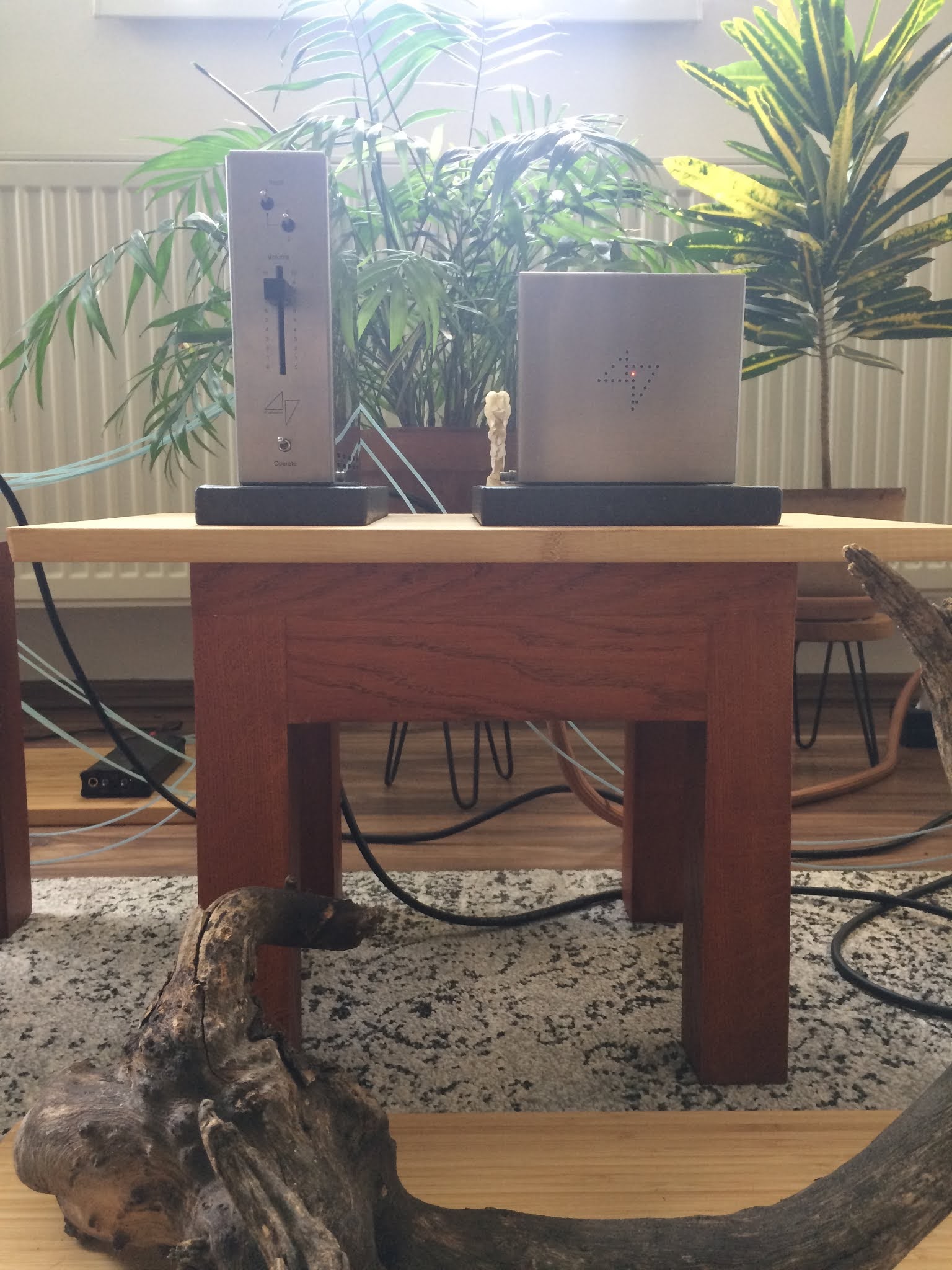
However, I still wanted to experiment with speaker and especially subwoofer placement, so one day I pushed the equipment rack with the turntable, phono stage and cd player to the side to have some space available for trying out now configurations. Then it hit me: I could also try my “old” components, which were previously part of my so-called downstairs system, such as my 47 Labs Model 4717 (aka Shigaraki) amp and my iFi macro iDSD Black Label DAC with iUSB 3.0 reclocker which I consider an integral part of the DAC, not just an accessory.
Now, ever since I turned this system on, my audiophile me have been practically frozen in the awe of that moment.
Falling in love with 47 Labs all over again
But before sound there were visuals. I love simplicity and I must admit that replacing a preamp + monos setup with a single integrated was a relief. Especially in this single source configuration the whole system looks beautifully understated. All else being equal, I would choose an integrated over a set of separates any day, and in fact, the smaller the integrated, the better. The latter doesn't stem from some sort of hifi belief, I simply like small, even a little bit toy-like hifi electronics.
I’ve had the Shigaraki (yes, I know that’s actually the name of ceramics, not the amp, but the phrase Model 4717 doesn’t quite roll off the tongue) for 3 years, listened to it with 3 different sets of speakers extensively (the Pylons being the fourth) and I always really liked it, but this time it was different. I was mesmerized.
At this point, I really would like to tell you why but I’m struggling to find the right words. And it’s not just because English is not my first language, it’s also because the sound kind of refuses to have adjectives hanged onto it. In my internal monologues I often refer to this hard-to-grasp characteristic as the Shigaraki-touch. It’s perfectly clear to me, what I mean by that, but I try to elaborate on it so that you have an idea too.
First of all, it’s not a spectacular sound. It won’t impress with detail extravaganza, soundstage size or thrilling dynamics. It’s not exceptional in any of the usual audiophile performance categories. To my ears it also sounds pretty much neutral. From a distance, it may seem like the scene is perfectly set for boredom.
But it’s not. On the contrary. If there’s one particular characteristic that aptly describes this system and especially the contribution of the 47 Lab amp to the sound, that’s the sky-high engagement factor. But again, I have difficulties with the root cause analysis here. If you read other reviews about this amp (and for that matter, 47 Lab gear in general), purity and directness are often mentioned. And while I fully agree with these descriptors, they might give the impression of a twitchy character.
However, that’s not the case. In fact, there’s a certain elegance and grace and lightness of touch to the way it plays music that is quite unique, I think. The "freshness of sound", which Kimura-san talks about, is wonderful to experience: it feels as if music just happens and hangs mid-air, not pushed out of the speakers by an electromotive force. Now when you add up purity and elegance, you may conclude that this is a sissy amp for solo flute and rotwein jazz. Again, this conclusion is wrong, because this amp can kick, hit and bite if my techno, noise and metal records require that. And without that strange pretentiousness that I sometimes hear in the presentation of über-high-end systems with this type of music. But even during the most vehement kicking and hitting and biting session, there’s always a sense that it is not simply about setting free a relentless destructive force; it’s also about the expression of the human condition. As odd as it may sound, that “humanness” is even there in the most alienated sounds of harsh noise or the most violent saxophone burst-outs of Mats Gustafsson. In essence, the sound of Shigaraki in the context of my system is best described with pairs of opposites. However, as opposites usually cancel each other out, what you end up with is – almost – nothing. What little is left is the umami of sound.
And now I’m under the spell of its taste. So much so that I’ve seriously considered stopping here for good. Because why bother if I can sit down in front of my system any time of the day, put on any music, and get involved and emotionally engaged within seconds after hitting play? Where else to go? And what would be the merit? Would there be any at all?

05 July, 2021

Why Care About Good Sound

By mrgoodsound

I am sure a few readers of this post will have asked themselves at one point or another, regarding audio: "Why do I care? Is it really worth it?". For some, including myself, audio is serious business. I mean the investments made eventually become sacrifices, to where the audio lover begins to compromise other opportunities and facilities in life. Audio, as in all of life, has ups and downs. The path to good sound is not an even road, and the troughs can be cause for sometimes severe self-reflection. I have witnessed many, including friends, decide to stop the chase: selling off most or all of their equipment in an effort to downsize or quit the "hobby" altogether. Most often this happens during a low point, and not a high one. 

Why? For one, there are too many people on the path for the wrong reasons. I won't focus on them, because the end of their road is inevitable. However there are also many who simply become lost, falling victim to consumerist tendencies which lead to purchasing decisions made on the basis of a cloud of polluted information, which hangs like a fog over today's audio marketplace. Even with the purest of intentions (how many times have you heard someone say a cliché like "it's all about the music?") you can only follow winding roads so far before you realize there is no end in sight.

The traveler has to have resolve. On a long hike, your resolve comes mainly from knowing how far you've come, and how far you've yet to go. But for the field of sound reproduction, the destination is vague, considering 'gains' are theoretically infinite, the destination is always shifting in the traveler's fickle mind. Except if you are one of those very smart audio science people, in which case, you have everything figured out. 

Fairy tales aside, you have to have a strong and unwavering conception of what can be. This is not a concept of what your system can be, for someone who is interested in equipment (aren't we all?) will have an ever-changing and often never-ending evolution of that concept. The concept of what can be must be focused on your state as a listener, on what level of perception (consciously, subconsciously) you may receive music, and the convenience with which you may do so. 

As an extreme example, I have met audiophiles with very expensive systems who only engage with them in tandem with another activity, such as watching a football game or browsing the internet. For such a listener, not even their conscious is fully engaged, let alone their subconscious, and therefore it is no wonder that such an individual could one day sell all of their equipment, purchase a Bose radio, and feel like they were missing very little. Why should they care? It certainly wasn't worth it for them. And yet this extreme example is not so far off from reality for a large number of people who engage in this "hobby". Despite fleeting highs usually obtained from an endless exchange and acquisition of equipment, they are never more than one or two steps removed from just quitting. And these steps are usually more along the lines of "what will all my friends think of me?" or a sunk cost fallacy than an actual fear of returning to a lesser sound system.

I will provide a personal anecdote. Most recently I have been in a 'low': my trusted digital source, a 2008 Mac Pro computer, went on the fritz and refused to communicate with my USB/SPDIF converter. I would consider myself a tech-savvy person, and yet roughly 3 weeks of continuous troubleshooting and experimenting proved unsuccessful to fix it (as of this post, I am still trying). In the interim, I had to have music, so I started trying many different computers in its stead. Unfortunately, and perhaps surprisingly, all of them sounded worse than the 2008 Mac. It is frustrating enough to have computers and software perform differently, but the fact that a solution I was quite content with suddenly stopped working was difficult even for my resolve to handle. I have other sources and systems to listen to music on of course, but I relied on my main system to be where I could consistently engage with music on the highest level of perception. 

What could be for me no longer was. During this low I even started contemplating selling some of my more prized equipment as the memory of 'what could be' faded further into the distance, replaced by a new normal in which I became used to engaging with music on a lower and more obscure level. After cursing myself while reinstalling the operating system on my Mac for the 6th time, I caught myself asking why do I care? Is it really worth it? 

These questions and the accompanying sour mood continued until tonight, where I stayed up to watch a film recommended by a friend, Portrait de la jeune fille en feu (2019). Without spoiling anything, I will attempt to explain that I had the most profound experience. The film can be described as deliberate and slow-paced, with only two pieces of music used throughout the two-hour runtime. The first, an original choral composition, is used to signify a turning point in the plot; though I was so engrossed in the movie at that time I did not think too much of it once it had passed. The second, however, comes right at the end. The presto movement from Vivaldi's Summer is used as a powerful catharsis for both the characters in the film and the audience; as the preceding 10 minutes formulate an emotional cliffhanger.

My reaction to the ending sequence was physical: my body seized, I began to feel numb in my forearms, my eyes involuntary began to well, I developed a lump in my throat. The only way I can think of to describe the experience for someone who has not seen the movie, is that for 120 seconds I felt close to God. I am not even a religious person. It was 4 AM when the movie ended and it was time to go to bed, but the effects lingered: I was alternating between giddy and nauseous, a state of laughing and crying. I realized it would be physically impossible to go sleep, the process of catharsis that the film and its music began had to be finalized with some sort of output. Almost immediately, the creative inspiration to write this (in)coherent article formed.

The clever reader is probably asking: "What are you getting at? Surely you watched this movie on a low-fidelity sound system! So are you saying high-end audio isn't a worthwhile pursuit after all, because such experiences can be had outside of it?"

Yes and no. Yes because like the characters in the film, which is set in 18th century France, you can have deep human experiences with music well outside the scope of a high-end audio system. Sometimes, I have them with my car radio. No because the experience I just described could be had at almost any time, on a consistent basis, with my home audio system (when the Mac was working!). Unfortunately, I have not yet mastered how to do that with my car stereo or $15 Koss headphones. This may sound far fetched to some. Indeed such a state of listening is generally reserved for sensitive and open-minded people, for lack of better descriptors.

So to return to the question: "Why do I care?", the answer must be that without what can be, I am truly missing the ability to have deep human experience with music on a consistent (almost on demand!) basis. If you have a lot (in your estimation) of money invested into your system and you are not getting this experience, then the question "Is it really worth it?" becomes difficult, but perhaps necessary, to answer.

The trailer for the film is linked below. If it intrigues you, and you do not mind films with more 'deliberate' pacing, I highly recommend it.