21 February, 2012

CD Recommendation: Bach Guitar Concertos

Although Bach did not write any concerto for the guitar, he did compose solo works for similar instruments. Given that Bach did much transcription, I think the concept behind this album is quite valid.

Yang Xuefei is a shining star whose albums frequently bring something new, necessary for re-rejuvenating the tired classical guitar world. In this album, she did transcriptions of mainly Bach works for strings. The reduction of the orchestra into a string quartet works surprisingly well. The Elias String Quartet is a young and wonderful foursome that I have followed since their excellent Wigmore Hall CD release (available from the HK Public Library). The collaboration is wonderful. Sound is good.

You can sample all tracks at EMI's Official Page.

Here are some youtube's of this album (top: promo; bottom: Concerto in A minor-1st movement):


11 February, 2012

Review: Kondo Ongaku + KSL-M7 System Part III

Kondo M7 in company with JC Verdier, Leben and Brooks; Ongaku in the background; click to enlarge.

Review: My Kondo System Part III
Kondo Ongaku + M7 System Part III - Digital Playback
Review: Sony CDP-R1/DAS-R1
Review: Audio Note DAC-2

Review: Genesis Digital Lens
Review: Gotham 10070 Coaxial Digital Cable


My Kondo System, Part I (background info on Kondo and Ongaku); Part II (all about M7); Part IV (largely phono related, skip if you are digital only)Part V (on old Audio Note M7 and use of Kondo with small bookshelves).

(Last revision Jan 23, 2015 - addition to the AN DAC-2)
(Extensively revised Feb 16, 2012)

Editor's Note:
I'd like to also refer you to a six-year old discussion thread dedicated to Kondo in the most well-known and worthwhile Hong Kong hifi forum called review33; the thread is humorously named AudioNote Ongaku - I'm in pain!, you get the idea! Although the webpage is in Chinese, most write in English, and there are useful information on Kondo buried there. I don't write much there but I do know (of) some of the regulars, all Kondo old-hands. Note there are two arrows on the upper right hand corner which usefully let you reverse the chronological order.

Recently, a part-Kondo user from Scandinavia found the review33 thread and asked about the use of Ongaku as amplifier and matching with preamp. It is a worthwhile question which has not been addressed comprehensively on the internet. The question coincided with my recently re-initiated effort to tune-up my Kondo system. So I have decided to explore his question while tuning up my system. This article is the first of my experience, and more would be forthcoming. First, I'd like to introduce my Associated Equipment for this Round.


Two Digital Systems
Personally, particularly when exploring something serious, I like to play with different sources, be it digital or analog. Contrary to popular belief, digital is still more complex than theoreticians/CAS/Perfect-bit people make it out to be. While digital replay standards have improved in general, all the theories and latest "advances" are often (like digital itself) merely number crunching games that get you nowhere. It still holds true that a good digital playback medium depends heavily on the ears of the designer. There are good sonic reasons why the best of the older products are still being cherished and sought after by connoisseurs (which the head-fi crowd shall never be).
There is a reason why some designers like Thorsten Loesch (now of AMR) still see greatness in the 16-bit TDA-1541 chip! Of course, "perfect-bit" or not, digital has yet to hold up to analog!

Aside from WE, perhaps nothing is more serious than Kondo, and a proper evaluation should be multifaceted. Mine uses older equipment that to me have retained their allure, in many aspects trumping their much more modern yet soul-less counterparts. And the two different sources differ markedly in gain, which proves to have relevance.

Digital System 1 This utilizes the superb Sony CDP-R1 as transport, and its matching DAS-R1
(16-bit TDA1541A; normal output level ~2V) as DAC (full pic at bottom of article). Connection is by the proprietary Sony Twin Link. I have previously written about this venerable system here. I'd like to add that subsequent evaluation has confirmed the greater, indeed exceptional, dynamic prowess of the Twin Link, and the connection is used as one of my references, particularly in replay of big complex music. Of course, the 16-bit TDA 1541A still reigns supreme in reproduction of the hall sound, and subtlety in integrating the whole sonic fabric. If there is a fault, it is that the Sony is a little too smooth, rounding out the edges of rhythmic figures.

L, AN DAC-2; R, Genesis Digital Lens.

Digital System 2 This system is more complex. It still utilizes the same superb Sony CDP-R1 as transport, but is more complex downstream. It uses the more conventional RCA digital output of the CDP-R1, which is connected to:

Genesis Digital Lens Over the years, the Genesis Digital Lens, an old anti-jitter system if you will, has stayed in my system. Its 5 inputs and 3 outputs offer infinite connectivity, and more often than not, even with modern DACs with supposedly top-class jitter-reduction, it improves the sound by firming out the contours. In some combinations, a mild deleterious effect of a little dryness can be detected. In this system it is connected via the same Gotham 10070 to the:

Audio Note UK DAC-2 My DAC2 is an older version, which employs the great-sounding 20-bit Burr-Brown PCM63P; it uses minimal digital filtering and I/V conversion unusually deploys interstage transformers; output via 2x 6DJ8 is fully tube-based, run in SRPP configuration. The output is significantly higher than normal, much higher than the standard 2V; see below). Here is Peter Qvotrup's philosophy and I quote some official descriptions on AN DAC's of the time:


L pic: inside the DAC-2; note the PCM63 and tranformer I/V; click to enlarge.


"...Audio Note waited until 1993 to introduce their first DAC because we felt there were serious problems with the digital format. Only after years of research did we feel we had developed significant enough insight to create a converter that moved the design goalposts forward. We wanted a DAC that would remain state of the art and retain its value for many years. To this end, Audio Note digital products now represent the most original and effective solutions to the design of digital circuitry and to the digital to analogue interface. In digital our approach is the same as it is in analogue; keep it simple and gentle and employ the highest quality components. The digital signal should also be handled with great care. Less processing; treat the original bitstream as fundamental truth.

Our goal is to create a line of classic D/A converters. We started by reducing the digital circuitry to its absolute minimum level and selecting the highest quality (and highest cost) digital chips (i.e.. the Burr-Brown PCM-63, K-type). Then we developed a battery of tests that allow us to further select higher quality chipsets. We do five separate tests to grade our D/A chips and reserve the very finest chips for the DAC-4 Signature, DAC-4, DAC-3 Signature and DAC-3.

In front of the D/A chip most companies use a high-order, "brick-wall" filter to "erase" frequencies above 20KHz. These high-order filters create resonant back waves (ringing) that result in energy reflections that add mechanical artifacts and hardness to the musical signal. This filter is the most critical juncture in a digital based system and how the signal is handled, how the energy is transferred, at this point will make or break a high quality system. Multi-pole filters are subject to ripple in their passband and poor transient response. Additionally, the high-Q ringing causes irregular and uneven dynamic and transient behavior, resulting in hardness, opaqueness, diffusion, exaggerated high frequencies and a false sense of detail. Additionally, the brick-wall filter is one of the primary causes of listening fatigue. Brick wall filters make music sound canned and artificial. Audio Note's solution to this problem was to use the only filter that does not ring or suffer transient or phase problems; a first-order, single pole. This simple filter employs a very high quality 1:1 interstage transformer. This original (patented) strategy gives our digital to analogue converters a very real musical advantage. This unique interface strategy allows the best type of energy transfer. Again, Audio Note has worked to preserve the original proportions and energy distribution of the music signal. Audio Note believes the signal must not be manhandled or subjected to unnecessary manipulations. The simple 'transient-perfect' single-pole filter/interstage transformer combination is the gentlest way to bandpass limit the output of a digital/analogue chipset.

The sonic benefits? Audio Note DACs have an uncanny sense of musical continuity; the listener's awareness of tempo and musical flow are distinctly enhanced. Their retrieval of small scale detail and timing information is second to none. These DACs can only be compared to the best analogue not other DACs.

All Audio Note DACs use the 6DJ8/6922 dual triode, except the DAC-4 Signature which uses the 7119/7044/E182CC. As you move up from the lowest priced DAC-1 to the higher priced DAC-4 Signature the parts quality improves with the DAC-3 and above using AN silver wire. The DAC-1 uses Audio Note Aluminum foil, paper in oil capacitors and copper wired interstage transformers. The DAC-2 is similar to the DAC-1 except that it uses either a 1:1 or a 1:2 interstage transformer for higher output and is designed to drive the Audio Note power amplifiers directly. Maximum output on the DAC-2 is 10VAC. The DAC-2 also has a higher quality component selection. The DAC-3 takes the parts quality to the next level with the introduction of a higher quality interface transformer, a higher grade of PCM63P chip and a more careful component selection. The DAC-3 uses AN-V Silver interconnect between the digital and analogue sections and between the analogue board and the output jacks. The DAC-3 Signature would be the best DAC in the world, were it not for the DAC-4 and DAC-4 Signature The DAC-3 Signature has even more and higher quality Black Gate caps, silver interface transformers, and a individually adjusted silver filter coil. The PCM-63s (K-type) are critically selected and auditioned especially for the DAC-3 Signature. The 4-Series DACs push that critical selection a step further with regard to the PCM-63s. In the DAC-4 Signature these chips are further selected by audition with musical program. The DAC-4 Signature uses the highest grade Black Gate caps, AN-Vx silver wire, and selected copper foil paper in oil coupling capacitors. The Production of the DAC-4 Sig. is generally VERY LIMITED due to lack of suitable chip sets, so delivery time can and should be expected.


The DAC-4 uses separate power supplies for the digital and analogue sections. The DAC-4 and DAC-4 Sigs. both are built on heavy, pure copper chassis. The DAC-4 employs still further power supply and parts upgrades over the DAC-3s. The DAC-4 Silver Signature is our current 'statement' DAC. It has a very improved, tube rectified, choke filtered power supply, the very best Black Gate Caps and Audio Note silver-foil, paper in oil, coupling capacitors. The exotic, E182CC/7044/7119 tube, used in the DAC-4 Signature, brings a greater sense of transparency and power to music reproduction. These DACs are designed to give at least a decade of analogue-like musical enjoyment. Jonathan Valin described the DAC-4 Signature in Fi magazine as "the best there is at any price"...".


Audio Note UK uses the exact same circuit for all of their DAC's, but the higher grade ones have "better parts" and tube rectification. As you can see from the pic, the DAC-2 is very well built. I agree (see descriptions below) the sound is much as the official literature described. Its great sound has as much to do with tube output and the excellent PCM63 chip (imho one of the best chips ever; its 20-bit sounds superior to most of the 192 stuff now) as the use of interstage transformers.

Audio Note UK later moved on to non-oversampling (so-called 1x) but, while I like the sound and simplicity of non-oversampling, imho latter-day chips are inferior. Maybe I am biased; I have heard their very expensive ones many times in other systems, but none impressed me like my old DAC-2. I have also owned the admittedly much cheaper and non-oversampling DAC One 1x (6111 tube). While it was certainly cheerful and bettered the more conventional Zero of the time, it was not at all a match for the DAC-2.


Gotham 10070
2 runs of this cheap but reference-grade coaxial digital cables are used. This utterly transparent and musical S/PDIF cable has outperformed everything else in my system. While here, I shall tell you Gotham's XLR digital cable is equally distinguished (as are the entire line).


Analog interconnect cable from either digital system to the preamp is Gotham GAC-4, one of my references.

System Used
For those who don't know my Blog well, please go to the right hand column of the Blog; scroll down to see the equipment I use in both Hong Kong and NYC. This will give you an inclination on my preferences. For this round, I used:

Preamp: Kondo KSL-M7 (stock Sylvania 6X4; 2x Mullard ECC82)
Cable from Preamp to Amp: Gotham GAC-2
Amp: Kondo Ongaku (stock GE VT4C and 4x JJGZ34; triple-mica black-plate 6072; Tung Sol 5687)
Speaker Cables: Gotham 50150 (another marvelous Gotham)
Loudspeakers: Tannoy Canterbury HE

Notes on the Tannoy Canterbury For the past years, since I received them in very dark-sounding condition, I have run these in with increased treble energy and rollover. While these setting still work marvelously well with the WE setups, with the Kondo setup I have found restoring close-to-default settings reaped greater benefits, while extracting no cost from the WEs!
Although Kondo is not bright or harsh, its strong presence and unrivaled airy presentation demand partnering with the right loudspeakers. Those with overly strong or grainy treble just would not do, particularly with digital sources.

R pic of Ongaku front; click to enlarge.

Ongaku as Integrated Amp (Digital)
To facilitate comparison, I used the Direct In exclusively. Unlike some erroneous reports, this bypasses only the selector and renders the other inputs (except tape) useless. The source/tape selector, balance and volume all remain functional. Note that the balance function desirably operates over a usefully narrowed range. In my system, the volume knob ranges from 9 to 11 o'clock depending on the digital system used and material.

With such a "monumental" project, I opted to use one CD as my main test material, and the MANGER Test CD (tracks here) it was to be.
I am happy to report that both digital systems, though different in their presentations, yielded excellent sound.

Digital Systems 1 vs 2 In general, System 1 is more composed, always finely layered and cultured, never making an ugly sound; whereas system 2 has more rhythmic incisiveness and a more "vocally" declamatory nature, more "hifi" too if you will.

  • -Track 1 With System 1, the bells are more telling in their tolls, their tones more varied and differentiated.
  • -Track 2 The cinematic effects and timbers of the various personae are better differentiated by System 2.
  • -Tracks 3-7 These classical tracks are overall better rendered by System 1, no-less by more accurate portrait of strings timber, but in terms of rhythmic accuracy (tracks 6-7) System 2 has the upper hand (Sony is weakest in this area). System 2 also portrays the piano (track 3) with more body and realism.
  • -Tracks 8-10 and 12-13 These Jazz/Pop-influenced tracks undoubtedly has more emphatic and audible rhythmic variations with System 2.
With classical and complex material System 1 scores a little higher, whereas in smaller pop/jazz combos I'd give the edge to System 2. Overall, I'd narrowly give the edge to System 2 for its superior PRaT. Please note that System 2 has the much higher output, and I believe that is an advantage when using the Ongaku as integrated amp.

Ongaku + M7 (Digital)
Direct-in was used throughout. After hours of going back and forth, I have to conclude that, with digital playback, adding the M7 is not really that superior to direct-in:

  • With the M7 , the position of the volume knob of the Ongaku is somewhat arbitrary, up to the preference of the user as well as the nature of the music played. I am not certain what is the optimal, but I resist having it much over 12 o'clock, as I think past 1 o'clock or so the sound coarsens significantly.
  • Addition of The M7 immediately brings about a more panoramic soundstage that is greater in both width and depth.
  • With the M7, Digital System 1 gains perhaps a little speed in the leading edge and a firmer rhythm, though it shall never be the equal of System 2 in this regard. More, this comes at the cost of loss of a little subtlety in certain areas, like massed string timber. I also notice that the hall sound is reduced somewhat.
  • With the M7, Digital System 2 displays an even more upfront rhythmic signature, but the depth of attack and PRaT are not necessarily superior to direct-in. In other words, what benefits System 1 a little is less obviously useful here. Note also that the high output of System 2 can be attenuated with the level control of the M7, but it'd take time to arrive at the optimum; I used the 1 O'clock position.
  • Overall, with significant reservations, I'd say addition of the M7 brings about a somewhat more even quality, but digital direct-into the Ongaku can be a success (higher source input level desirable). So there is much room for tuning the sound.
Analog experience to come in Part IV. Suffice to say I also think the higher the cartridge's output the better...

10 February, 2012

Review: Kondo Ongaku + KSL-M7 System Part II

R pic: my unit; click to enlarge; note the ALPS volume pot.
Review: My Kondo System Part II
Kondo
Ongaku + KSL-M7 System Part II Introduction


Links to My Kondo System, Part I (background info on Kondo and Ongaku); Part III (the most important one, detailing set up and listening experience); Part IV (largely phono related, and Kondo preamp/amp were not used; skip if you are digital only); Part V (on old Audio Note M7 and use of Kondo with small bookshelves).

Yes, this is still the Introduction. This time, on the Kondo M7. Since the M7 went through myriad iterations, I think I shall spend some time on it.

Kondo M7 components
As famous as the Ongaku, the M7 preamp, as designed by Kondo san, is likely the most talked about and cloned preamp after another number 7, the venerable but very different Marantz 7. Kondo's M7 went through many iterations, and I am trying my best to list them here in chronological order. Much info is gleamed through Singapore's Soundscape website, which is NOT up to date; aa well as through a Taiwan website 臺灣的音響共和國 日本 Kondo KSL-M7 前級 (編者按:是個有水準的網頁, 有全面的介紹及寶貴的技術上的資料,但是網頁完全抹殺/略過 Kondo 和英國 Audio Note 合作的年代), which completely ignores the collaborative period between Japan and UK (yes, both sides try their best to re-write history). Correct me if I am wrong!
  • --Kondo san's M7 started as a solid-state (!) preamp. The "M" stood for German "Meister".
  • --The first tubed M7 preamps were marketed jointly with Peter Qvortrup as Audio Note, before the UK-Japan split. The line-only version employed 6X4 rectification and a single 5687 was used for signal amplification, and this is the circuit most often seen on the internet (an example here). Note that this was quite influential for its time, single-handedly reviving use of the 5687. (編者注:所引的臺灣網頁完全抹殺/略過這個 Kondo 和英國 Audio Note 合作的年代)
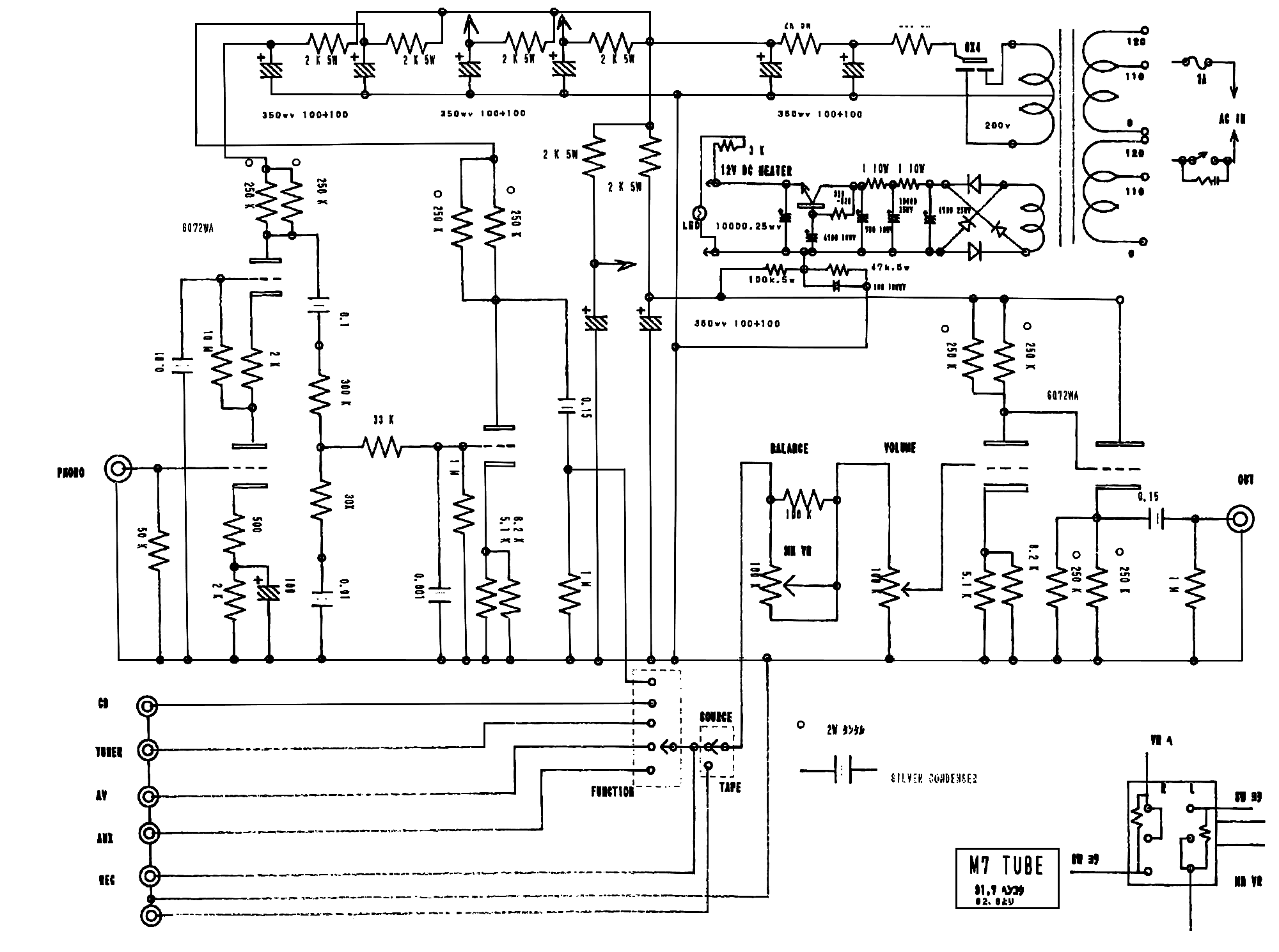
  • --The first tubed full-function preamps, also marketed as Audio Note, incorporated an MM phonostage and used 6072 in both the phono and line stages. Circuit of this is also ubiquitous on the internet (an example of a 1991 version here). It is interesting to note that that onto the next generation Kondo has largely maintained different topology in their line-only and full-function preamps. (編者注:所引的臺灣網頁完全抹殺/略過這個 Kondo 和英國 Audio Note 合作的年代)
  • --In 2000, the M7 line was revamped. The label now became M7 IIk. All retained the use of 6X4 as rectifier. But now the line-only version used 2x 5687 and 2x 12AT7; the full-function version used 2x 5751 and 2x 5687; a stand-alone phono preamp version was introduced, which used 2x 5751 and 2x 12AU7. A signature version offered better tubes and material. 第二代 (編者注:這個不準確,應是第三代;所引的臺灣網頁完全抹殺/略過 Kondo 和英國 Audio Note 合作的年代) 的M7前級在2000年推出,稱為M7 II K,外觀與今天的KSL-M7並無二致,僅是中間的英文編號有所不同。但從這時開始,M7前級改用電子管放大,並細分為四個不同的型號,分別是M7 Phono(只有唱頭放大,使用5751管2只,12Au7管2只,6X4整流管1只)、M7標準版(具備唱頭與高電乎輸入使用5751管2只,5687 管2只,6X4整流管1只)、M7 Line(只有高電平輸入,使用5687管2只,12AT7管2只,6X4整流管1只)、M7 Signature簽名版(也是有唱頭與高電平輸入,使用珍貴的古董真空管與更好的音量電位器)。
  • --The latest revision came some time after Kondo san's death in 2006 (and I think it is "current"; though there is talk of the discontinuation of the entire M7 line) . Use of the 6X4 as rectifier has been retained. But now, the line-only version uses only 2x 12AU7; the full-function version uses 2x 12AX7 and 2x 12AU7; the stand-alone phono preamp uses 2x 12AX7 and 2x 12AU7. Looking at the tube complements, personally I see simplification from previous generations. My own M7 phono and M7 linestage belong to this period. 最新的KSL-M7 ...自從蘆澤雅基接任社長後,Kondo展現了較年輕的活力,他推出重量級的黑膠唱盤,以4只西電300B放大的Kegon擴 大機、使用4只2A3輸出功率僅有10瓦的Souga擴大機等,第三代 (編者注:這個不準確,應是第四代;所引的臺灣網頁完全抹殺/略過 Kondo 和英國 Audio Note 合作的年代) 的KSL-M7前級就在這樣背景下誕生了。最大的改良部分是電子管,KSL-M7同 樣有Phono、Line、標準版三款,使用的電子管也有不同。KSL-M7 Phono唱頭放大使用12AX7管2只,12AU7管2只,6X4整流管1只;KSL-M7 Line使用12Au7管2只,6X4整流管1只;標準版使用12Au7管2只,12Ax7管2只,6X4整流管1只。
  • --Most interestingly, according to the Taiwan link, Kondo moved away from use of the 5687 because digital replay has improved vastly, and no longer needs the service of the mellower 5687. I am not sure I can agree here, as the 5687 can be quite a sharp tube. 第二代的M7前級上使用5687雙 三極管(E182CC)(編者注:這個不準確,應是第三代;所引的臺灣網頁完全抹殺/略過 Kondo 和英國 Audio Note 合作的年代; 而且 5687 和 E182CC/7119 就算可以代用也不是相同的管子 ) ,據Kondo的說法是5687管聲音沒有那麼清亮,配合CD訊源聽感上「數位聲」比較不明顯。但隨著SACD、藍光等新型數位載 體出現,Kondo不能再故步自封,所以換用更通用的新型電子管。
Although minimally equipped, the M7 does allow for level adjustment of the two non-direct line inputs. As we shall see in the next article, this not only allows for equalization of the volume of different inputs, but is a feature that can be useful in fine-tuning the sound of certain sources. The direct input bypasses this control but not the selector itself (unlike the Ongaku, you can still choose to listen to the 2 line inputs even if direct is connected).

09 February, 2012

Review: Kondo Ongaku + KSL-M7 System Part I

Review: My Kondo System Part I
Kondo
Ongaku + KSL-M7 System Part I Introduction


Links to My Kondo System, Part II (all about M7); Part III (the most important one, detailing set up and listening experience); Part IV (largely phono related, skip if you are digital only)
Part V (on old Audio Note M7 and use of Kondo with small bookshelves).

How these (projected series of) articles belatedly come about
Friends often ask me how does my Kondo compare with my other stuff, SET or not. I have always refrained from answering, for the simple reasons: (1) my innate penchance for playing with cheaper things necessarily means I have spent far more time setting up my other (far cheaper) SET amps than Kondo; (2) while the Kondo sound is immediately distinctive for its uncanny presence, its strong projection of the upper midrange demands more time and effort in system matching and, like the best things that I have, I'd want to gain more experience before writing them up; (3) I first acquired the Ongaku and waited for a long time to "complete the system" by getting the M7 set. Since I got my M7 set I have used them extensively with other SET amps, but not so much with the Ongaku itself.

Paradoxically, it was my recent experience with Western Electric that prompts my re-evaluation of Kondo. As reported in an article below, the WE 133A amp immediately seized the attention of all of us. Trust me, the WE sound is unique in the realm of Push-Pull topology, where nothing remotely compares in subtlety and humanness. The event forced the question, if one is in possession of WE, is there room for SET? This led me to re-tune my Kondo system, and I believe I have gotten closer than before to doing Kondo justice, if not answering the difficult question with a resounding yes or no. Lest you misunderstand, the question is not really on which is better, but on which has more strength of what, and ultimately how one makes you appreciate the achievement of the other.

My experience up to now is far from complete, I am sure. But I do know, at least to these ears, most of the Kondo setups I have heard previously tended to be a little unbalanced (usually a little over-bright), perhaps due to misplaced effort at maximizing what needs not be. There is such a thing as too much of a good thing. I also know, it shall be an ongoing experience...now, does that answer the previous question?

Kondo san and his Philosophy
Kondo san is one of the seminal figures in the SET revival, but not at all the lone figure showing the shining path, as he is sometimes made out to be (especially by his dealers). But he was the first and only one for a long time who has gone to such extremes.

Kondo san's bio and philosophy make interesting reads. In my opinion, for those interested in Kondo these are mandatory reading material:

Kondo san's Thoughts on Hifi
(from Kondo's Japan dealer Sibatech)
Kondo san's 1992 Sound Practices article on the Ongaku

Interview: Stereophile 1996
Interview: TNT 2001
Litmus Test Now, many of Kondo san's beliefs were/are not unique, and indeed shared by SET designers/enthusiasts. But if you fail to understand, let alone identify with, the talk, then I am afraid Kondo, or SET, may not be for you. If you think all that is empty talk, then look elsewhere.
If, by reading the above links, you interest has not waned, or has been piqued, then there are more worthwhile links. Some are in Chinese but the pics are more than worthwhile for your time (臺灣的音響共和國是個有水準的網頁, 下面一些文章有全面的介紹及寶貴的技術上的資料):

Factory Tour TNT 2001
Kondo華麗銀之聲(一)Factory Tour 1
Kondo華麗銀之聲(二)Factory Tour 2

Audio Note, Kondo, and Audio Note UK
A brief note, though I presume you know the story. Many moons ago, Kondo san in Japan used to collaborate with Peter Qvortrup in the UK. The latter established Audio Note UK, and together they presented and shook the world with Kondo san's designs, primarily the Ongaku and the M7 preamp, which bore the Audio Note name. Later, they had a bitter fallout and, after lawsuits, Kondo san lost use of the name Audio Note, and began using the name Kono/KSL. The rest is history.

I have no intention here of pitching in the conflict. I think Peter Qvortrup, from his first efforts at Audio Innovations to now, had made fine contributions to the tube/SET world. Audio Note UK had made much contribution to the SET world by making kits like the Kit One. But I think it is unfortunate that their current products bear similar Japanese naming schemes to estranged Kondo, even if they are designed by Brit Any Groves.

The important thing is, in terms of current flagship level products, judged sonically alone, I much prefer Kondo Japan to Audio Note UK. Despite the naming game, they sound radically different. Mind you, I don't dislike AN UK products. Contrarily, I like them for their own attributes, but they do not sound like Kondo. When it comes to SET, I shall follow as closely as possible to the Japanese masters. This, is my belief.
R pic: Inside the front compartment of my Ongaku; 2x 5687 in the middle, flanked by 2x 6072) click to enlarge)
Ongaku
The Ongaku is the most famous SET amp ever, if you forget about the legendary WE 91A that is. Here, I must tell you that, although it is said Ongaku means “music“ in Japanese, the ideogram 音樂 is what the Japanese calls hanji = Chinese Characters. Yes, it is a fact music, or other art forms for that matter, in Japan derives from the Chinese counterpart. The same applies to almost all the other model names.

Although first marketed under Audio Note, the Ongaku, or at least the Kondo version, has remained much of itself, an evergreen and a legend at the same time. No other AN or Kondo amplifier has such a claim. I first learned about the Ongaku from an ancient UK HiFi World article, one that is not on the net.

Surprisingly, for such a famous amplifier of longevity, there are not many reviews available on the internet! Here, I refer to those products associated with Kondo san, either the previous version marketed as Audio Note, or those now as Kondo. Not the AN-UK product. Here is a review of the near-original Ongaku (when it was Audio Note):

Ongaku Review 2002 Positive Feedback

The reviewer, Steve Rochlin, noted that he did not like the feedback added (by Peter Qvortrup?) to beef up the sound, but, some years later, the same reviewer waxes lyrics on the current Ongaku AN-UK, which is radically different in using interstage transformers among other things!!! Is the current AN-UK Ongaku an improvement on the Kondo original? Maybe you can answer that...I shall stick with Kondo. I believe, but am not sure, the current Kondo Ongaku is much closer to Kondo san's original design and employs no negative feedback (and certainly no interstage transformer, which, aside from WE, is most difficult to get right in my experience). If you know otherwise, let me know!

There is a nice Chinese review on the current version of the Kondo Ongaku. even if you don't read Chinese you should browse through it:比真實更豐富-全茂試聽Kondo Ongaku後級- U-Audio (編者按:文内有一錯誤"...如果你要把Ongaku當作純後級時,訊號可以從direct檔輸入,就會跳過音量控制器..." 是不對的;direct 只會跳過音源選擇器,Selector 而令其他輸入不能用; 音量控制器還是要調的)The Case Against The Ongaku is so famous that it has been targeted as the epitome of SET follies by the technology's detractors. One that I find particularly interesting is penned by TAS' Robert Greene, a reviewer I generally admire but do not always agree with:

REG against the Ongaku

Paradoxically, I agree with REG that, in many hifi parameters and as compared to my other SET gears, the Ongaku is not at all the epitome of neutrality. But then, for me, the Ongaku's unique strengths bring it closer to neutrality, or absolute sound, than almost anything else.

...to be continued in Part II