21 July, 2020

Naim NAC-42 233 MC Card The Color of Preamps


Click all  pics to enlarge: lower left corner; the red and black wires are my addition, the + and -ve of 24V DC. The vertical boards are MC Phono Boards. Pic immediately below shows the Jameco on the power bar.

Review: Naim NAC-42 Preamp with 233 MC Card 
Naim Nait 1, 2, 3

Revised 3/14/22: A few corrections after a reader pointed them out.

If not for the lockdown, I'd never have acquired this piece of equipment. It was quite a bit of work to get it going, just to prove on the cheap whether a hunch is correct or not. As Naim is well documented on the net, I'll not cite much for background.

My Unit The Serial Number of my recently acquired very reasonably priced but mint US 120V Naim NAC-42 (1979-85) Preamp is 7416, which Naim's Website tells me is from 1983. My unit came with the 233 MC Card but without power supply, which is usually derived from its matching 110 Amp. In terms of looks, those large knobs are kind of whacky - I prefer the looks of the Nait 1 and 2 that I had before. I was also surprised by the size of the shoebox, a little larger than I remember of the Nait 1 and 2 (but my recollection could be faulty). At the bottom of this article is an old review.

Why This Project? Sit tight, for this will be heresy to some: I wanted to show that the magic of the earlier Naim's (which many prefer to later ones) come mostly from the Preamp Section than from the Amp Section. Let me tell how this came about. It started with the NAD 3020 I have always loved this iconic NAD integrated amp and have written a lot on it. Around 2014 I acquired a 220V unit and tested it in NYC before bringing it back to HK. I didn't write about it then but one of the things I did was to evaluate the preamp section (3020 has preamp out-amp in jumpers which can be removed to facilitate the use of either section). Used with my other amps, the sonic signature remained very similar. I concluded that the NAD sonic signature largely comes from the preamp section. This was corroborated by my friend Hoi when I visited him (here). On to Nait 1,2,3  Back in HK I then got to use all 3 generations of Nait's, but not their power amps, which are overpriced. I particularly admire their rhythm and pace. My first was the Nait 2 which truly astonished me. As I wrote in my Special Integrated Amp Article: "...These are excellent but not as neutral as the Cyrus. The sound is bolder and Naim's famed "Rhythm and Pace" is very much in evidence (more than its modern counterparts), but there are things to watch out for: (1) the vital vocal midrange is a little recessed; (2) Lower midrange to upper bass is a little emphasized; (3) Treble is just that little bit reticent. Its primary strength is in its portrayal of the leading edge, an area I have not heard its equal. It is best partnered with its own CD players, which shall yield a sound that is uniquely rhythmic and pacey, not neutral but a paradigm in what it excels in. In a complete set, it can lay claim to a unique sound not heard with other brands, and here I tip my hat. An example is my Nait II and CD2 (TDA1541A) combo. With it, the ATTACK of a single plugged string (like guitar), or drumming, is phenomenally live. Even more surprisingly, the "rhythm and pace" benefits tremendously a slow instrument like the organ. With Bach's organ work, you can literally feel the different degree of attack that the organists applied on the keyboard, and it's a revelation. For a good read click for this TNT audio article. Note that the phonostages are either MM or MC, and they are excellent..." My first was the excellent Nait 2 but some reason I didn't write it up individually. Then came Nait 3 (here) and last, the Nait 1, which I only let go when I left HK (here). Of the 3, in terms of the most prized Naim rhythm and pace, I'd say it's a toss up between the 1 and 2 (the 2 is from memory a little airier), but either is significantly better than the 3. Incidentally, I have heard the later 5(i) and it is not even close to even the 3, not to mention the 1 and 2. So! Given the unique early Naim sound which I know so well and love, I wanted to investigate whether the Naim Preamp is responsible for the sonic signature. This project is on the cheap and I'd not have to get a Naim amp, which are expensive. Nait 1 was produced from 1983-88; Nait 2, 1988-93; Nait 3 1993-2000, so my 1983 NAC-42 likely most corresponds to the Nait 1. Does it have the magic?

Power Supply One can power the Preamp from a Naim Amp of the period, or one can use one of Naim's Power Supplies (or an aftermarket one). This ecoustics forum thread gives a run down on which ones to use and how to connect. Basically, what is needed is a 24V DC power supply, easy enough, right? But we shall see. As this Naim project is just a diversion I was not about to go all the way to build, not to mention buying, a serious power supply. I toyed with the idea of using one of those cheap Chinese DIY 24V kits but that's still too much work so I resolved to use Wall Warts. Online discussions mentioned the preamp uses very little power, estimated to be 0.5 A or less.

Connectivity Except for the Phono Inputs of some units (others even use BNC), the Naim's of this era all use various DIN connectors, which they claim are superior sounding (actually many UK manufacturers like Meridian and Quad also used DIN connection early on). The Preamp Output is the most interesting, utilizing a 4-pin DIN that sends both the signals to the amp and 24V DC power supply back from the amp to the preamp (signal and power supply grounds are common). Tuner Input uses a 180 degree 5-pin DIN, as does the Tape In and Out.

A Lot of Work! First, I had to gather some parts. I have leftover quality 5-pin Rean DIN male connectors but for 4-pin it seems only generic ones are available, so I ordered a 5-pack. I also ordered the appropriate 2.5mm male socket for mating with wall wart. The extra unlabeled 4-pin DIN is supposed to be used for the SNAPS Power Supply, but it is not even connected to the circuit board. As seen in the top pic, I decided to avail myself of this socket by soldering a red wire (for 24V+) and black wire (for 0V) to the appropriate points on the circuit board (red wire and green star ground). I constructed a 4-pin DIN to Male 2.5mm DC plug socket adaptor (rightmost grey cable) for mating with the wall wart. Thus I did not have to connect the power supply to the preamp out cable (less soldering difficulty). The 4-pin DIN is connected to 2 runs of the slim but sonically good Belden 8451 (my go-to hookup wire, used also in my TU-8150 bypass). For Tuner Input I divided up the 4-conductor Mogami 4534 for both channels and connected it to the 5-pin DIN. Boy, soldering those tiny and close-together DIN pins was a royal pain, especially with the lower-quality 4-pin connectors (I ruined one)! Finally I was ready to go!

Turntable: Technics SL-1200 Mk II with Denon DL-103
Bluetooth Receiver: Dayton Audio BTR-01 Digital Out with Belden 1694A
DAC: Micromega MyDAC
Amp: Akitika GT-102 with Gotham 50025
Loudspeaker: Audiomaster LS3/5A 15 ohms

Comments and Sound
  • Power There is no on-off switch on the preamp (it is on the 110 amp). When the power is plugged in, the light stays on. To turn off, I had to unplug the wall wart.
    DFU240050F1121
  • Interference First I used a Switch-Mode Power Supply and, sorry, that was no go. I heard a high-pitched frequency sound and knew that was interference. So I ordered a 24V regulated Linear (transformer) DC Wall Wart, made by Jameco in Taiwan (Part # 174879, here), a really high quality unit. Despite the heft, its rating is only 0.5 A. I have had it on for many days and it only gets lukewarm, so I deem it sufficient (I do unplug when signing off). The background was totally quiet. I highly recommend Jameco Linear DC power supplies if you are looking to upgrade your Switch Mode DC supplies and your current requirement is not high (more current of course available for lower output voltages).
  • Scratchy Pots Initially occasionally one channel or both would cut out. Rocking the selector back and forth would restore sound and with time the problem disappeared, even without cleaning.
  • Cables Before I forget I shall say that, in contrast to most Flat-Earthers, I have always disliked the stock Naim interconnect cables (which are made by Chord, whose cables I don't like because of their subtractive nature). Yes, I have compared before and I prefer my Gotham, Mogami, Belden. And, for loudspeaker cables I never used NACA either; I have use Gotham  (50025 and 50150) and Belden 9497 to great effect.
  • Sound - Line I knew exactly what I was in for. Coming off the Artemis, I felt the top lacked a little air but the ear soon adjusted. The sound was exactly like what I wrote about the Nait's (shaded text above). Very good rhythm and pace, more apparent on jazz. As I was just streaming I did not even try the CD.
  • Sound-Phono Wunderbar! I played the Hank Jones Happenings (Impulse, shown in next to top pic) was swinging hard! And, with the keyboard, that famous Naim quality was again evident - we can virtually feel (and hear) how Jones touched the keyboard (again, see shaded text above). This was the first time I used a Naim MC card and I have to say I think it is superior to my experience with the MM Cards (well, I prefer MC).
Conclusion My write up is short, but actually I listened to the Naim endlessly for at least three weeks. I am convinced, like the NAD 3020, The Naim Preamp, or Preamp Section of the Nait's, is largely responsible for the Naim Sound.

I hear you. This is not "neutral"; this is a "color". Well, if "colors" make music sound real, I want more colors. If colors make me feel and hear how Hank Jones touches the keyboard, I want more colors. I am glad vintage Naim is so "colorful". And perhaps Western Electric is colored too?

I'd gladly have continued using the NAC-42 in this baking hot weather (I only use a fan). But then by chance I got a Yamamoto Preamp, which beckoned me away...I told you, no relationship is forever, but a fling now and then is rejuvenating...who wants to be tethered to something that is always "correct" - meaning you are always wrong in your desires?

Pic above from 7/89 Streophile; review below from tomtomclub page

20 July, 2020

Early Memories of an Indian Audiophile Counterfeit and Pirate Music

Editor: It's my pleasure to introduce another writer to the blog, audiopro from Mumbai, India, a friend of Prem and Vivek, whom you'd remember from a previous Virtual Home Visit. audiopro also frequently contributes to the Indian forum hifivision. For some reason, these Indian friends all have kind of a philosophical bent, which is just what I like! This first article was actually an email. I liked it so much that we are publishing it here. People from the US and Europe will find it fascinating but people from many other countries in Asia and elsewhere will certainly find resonance. Even today, with wider and official availability, it is actually still hard to be an Indian audiophile. Personal Import duty starts at 40% and can go up to 75%! Wow, that really hurts!

Letter from India (2)
A walk down memory lane...
by audiopro

Growing up in India in the 80's was a different universe. I grew up on billboard and much later on MTV hits. I remember waking up at 6:30am to watch the MTV top hits countdown. Those were the days of music videos. Elton John's sacrifice, Nirvana Team Spirit, Michael Jacksons Jam, Remember the Time, Speed Demon, Thriller, Aerosmiths Amazing, Crying and Crazy and so on.

India was a shut economy those days. It was difficult to find all sorts of English music and imported audio equipment at a store. Hence there existed a large grey market where you had shops that recorded whatever you wanted. You gave them a list of songs and they recorded what they had, which was surprisingly almost everything you asked for. If he didn't have a song he'd call your landline and give you choices or leave a message and you'd call back frantically. We bought metal tapes that were carried by people visiting foreign countries. They worked as carriers and sponsored their trip by selling articles that they brought back. I remember buying Maxell Metal cassettes and TDK ones. They were my favourite. I loved the dark grey finish of those cassettes. The smooth acryllic covers. Opening the plastic foil wrapping of a cassette was like unveiling a new iphone, maybe even better! The Sony C60 and TDK B90 were the go to ones if you didn't want metal. Whenever you struggle to get something you tend to appreciate it. I had a cassette rack and a cassette drawer. Each cassette was labeled like Super Mix 80s, etc.

Then, getting a system was another story. In those days Mini combos ruled the market. You had local manufacturers who made stuff which looking back was really decent but they lacked the brand, fit and finish of a Sony or Panasonic or Philips mini compo. Sony, Philips (Netherlands), Pioneer, Hitachi did not exist in India but the grey market was so large, at least aspirationally, that they even had a few service centers in India and sometimes ran ads here! You went to a shop and he showed you a catalogue. My 10 year old eyes would shine when I saw the plethora of Japanese mini combos featured in that catalogue. I could barely reach the top of the counter but yet it was magic.

I lived in a small quiet suburb on the outskirts of Mumbai. Today the city has expanded and this suburb has become the center of it. But in those days we were cut out from the main city unless one used the train or owned a car. So we grew up in a suburb cut off from city life in a country that was already cut off from the rest of the world. Those were beautiful days and I would happily give up the internet, etc and go back to humanity.
Everyone of us had a setup, be it a walkman, radio (called a 2 in one, sometimes with a double deck) or a mini combo. My first setup was a Fisher mono radio and then came a Sony FH series mini combo with a CD player. Man! I felt like I owned a Dartzeel! My neighbour had an Akai mini combo, another had a locally made one. Sony was the standard pretty much.

Every evening between 6-8pm you played music and you played it loud. The entire locality would be abuzz with Ace of Base, Michael Jackson, Aerosmith, Queen, Guns and Roses etc. You had a rocker who wore black T-shirts and played Pink Floyd (and your grandma was scared of him), you had a pop neighbour who played George Michael and Richard Marx and so on. In fact it was an unspoken expectation where one person played lovely music into the night. I remember Madonna being played loudly for the entire locality to hear at 9-10pm which in those days was considered very late. That was the only way I could listen to the True Blue album. My dad's brother was dating someone and when I heard she had the True Blue album, I begged him to get it for me to use it for a few days. If someone owned an original Thomson cassette or an Original Billboard tape there would be a line begging to borrow it. Even if I hated the mix I'd try and listen to the tape because it was an original Thomson! Sometimes the person would lend it to you secretly and you had to hide it nor play it loud or you'd have neighbours kicking your door, trying to figure out how you got that tape! With time the official cassettes became widely available and stores sprouted up. I still remember buying an album once a month because that's what my pocket money allowed me to do. The Now series, Krushchel Rock, Meatloaf's Bat out of Hell II.

We had very little but no one really complained. It was beautiful, pure, innocent and it was all we had. We had posters of Hollywood stars in our cupboards, Calvin Klein perfumes and Denman brushes were sought after. Everyone wanted George Michaels Aviators!

TV was a similar story. You had video cassettes that you got from the local store. Again everything was bootlegged but that's how the system functioned. Robocop, Ghost Busters, Superman, Terminator, Police Academy, Top Gun, Gods Must be Crazy, Evil Dead, Blood Sport, Child's Play, Lethal Weapon, Twins, True Lies, Total Recall! Today kids take the net for granted and have no idea what they are missing out on. We were born human but ruined into robots.

Then as we grew up our parents got basic cars that didn't come with a stereo. Slowly we grew up and had our own cars. So came the aftermarket car stereo setups. Pioneer was the king and we had amplifiers with Pioneer helmet speakers and subs being fitted in the cars. As labour was cheap it was easy to modify car doors, have boxes built for your speakers, etc so that it would fit in aesthetically yet be functional.

The affluent had KEF, Sansui, Goodmans, Tannoy, B and W, JBL, Pioneers, Kenwoods, Sony, Wharfedales, Bose, etc. Again all this was available via the grey market. You didn't have much of a choice as such. You just went with whatever was brought in. Then there was a large second hand market and so on...it was beautiful.

All this sowed a seed of passion for music because it was all around us and we worked hard, very hard to source it. Today we seek DSD, lossless music etc. and talk about going back to good old NOS DAC's. In those days we wanted music, we wanted skateboards, BMX bikes, Spalding basketballs, Butterfly table tennis rackets. We valued passion, we valued innocence. I wonder what changed...I really wonder....but the memory remains...

Editor's Postcript: 
This article brought back so many memories! I came to the US when I was sixteen (on a Pan AM flight). Prior to that our home in Hong Kong was very small and there was only a TV, no music playback equipment except a small radio. Unlike audiopro, I didn't have an avid interest in music then but was aware of what's happening. As I am older than audiopro, my memory includes vinyl in its heyday. HK was a little ahead of India because it had always had a large (and rich) expatriate (colonial) and business community (including many Indian traders) who could afford the luxury goods. Also, HK has always been a free port, which is why HK audiophiles are lucky. But back in the 60's and early 70's, most people were not well off, and some were desperately poor. The radio would play western music and both official locally pressed and imported LPs were available. However those were so expensive for most people that there was a large Pirate Industry. Say, you made $100 a month and an official LP was $20 and a pirate $5. The pirated LP's were mostly pressed in Taiwan or Vietnam because the record companies did not have representations there. They had translucent and ghastly colored vinyl (now back in vogue for young people)(pic below from interesting Chinese article in popd.hk; English translation; the "Top Hit" is likely a compilation). In the West, there too have been counterfeit's and pirates too but they seem to be much higher in quality (see here). Of course, piracy was even crazier when the cassette came (you can tape off radio too). Just like in India, any song can be had and you can make your own compilation, all for a reasonable sum. I remember my richer classmates bringing to school the latest Chicago LP, whatever, for showoff and for lending to their buddies. I wasn't interested in the music but I was somehow jealous. And audiopro mentioned Butterfly table tennis rackets. Ping Pong Ball has always been popular in poorer countries, and HK was no excpetion. I spent at least a couple of hours playing table tennis everyday! The Chinese made rackets were cheap and had good wood but lousy rubber surfaces, so we would peel the surface(s) off and resurface with Japanese Butterfly!

台灣生產的翻版黑膠,以彩色為主,招紙上更註明翻版唱片的公司名字,甚為明目張膽。

18 July, 2020

Quad ESL 2812, DMP, Elite QMP, 50E, Audio Note M8 Micromega Microdac Rel Strata III


Click pics to enlarge.

Virtual Home Visits (10): Quad System, Audio Note, Micromega

Hot on the heels of the vintage ESL 63 comes another current ESL 2812 from our friend Joe L! Joe is a young retiree living in Toronto. Joe is a very experienced audiophile well connected in both Canadian and Hong Kong circles. In fact every year Joe spends quite a bit of time just hanging out in HK. I guess not this year! Joe is a very discerning listener who knows exactly what he wants. And he is handy, makes his own cables and mods.

He has used his current system for quite a while. If the system looks familiar, it is because it is very similar to the current system of our dear mutual friend WSS (more on this later).

CD Transport: Quad DMP CD Player Digital Out
DAC: Micromega Microdac
Preamp: Audio Note M8 Line
Amps: Quad 50E monoblocks and Elite QMP monoblocks
Loudspeakers: Quad 2812
Subwoofer: REL Strata III
Cables: Gotham GAC-1 S/PDIF-Pro digital cable, GAC-2 interconnect; Belden 9497

Quad ESL 2812 This is the same as WSS. More info on the 2812 and an early iteration of WSS' system can be found here. The article also covers the larger 2905 and contains a mini Overview of Quad, which I have just revised.

Quad DMP CD Player This is well reviewed here and in HiFi News. The DMP is likely an updated version of the older 99 CDP that I once had and liked (reported here). Take away the balanced and USB connections and the back is quite similar. The DMP has preamp function but Joe obviously prefers his ANUK M8.

Quad Elite QMP Monoblocks See above HiFi News link for the current version. When WSS acquired his one generation earlier Elite QMP, many went to listen (my report here) and all preferred the Quad to the ANUK amp. If memory serves me, this was all icefox's doing. He was at someone's place where the very reasonably priced Elite QMP massacred the very unreasonably priced Dartzeels's (Fremer, are you reading?) Soon, WSS bought his and Joe followed suit. BTW, I like the looks of the Elite's better.

Quad 50E This has always had a following and is different from other Quad amps in having a transformer input, attesting to its pro origin (including use in BBC). Joe's Canadian version came with a different input transformer and pinout. Being his fastidious self, he found a pair of the original input transformers on Ebay and restored it. In addition, he re-capped and adjusted bias. Joe said: "...to me there is not enough gain without the input trans. With a fixed 1k Hz signal to the 50E, the output voltages were 0.943V and 0.475V with and without the input trans, respectively..." That could account for my reservation of the bass when I heard it at icefox's, as he didn't use the transformer input. Joe obviously prefers the 50E to his QMP's as he is planning to sell the latter. Someone should grab them ASAP, very reasonably priced but excellent amps imho. I also think there may be another factor at play. Using the RCA out of ANUK M8, it goes through an input transformer when he is using the 50E, but it just goes into the Elite QMP RCA input directly. If one inserts a 1:1 input transformer between the M8 and Elite QMP, the result may be a little different. I once had the Manley PSE/PP switchable 300B monoblocks (very good) and I definitely preferred the transformer input. More oomph.

Micromega Microdac (my entry) Joe bought one for very little money. This is a small and beautiful looking DAC with a clear acrylic top. It is a true 1-bit (bitstream) DAC using Philips chips, like the whole line-up in that era (up to the mighty Trio). The other members of the Micro- series are Microdrive, Variodac, Microamp (I still have them all). The sound of the Microdac is very sweet, yet a little more resolving than the Duo BS-1, the lower priced of the 2 Duo DAC's (the other being the Duo Pro, which is sonically superior). I actually had 2 of these - I kept one and sold one to my friend whlee. Obviously Joe prefers this humble DAC! Indeed one of my budget favorites. Given that the Quad DMP is likely delta-sigma, it does not surprise me that Joe prefers a well-executed bitstream.

Subwoofer (REL Strata III) When the subwoofer arrived at WSS, Joe was there with me, as recorded here. I'll just paste it here: "...As you know, the Quad ESL crowd is a special breed. They swear by their ESL and are in general very reluctant to add a subwoofer. So, I am proud to say that after listening to my 47 Labs 4737 augmented by subwoofer (here) both Quad ESL-2812 owners WSS and JL were persuaded to give it a try. They lugged my down-firing REL Strata III from icefox's cavernous place (he used it to augment his Tannoy) to WSS's small den...The REL Strata III was an old product, but one of the more expensive offerings. It was generally very well received at the time and you can find quite a bit of info on the internet...The afternoon I was there, with the low-level input we tried crossing over from 69 Hz to 95Hz. All worked quite well. The volume is indented. We started with 3 small clicks, but eventually went down to just one click. If you touch the woofer unit, it was barely vibrating. This very small bass augmentation however had the eminently audible effect of improving upon the liveliness of the presentation. The ESL has always been too polite for me. It is good for a few instruments, but when the orchestra comes in, it is always underwhelming. The subwoofer improves upon this most important aspect. The effect of the subwoofer here is a bit different from what I get with my own systems - with the ESL one picks up the gain in presence more than bass extension. I am not sure whether that is due to the ESL or this REL. The important thing is, used judiciously, it is definitely a plus for the Quad ESL-2812, though I think other subwoofers may be worth trying too..." Joe also compared the low and high level inputs and said: "Although REL suggests using the Neutrik Speakon High Level Input, I think that masks the high frequency of the ESL and so prefer the Low Level Input." I agree, but one should always compare and trust one's own ears.

Cables Handy Joe has made quite a number of professional cables. His final choice of each of the three above, in his own words, "...was chosen from at least 3 to 7 different ones..."

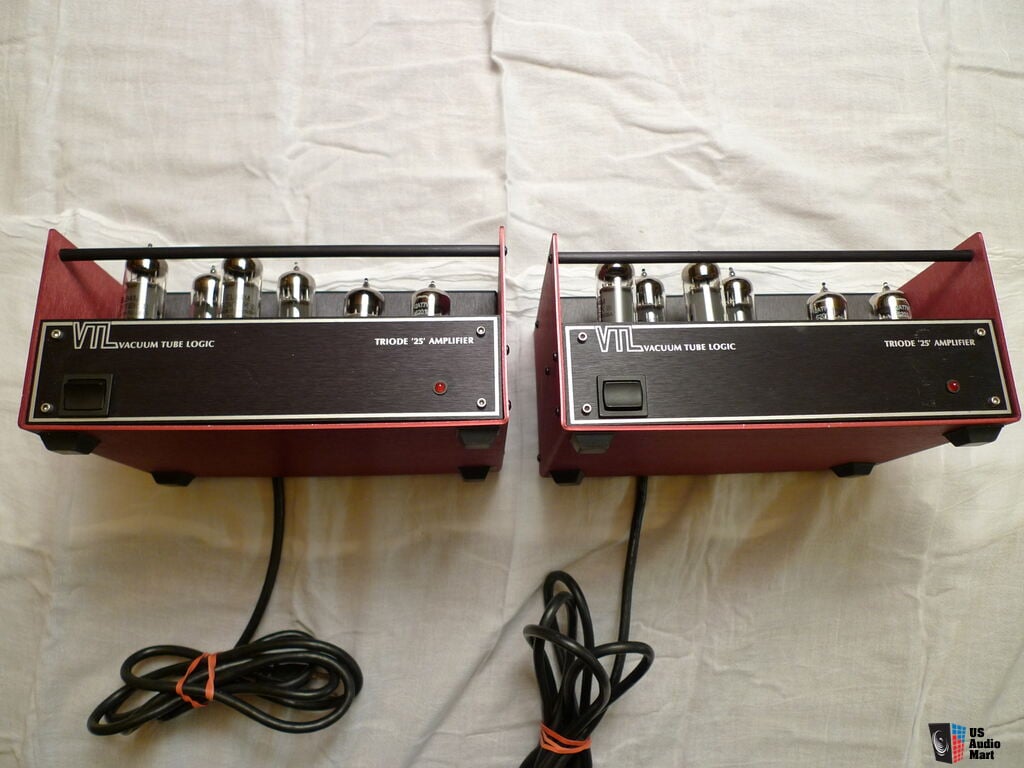
What's next? Joe has expressed his interest in a tube amp for the Quad's. After icefox reminded us that his ESL 57 sang with the Manley Tiny Triode 25 (actually recorded here), he is looking. Actually, the Manley was made by VTL, and the original VTL Tiny Triodes (sassy chassis; later uglier silver faceplate hides the tubes) was nicknamed "dice" 骰仔 (for their small size and cuteness) in Hong Kong. Heard them several times - yes, very good. None of the versions would be a wrong buy but the earliest red ones are the prettiest and cheapest. These are triode connected but I think vintage Pentode PP can be excellent too. Two favorites are Eico HF-86 and Dynaco ST-35.

Top, ANUK M8, Quad DMP; Bottom, Quad 50E flanking Elite QMP, Micromega on top.
REL with low level input
I hope Joe gets a pair of these for Christmas present
VTL Tiny Triode 25 Amp Original Version Red Finish
The transformers that came with Joe's 50E's are smaller than the originals

Surgery (R) and Final Result (L)

16 July, 2020

Graaf GM200 GM20 Modena OTL Quad ESL 63


Click pic to enlarge. Quad ESL-63 on stands; Graaf GM200 on stool, connected with Nordost Speaker Cables; above, pair of GM20 Modena Monoblocks with black coverings, next to which Marantz 10B Tuner; beneath Marantz is Luminous Audio Passive Control.

Virtual Home Visits (9): Quad ESL, Graaf OTL

The Perfect Gentleman
This photo came by accident. When Jules (Visit 8) sent his photo to me, he included this one, which briefly threw me off. It turned out to be a more recent picture of the home of dkyyu, which I had visited a few times before. dkyyu is a perfect gentleman and a generous man (come to think of it, don't you think the majority of audiophiles, of any nationality, are really nice people?). I took the liberty of using this photo, just to say hello to him! dkyyu is also a precious tea collector and an LP collector.

Researching this blog, I was surprised that I had actually recorded a visit to dkyyu more than 10 years ago!!! I forgot about it! It is still a good read, and relevant to this article! :-) That makes me happy. I have visited him after that, but did not write about it, so please say hello to LeeHC and big Lau for me too! I miss you all!

dkyyu's living room can be considered reasonably sized in HK. He is a die-hard vintage Quad ESL fan, owner of the iconic ESL-57 and ESL-63. There is a crazy gang of vintage ESL users in HK; some members even do DIY repairs (HK is very humid, and almost all ESL's go bad). Some of their exploits can be seen here (pics galore).

ESL users naturally gravitate to OTL (the theoretical high impedance matching thing). That is one of the reasons (but no the only one) why I have heard many Graaf's in HK. This Modena (home of the 3 i's of race cars) manufacturer is not well known in the US. This is understandable, as North American homes on the average are much larger and OTL, being a low-powered and impedance matching oddball, is a niche; and the US also has its own Atmasphere and Transcendent Sound. On the other hand, in places like the UK, Europe and Hong Kong, listening quarters are small and Graaf would be more suitable. In the HK market, any Graaf that shows up is lapped up quickly; in NA, I think it'd be like hunting for hen's teeth. Graaf's official websites have not been updated for a few years but can still be read (old one has more info, "new one" less so). If readers know if they are defunct or not, please let me know. Where are you, "Giacomo Bello" (come to think of it, can you email me?)?

OTL in General My own experience with OTL is summarized here in an Overview.

Graaf GM 20
Graaf's most commonly seen OTL amp is the GM20 (this review is probably by Ken Kessler of HiFi News). Employing 4 x 6C33, it puts out 20 watts. It is a great amp, and not just with ESL. Yes, I have heard it with vintage Quad ESL, like at dkyyu's place, to good effect. But, keep in mind, I understand what's good about ESL, but am not an exact fan of vintage ESL, as they image low and have no power envelope to speak of for this classical symphonic listener. In my opinion, for vintage ESL, elevation and addition of subwoofer is a must. I'd actually prefer my lowly low-level Martin Logan Source (here, and there are many after that pilot, just search; second-hand price is probably a few hundred dollars). But I notice that dkyyu now has a subwoofer! If my memory serves me, my previous visits were without, and that is a big step forward by my thinking! In terms of average,based on what I heard in HK, I actually prefer the sound of my friend relax173's Graaf + B and W Nautilus 804. So, OTL can work well with other lower impedance loudspeakers as well.

Graaf Modena Monoblocks 
These are special monoblock editions of the GM20, and highly coveted. The sound is excellent, just like the GM20, with a little more power. Should you be interested, this past sales ad has a lot of great pics.

Graaf GM 200
Judging by the looks and the "magic eye" tubes, dkyyu's ' "newest" acquisition, which I have not heard, is the GM 200, 10x the power of the GM20! This was reviewed by Ken Kessler in HiFi News and Stereophile. A whopping 42 tubes, and in ultra-hot sub-tropical (misnomer; I think the difference between sub- and tropical is disappearing) HK! While I admire the fanaticism, I cannot really take this to heart. I am sure it sounds great, but the energy cost! I'll take the GM20 myself, thank you. What I am saying is, no matter what the power, vintage ESL is highly limited in dynamics - there is a reason why SME's Alistair Richardosn employed stacked pairs! For me, the current Quad offerings (28' and 29' series) are more dynamic and suitable (though I shall still opt for Martin Logan).

Thank you Jules, and dkyyu! You both have enhanced my audio experience so much. I am grateful that I have you as friends.

15 July, 2020

Happenings Hank Jones Baldwin Electric Harpsichord

Click pics to enlarge. Technics SL-1200 Mk II upper right; LP atop Schiit Valhalla, Naim NAC 42, Artemis Labs LA-1.

New York Diary (20-21): The Baldwin Electric Harpsichord

This beat-up and somewhat musty smelling Impulse LP, which I found in a dollar bin, is a personal favorite. It is a star-studded big band production in brilliant sound. But my fondness for it is because here the great pianist Hank Jones plays the Baldwin Electric Harpsichord in 7 of 11 tracks. Even jazz lovers may not have heard of this instrument.

This instrument was ahead of its times, though of course forgotten now. Today's electric keyboard can produce any sound in a much smaller enclosure. This FANTASTIC NMC link. tells you everything about the Baldwin.

This album was emphatically not well received by critics. Allmusic gave it 2 out of  5 stars! But if you look at reviews of actual listeners (e.g. discogs, Amazon) most love it as I do. Apparently, rock and pop musicians took to it a lot more. From the quoted NMC link:

"...Among the most recognizable albums and compositions to feature this instrument include: The Beatles’ “Because” (performed by George Martin) from Abbey Road of 1969; The Beach Boys’ “God Only Knows”, “I Just Wasn’t Made for These Times”, and “Caroline, No” from Pet Sounds of 1966 and “Wonderful” from Smile of 1967; Simon & Garfunkel’s “Scarborough Fair” from Parsley, Sage, Rosemary and Thyme of 1966; The Doors’ “Love Me Two Times” from Strange Days of 1967; James Taylor’s “Taking It In” from James Taylor of 1968; Grateful Dead’s “Mountains of the Moon” from Aoxomoxoa of 1969; Nick Drake’s “Fly” from Bryter Layter of 1970; Van Morrison’s “Cypress Avenue” from Astral Weeks of 1968; Donovan’s “Hampstead Incident” from Mellow Yellow of 1967; and, The Kinks’ “Two Sisters” from Something Else By The Kinks of 1967. The instrument was also featured in the opening theme to The Addams Family (1964), and in the film score to The Odd Couple (1968)..."


That's a lot of songs we know well! Now, where is my Abbey Road album?

The reason why it fascinates me is: the instrument is to the fore during Jones' solo's (unlike the cameo ways it is used in pop). The reason I include the part of the liner notes is because I don't think it tells everything. As a classical listener, it is important to say that the term "electric harpischord" is misleading. As the note says, the instrument can produce different keyboard sounds. And Hank Jones made the most of it. Sometimes it sounds like the harpsichord, other times it sounds like the clavichord (even fortepiano as the Baldwin does have a pedal) or the dulcimer. The clavichord is at least as old as the harpichord, which transits through the fortepiano to piano.

I urge you to stream this album in its entirety. I just played it on my Technics which fed into Naim NAC 42 and Akitika GT-102. It swings, critics be damned!

pic of actual item that was sold

14 July, 2020

BBC LS5/1A Western Electric 124 Conrad Johnson Premier 7 Soundsales AM 8/1 Jorgen Schou No. 251


Click all pics to enlarge. Many more pics with captions at bottom. jules' living room is small, but the sound with the LS5/1A is big!

Virtual Home Visits (8): BBC LS5/1A, Western Electric 124, Conrad Johnson Premier 7, Soundsales AM 8/1, Jorgen Schou No. 251, and other goodies

Editor: I have known Jules for over 25 years. Jules is an engineer involved in a lot of Hong Kong development projects, quite a busy man! With two kids, I have no idea how he finds the energy to acquire so many audio classics. Jules is also a classical music fanatic and still buys CDs regularly in addition to streaming via bluetooth.

Regular readers will recognize him as a frequent host of our HK home visits. Truth to tell, by the end of my stay in HK, I was not that keen on home visits, except when there are rare gears to be heard, and jules surely gave us several surprises. In particular, I urge you to read my last visit, a mammoth but informative article about more than the RARE LS5/1A and jules' Reel-to-Reel setup; in that article you will also earn how a CD Transport and DAC can drastically degrade the sound (The visit before that is also a good read as it reported on how a "respectable" modern loudspeaker got trampled by a vintage one).

At the end, I shall write some Footnotes.

Not surprisingly with Jules, equipment has changed quite a bit!

Analog: Garrard 301 with 2 arms - SME 3012s1/Ortofon SPU AE/Jorgen Schou step up and Decca arm/Decca mk2 [Editor: see Footnote 1]
CD transport: Forsell Air Bearing Reference Mk2
Bluetooth: Cheapie from Taobao
DAC: Totaldac D12 dac
R2R: Studer A807 and Telefunken M21
Phonoamps:-Built-in Phono of CJ P7 (below) or Diatonic Precision DP10 (solid state, HK brand) [Editor: see Footnote 2]
Preamp: Conrad Johnson Premier 7 [Editor: see Footnote 2]
Power amp: Western Electric 124 or Soundsales AM 8/1 [Editor: see Footnote 3]
Speakers: KEF LS5/1a

It's too bad I cannot be there!

Editor's Footnotes: 

  • 1) For better pics of this and other Decca cartridges, see my home visit to Kevin, another Decca arm/cartridge user, here. The Step-Up Transformer uses the rare vintage Jorgen Schou No. 251 that is supposedly a perfect match for some SPU's.
  • 2) Having heard so many CJ preamps (and used the PV10), the only one that attracts me is the P7, which I have not heard. This is a classic (read J Gordon Holt's stereophile article for details), and I am particularly interested in its use of 6GK5 which is also used in my Melos 222. Jules and I listen in much the same way and we both agree that the CJ P2 and P3, so prevalent in my NYC circle, are just too sluggish sounding. Jules said the P7 is more neutral sounding, and he prefers its tubed phonostage's dynamic bloom to the HK brand's solid state.
  • 3) WE 124 needs no introduction and has appeared in this blog many times. Unless you are from the UK, you'd not have heard of Soundsales. This vintage amp maker was associated with the BBC. If you google "Soundsales AM 8/1" you find almost nothing in writing, but if you switch to image search, there are a lot of pics, many originating from HK. Apparently, there is a cult following. I asked Raymond what's the difference between the Soundsales and the WE, which is much more expensive as they are tubed with WE tubes, he said:" ...124 聲音更多內在變化起伏,絕不拖泥帶水,節奏明快,而高中音帶有西電 DNA 的 吸引力。雖然 8/1 輸出比 124 大一倍,但聽感上 124 的驅動力更強更豐富...." the WE 124 is superior in microdynamics and rhythm and pace, and its treble and midrange of course has the mesmerizing quality unique to the WE DNA. Although the power of the Soundsales is supposedly twice that of the WE, subjectively the WE 124 is grander and more effortless in its drive..." There! As I expected.

Garrard 301; Decca Arm/Cartridge in the back; SME 3012/SPU in front
Jorgen Schou Step Up Transformers
Forsell on top, multibox Totaldac below
Studer R2R
From top to bottom: SS Phonoamp, PSU and Dual Chassis of CJ
WE 124 and vintage Step Down Transformer
Telefunken R2R
Soundsales AM 8/1 (pic from the net)
Rare Pair Of BBC Vintage Sound Sales Tube Power Amp AM8/1 | eBay

12 July, 2020

Horns Jensen 302 201 P15LL103 Fountek General Radio 1450TA Altec 808 Fostex T90A


Click pics to enlarge. Tri-amped Altec System. L, from top: TT, Conuterpoint, Electronic Crossover x 2, ASL. R, from top: Passive Pre, Puresound, Adcom, Raphaelite, Adcom.

Virtual Home Visit (7): Dual (Duel) Horn Systems

Editor: BenYC is one of the gentlest souls that I have had the pleasure of knowing. Always willing to lend a hand, Ben has been very kind to me. He is a very experienced audiophile; just a casual look at his equipment will tell you that. Ben also had my ferrite La Scala for a while before he evolved into the Jensen's and Altec's. Although we probably listen in different ways, there is one thing that now we share: we both listen to the low-res streamed music - Ben to his YouTube and I to NML or Spotify. We just love to explore music. For Ben, this comes in the wee hours, after a day of working and cooking (he's an excellent cook) and tending to his three kids; he then is free to listen at low volume or with his desktop system - his private hour. I am sure a lot of readers can relay. Ben plays the violin.

It was more than 10 years ago that I wrote up BenYC in a Home Visit. I had visited him several times after that but didn't report on it. Note that the equipment haven't changed that much. How does BenYC describe the sound of his systems? "...All are old gears that no one wants.  They sound like a mini-hifi that can play a bit louder..." But, don't you believe him...

BenYC's Living and Dining Rooms are conjoined in an L-shape. Top pic shows the Dining Room System, which is kind of his main system.

CD transport - Puremusic MU20
DAC - Adcom 600
Turntable: Nottingham ?
Phono - Counterpoint 5.1 + Raphaelite SUT
CD Passive Pre - General Radio 1450TA (RCA 11713 Transformers in out)
Crossover and input selector - Ashly SP4.8 x 2
Treble - Raphaelite 6L6 SE to Jensen 103 + Fostex T90A
Mid - Sun Audio 45 SE to Altec 808 + 511
Bass - Antique Sound Lab 6L6 PP to Jensen P15LL
Sub - MJ Acoustics Ref 100 x 2

The system below is the second system, located in the Living Room by the Door.


Top Shelf: Ampex,  Raphaelite behind amp on left, Sun Audio behind amp on right, Electronic Crossovers stacked behind Center Speaker. Middle: Parasound and Passive Pre. Lower: PS Audio. See also right pic and pic below.

CD Transport - PS Audio Lambda
DAC - Parasound 1600
Passive Pre - General Radio 1450TA (RCA11713 transformers in out)
Crossover - Ashly SP4.8 x 2
Treble - Raphaelite 6V6 to Jensen 302 + Fountek NeoCD2.0
Mid - Sun Audio 6V6 SE to Jensen 201
Bass - Ampex 6L6 PP to Jensen P15LL
Sub - Sunfire HRS12

BenYC also has a lot of stuff on his desktop, but that is enough for now!

10 July, 2020

TAD 3401 Kondo M7 Ongaku 47 Labs Gaincard


Click pics to enlarge. TAD 3401 flanking Kondo M7 + Ongaku. Seng is a classical music man, and his wife is a bookworm. Even without children, their rooms are filled to the brim. 

Virtual Home Visits (6): TAD 3401, Kondo, 47 Labs revisited by Seng

Editor's Note: Regular readers shall remember my Hong Kong friend Seng, whom I featured in Home Visits many times. Before I left HK I consigned  to him my most treasured stuff, including a pair of the TAD 3401. The initial setup was reported here, and I urge you to read it as you will see the rest of the room as well as even more equipment. The following are his words.

When the speaker first came to the house, it was placed in the adjacent side of the living room (refer to link above) which was really too confined a space for such large speakers. I then moved them to the wider side of the room and the sound stage was much improved.

Before the Ongaku, I was using the 47 Labs Gaincard with the Kondo M7. Daniel [Ed: see Footnote 1] has come and listened to the system. He commented that the system sounded very direct and particularly good in playing jazz, the only weakness being the lack of micro-dynamics.

After switching to the Ongaku (I know it may not be a fair comparison), I understood what he meant. The sound of Teresa Teng became sweet and attractive. Before that, I did not find anything special about her vinyl. Now, I know why people like her so much [Ed: see Footnote 2].

Editor's Footnotes: 1) Daniel, aka Danz, is Seng's brother-in-law. More than 10 years ago he contacted me about Tannoy (I wrote a lot about Tannoy in the HK forum r33) and I have featured him regularly in my Home visits. Those are among the most interesting of my posts, and it chronicled his whole journey; should you be interested you can read everything by entering the word "danz" in the blog search (top left). A few highlights: here for my first visit with Tannoy Canterbury; here for his Wavac; and here for his Tannoy Kingdom. I met Seng through him. 2) I was in my early teens when I first watched a very young Teresa Teng on Hong Kong TV (our TV set was black and white). Due to her popularity in China when the country was opening up, generations of Chinese knew her songs by heart. In the mid-eighties, when there was an intelligentsia of Chinese artists and writers in NYC (most returned to China), I held parties for them sometimes at my home. I only have to play Teresa Tang (on my Dahlquist DQ-10's) and everybody would get up and do ballroom dancing (very popular in China then). For me, Teng is the best Chinese singer ever (I am a native mandarin speaker, whereas most HK people speak Cantonese and tend to gravitate to Cantopop). Her voice is sweet and there is an artlessness in her approach. Many of her songs are covered by female wannabe's, but no one can surpass her. Below I attach the youtube of one of my favorites, "sea tune", which is among the least covered because no one can approach it her way. 

09 July, 2020

Spendor 3/5R2 Review

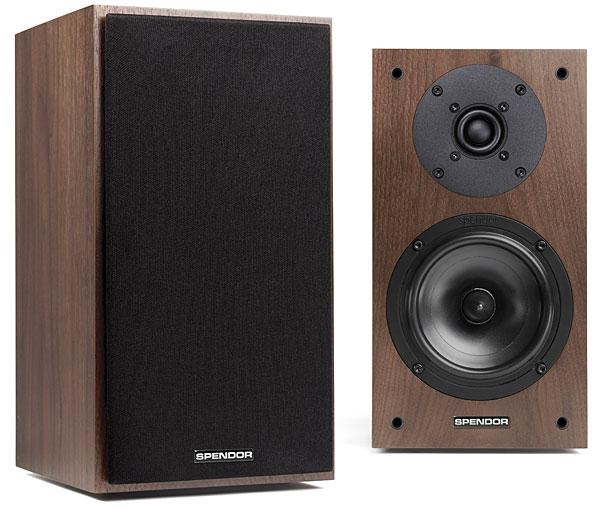
Click pics to enlarge. Left pic from Stereophile of the S3/5R2 but Vivek's later sample has a diameter 1 cm larger. See his text.

Letter from India (1): Spendor S3/5R2 by Vivek R

Editor: We met Vivek R only recently in a Virtual Home Visit. He recently bought this and emailed me this mini-review, which he posted in India's hifivision. Now, as discussed in the previous home visit, Vivek has a particular interest in BBC derived loudspeakers.

Vivek is a very cultured person, works in the finance sector, and a is a music fanatic. His wife is a journalist as well as an author of children's books. Based in Mumbai, they met in the US!

I bit the bullet and bought a Spendor S3/5R2. Creating a separate post for this as it has no comparisons with others of it’s ilk. Of course I have heard the lovely Graham 3/5 and Harbeth P3ESR in altogether different rooms and front ends - so there is no comparison to make.

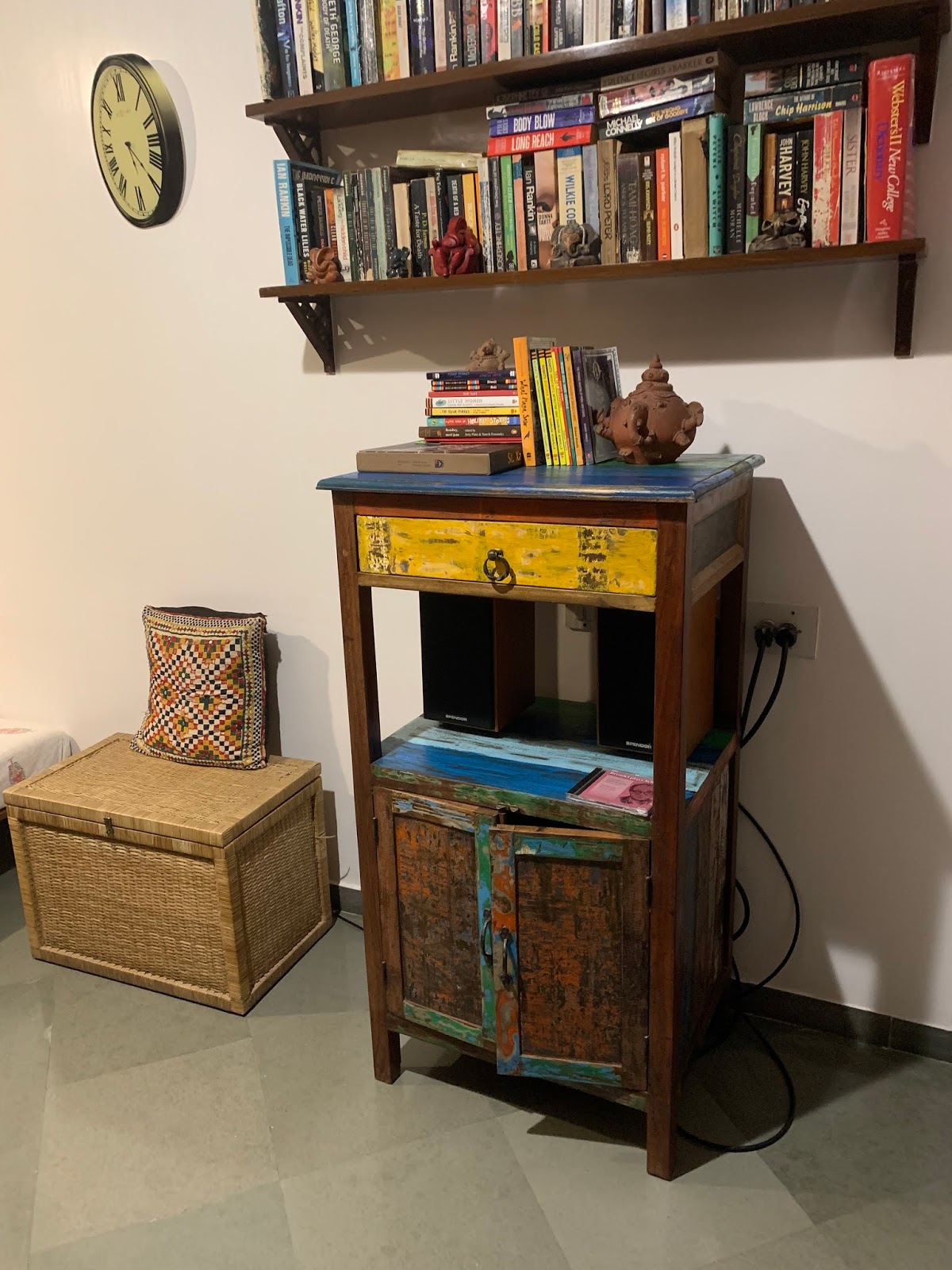
It is for my bedroom and against the wall and it is not even on stands - in a shelf (and like a scene from the Gladiator “kill kill kill” the audiophiles scream)[Editor: see right pic, click to enlarge. Vivek's wife's children books are on top surface]. And it is magnificent for my purposes. And lighter on the pocket too.

Sound Midrange to die for and amazing vocals. Highs without fatigue. But that you knew, right?

And bass that works well with much of rock, jazz, (you hear it, you wont feel it and not much texture), classical as long as it is not complex -e.g. with Schoenberg’s Pelleas and Mellisande, those raw emotions of love, jealousy and betrayal get a bit miniaturised. Play Kendrick Lamar and the vocals are amazing but the deep bass goes “dok-dok-dok” as opposed to “dunnng dunngg” with the Graham even - you get the drift.

Play a string quartet and it sings.

I am really enjoying this and suspect it is a keeper and not honeymoon period. Only time will tell. I am using the Clones 55pm and Elekit 8500 pre.

I googled like a maniac before I bought this and think will put in what I learned for the sake of others.

1. This is 165wx190 depth. Exactly BBC LS 3/5a turned by 90 degrees. So this is a narrower baffle - some feel it does not float voices (see stereophile review of the 3/5se - thank you my friend DJ for pointing it out), but there is one difference in specs with the R2 - see later. Don’t know if it makes a difference sonically. I have no complaints though.

2. The S3/5R2 come in 2 versions. Ones that have serial number starting 206 have a 14 cm woofer [Editor: like the pair reviewed by Stereophile] and the later 236 with a 15 cm woofer. I could not find a review comparing the two. I got the 236 version.

3. This 236 series has the same dimension of woofer as the Spendor classic S3/5. That latter version (now discontinued) has apparently better quality parts. I could not find any comparisons, but I gather that under real life conditions they are pretty similar.

4. The new and the more expensive 4/5 is reverting back to the wide baffle format. It is positioned closer to the other ones like Graham, Harbeth etc. Likely a big difference.

Classical CD/SACD Recommendations

Classical Music Recommendations

Editor: These all came from the Music Side Bar. Every so often I collate them to be preserved. Due to space limitations, no pics and small fonts.

CD


Two Great Recitals Amy Yang Like most UK Classical magazines, MusicwebInternational tends to over-praise, but if not for them I'd never have heard these two wonderful young pianists. Amy Yang is the better known but this is her first solo CD, and it is wonderful. I don't easily take to Schumann's piano music unless it is a great performance and it certainly is here. Beautifully done. Tony Chen Lin is very young and even more obscure. His album by coincidence has so much in common with Yang's. Both feature a Bach work and a major Schumann work. Both include new music. Lin's Bartok Sonata I also find lovely, especially the last movement. I like his way with Bach even more than than Yang's more opulent ways. Both of these discs require concentration on the part of the listener to appreciate the subtleties on offer. Both form a complete recital. Both can be streamed on Spotify.


Top Drawer Prokofiev I have heard and recommended many versions before, but this one still stuns me: 1) the totally appropriate gritty playing by the excellent violinist; 2) transcendental recording quality and a beautiful balance. Relished from the first to the last notes. Unbeatable. If you enjoy this, check out the equally outstanding Prokofiev Violin Sonatas by this same soloist.


What Flair! Biber Mystery Sonatas I am a great fan of Biber's Violin Music, and the Mystery Sonatas comprise his greatest achievements. This echt-dramatic performance is top drawer. I wanted to list it as "This Round's Pick" but refrained. Why? Because it is recorded in a quite reverberant acoustic that not all will like.
A Landmark Shostakovich Box from New Names Wonders never cease! I have heard so many cycles that it will take quite something to make me jump out of my seat. Yet the first disc in this box did precisely that. The conducting is sure and exciting, and different! And the orchestra plays with fantastic color that are missing from even top bands. Recordings are superb too! What's not to like? Exorbitant price for the CD set! Better listen on Spotify!
Tianwa Yang makes us Listen Anew This disc has smaller works in addition to better known ones like the Havanaise and Introduction and Rondo Cappricioso. The familar works sound utterly fresh. Delectable! If you like this, there is more on a companion Naxos disc!

Young Artist: Camille Thomas A couple of years ago I liked her recital on Fugera Libera and remembered the name. Imagine my surprise when I found out that she's recording for DG (good albums) but this earlier one is even better, with a beautiful Ysaye solo sonata, rarely heard. France has more than its share of excellent cellists. Usually they are bright toned and incisive, but Franco-Belgian Thomas is different, very smooth and rich toned. Great taste. Note that since 2019, she has been playing the famous Hubermann cello.


Young Artists: Esme Quartet These 4 young Korean ladies have everything, looks, technique...They have been friends since childhood and it shows in the blend. Adventurous program centered on a work by Korean composer Unsuk Chin, but the Beethoven is well done too.


The Great Monteverdi This is probably the crowning masterpiece of this master. This version has expressive, even majestic, singing and playing. Best listened to as you start your day. I was going to just sample a few tracks but ended up listening to a lot more.


Walton Symphony No. 1 This is an exciting early work of Walton. The benchmark has always been Andre Previn/LSO. This reading is very different but really excellent. Crank it up!


Suave Handel I have always liked Handel's Violin Sonatas. These are performed with both harpsichord and cello as continuo, which yields a fuller sound than some rivals. Stylish playing.


Juxtaposing the Old and the New Refreshingly different solo violin recital pitting 17th century works against modern ones. The violin sound is especially beautiful.


Berio Berio and Stockhausen are the modern composers that influenced rock musicians. Berio's Sinfonia is likely THE most iconic piece of modern music. Make sure you read the link for the Mahler context.


Weinberg from a hot new female conductor This is a challenging one. Weinberg, Shostakovich's friend, is less sardonic and more measured, and his symphonies require tremendous concentration to listen to. This issue has the best orchestras to do him justice, all under a dynamic conductor. The two here bracket Weinberg's life. The 21st is a hugely long work, and requires as much concentration as when listening to Mahler, Bruckner, but its language is not far from late Shostakovich (like my favorite, and enigmatic, N0.15). The conductor even does a vocalise in the last movement. Exceptional!


Poised Tchaikovsky from Rolston String Quartet Yet another new name delivers an incredibly blended sound in 2 Tchaikovsky masterpieces. The Andante Cantabile in the Quartet No. 1 is justly famous and lovely here. Wiki it to learn of how Tolstoy and Helen Keller reacted to it.


A Favorite Violinist Antje Weithaas is a violinist's violinist who sounds exactly the same in concert (I had the fortune of hearing her in Shenzhen). I streamed almost all of her albums and there is not a loser in the lot. This one has an unusual coupling and both works were performed wonderfully.


Lean and mean period style Mozart I find these performances of the last 2 symphonies very exciting!


The Indefatigable Meredith Monk Everyone knows Thelonious but to New Yorkers there is another Monk, Meredith that is. She has been a fixture of NY's Avant Garde for Decades. Her music is minimalist, vocal oriented and incorporates speech and improvisations, frequently in multimedia presentations. Bang on A Can is of course NYC's (and the Nation's) Foremost New Music Ensemble. Refreshingly different. This is on Spotify too.

Two by Vasks What is it with these Baltic States? They produce excellent musicians and composers like Arvo Part and Peteris Vasks. Sample these 2 Vasks discs to see if you like this style. The Violin Concerto is often recorded and on the same label you can find a very recent SACD version by Vadim Gluzman, but somehow I like this one more. Thoroughly committed performances. And this disc presents Vasks' chamber works, quite unlike classical works, but equally entrancing.

Undersung Masterpiece When Suk was writing the Asrael Sympony, his wife, Dvorak's daughter and her father both died. The grief is written on the page and is extremely moving to me. Regrettably, this is rarely played in concert. If you like this one, sample the equally powerful one by Flor and the Malaysian Philharmonic on a splendid BIS SACD (I have recommended that one before).

Cello Bonbons Just like the linked review, I was surprised by the quality of the playing and sound. This cellist was member of the famous Arditti Quartet, who played almost exclusively modern music. Hard to imagine him playing these chestnuts but hearing is believing.

A Spectacular Debut The young violinist is now concertmaster of the great Staatskapelle Berlin. These 2 works are not quite mainstream but they receive definitive performances here that elevate their status. The orchestral contribution is sterling.

More New Names in two less travailed Violin Concertos This is brand new on NML, and there is not a single review. The Stravinsky is a personal favorite, and I have heard the Corigliano before (orignated from his film score). Refreshing and taut performances that were just perfect with my cup of coffee! Excellent sound

Less Known Shostakovich I have long loved Shostakovich's Film Music. But this issue is different in that it is played by a chamber orchestra with great incisiveness. Exciting and in excellent sound. Make sure you read the review.

It Takes New Names to Tango Piazolla All the musicians are new to me, yet the performances are dynamite, much better than Gidon Kremer's recordings (he popularized Piazolla among classical lovers but I always thought he didn't have that primal emergy). Recording is appropriately up close. Piazolla's Seasons contain quotes of Vivaldi, and Schnittke's piece quotes Mozart and Haydn. This is not my favorite Piazolla piece but when done so well it is immensely satisfying. These musicians shall be on my radar from now on. Read the link for more info.

Transfigured Isabelle Faust Schoenberg's Transfigured Night here is its sextet version, and played beautifully by the star-studded lineup. But what is REALLY transfigured here is the notoriously difficult and acerbic, even aseptic, violin concerto. It is still challenging listening, but there is great beauty in it. Best recording I have ever heard and a sonic spectacular.

Symphonie Fantastique! A period instrument version of Berlioz' masterpiece. Exciting, as always from Les Siecles under Xavier-Roth. There is another good period version by Immerseel on Zig Zag. If you like this performance, you may want to investigate the same forces' Harold in Italy, my next favorite Berlioz work. Magnificent sound, as usual from this label.

Mozart's Most Popular The two concertos are Mozart's most popular and often played works. The pianism of Bavouzet is fresh, as one can expect of this excellent artist. Icing on the cake is the thoroughly engaged conducting of and orchestral support. It should be noted the conductor is a founding member of the renowned quartet that bears his name.

Great Bach from Concerto Italiano
 They are one of the best baroque music groups and every one of their recordings are worth hearing. Actually I like their Brandenburg Concertos even better, but they are out of print, though you can download or stream.

More Joyous Bach from unsung forces
 When I was younger I listened to a lot of Bach Cantatas. Somehow as audio grew that was lost. But I just streamed this one and it was joyful from start to finish.

Chiaroscuro from Volodos That's the word one critic (click link) used aptly to describe the incredible pianism of Volodos. Old-timers like I will find the reading of one of Schubert's greatest works wayward, but there's no denying the pianism. Make sure you are focused and not doing anything else when listening. Better at night!
Yang Tianwa, Master Violinist Ever since I heard the first volume of her Naxos Sarasate series, I have become a die-hard fan and follower. I have heard her several times in HK. She is tha real thing; whatever she plays, there is no sense of struggle and a natural and musical demeanor. In my opinion, she is the best Chinese violinist, and completely home grown too. It took her a while to get to Brahms, but this CD does her justice. Wit is also a favorite conductor and does a great job here. The recording is good but misses the best, but her playing is tops, better than most others in even better sounding recordings.
Brahms String Quartets and Piano Quintet This issue by my favorite Belcea Quartet outshines even the Emerson I wrote about not so long ago. My top choice now of these very difficult works (I mean the string quartets; the piano quintet is more easily assimilated) that I am growing more and more fond of.
Dvorak American Quartet and Quintet There is nothing like a top Czech quartet playing music they own, and so it proves here with the top-notch Skampa Quartet. Resplendent sound that is superior to the also good Pavel Haas Quartet on Supraphon. This goes to the top.
Martinu Violin Concerto No. 2 I am a great Martinu fan, and have heard most of the Supraphon and Hyperion series, but this one, by one of my favorite violinists, Isabelle Faust, goes to the top. The coupled works are just as delightful.
Bach on the Piano Finally I get to catch up with the excellent pianist Rafal Blechacz's earlier Bach album, which is so clear and good, even better than his Chopin!
Bach Viola da Gamba Sonatas I love the rich sound of the Gamba here. The playing of Marianne Muller and Francoise Lengelle are fluid and time flies by easily.
Light over Darkness When it comes to expressing grief, few can equal Shostakovich, except perhaps Schnittke. This CD pairs the mournful Piano Quintet with an elegiac piece by Kancheli in electrifying performances by the Lutoslawski Quartet and pianist Erato Alakiozidou. See also below for Shostakovich's counterpart.
Shostakovich Piano Quintet and Quartet No. 3 A great Piano Quintet played with rarefied feelings, with a great coupling. Belcea Quartet strikes again.
Shostakovich Trios and Viola Sonata Surprisingly ardent performances, especially of the early First Trio. Excellent playing by all, but the subtle violin playing of Philharmonia concertmaster Visontay deserves special mention.
Art of the Fugue (for String Quartet) This long piece is one of my favorite Bach, and I prefer it in non-keyboard string/chamber version. My benchmark has always been the starkly magnificent Musica Antiqua Koln, but the Delian Quartet's more dancing version is just as good, and most people will likely prefer the less sombre view. Excellent and a new standard for string quartet versions!
Lyrical Schubert Trio No. 2 Previously I have heard the Trio Wanderer in many German works and I found them fluid but lacking a little in gravitas. Not so in Schubert, where they have the perfect blend of lyricism and feelings. Sample the transcendental slow movement of the Op. 100. The E Flat Trio is hard to get right and has eluded many more famous ensembles, and somewhat less popular than its predecessor, the Op. 99, B Flat.
Debussy and Poulenc Cello Music The elusive Debussy Cello Sonata and the even less played Poulenc cello works receive definitive treatments by the excellent cellist Jean-Guihen Queyras. Superb sound and the many technical effects on the cello are likely to please the audiophile.
Bach Goldberg Variations (for String Quartet) This masterful arrangement by the Quartet Ardeo is utterly beguilingly played, much more vibrant than the better known Sitkovetsky string trio arrangement. This shoots to the top.

SACD 

Elfa Run Kristinsdottir I LOVE the cover art, but even more the playing of yet another young violinist. This is done at breakneck speed but I don't feel breathless! Note that only the double violin concert is one for the violin, the other 2 are better known as harpsichord concertos, but you would not know it when listening. The good thing is if you have the regular 3 concertos, there would not be too much duplication. Catch up with her equally excellent solo Bach on Spotify!

Grieg and Sibelius Quartets are not as mainstream as Beethoven and Shostakovich, but they are special and here performed beautifully by this Norwegian group previously unknown to me. If you like it, their Mozart and Schumann Albums are equally accomplished


Saariaho Ever since I first heard her electronic music, I have followed this iconic composer. Here is a wonderful compilation, better than any ECM new age stuff (a few of her works are available on that label too). This is hip.


The Power of Youth Mendelssohn's Octet, a youthful work, is one of a kind and this performance is sheer exhilaration. The coupling though may not be to everyone's liking.


Fresh Mozart Many established violinists fail to make Mozart flow, but this young lady sure did! The orchestra is wonderful too.


Czech Master Ever since I heard him live with the NYPO I became a Jacub Hrusa fan. His sensitivity is amazing. Now the director of the magnificent but undersung Bamberg Symphony, he is recording for TUDOR. This Smetana is excellent, so are all the other Dvorak releases. Great sound, as usual for this label.


Three from Honeck I have never been really impressed by Reference Recordings, sonically or artistically. Now, at least, they have the fantastic Pittsburgh Symphony under the charismatic Manfred Honeck, who can do no wrong. His Tcahikovsky 4th is a non-hysterical but exciting version of this frenetic work. Ditto the Bruckner 9th. This is my favorite Bruckner Symphony. To me the adagio is the most graphic depiction of the struggles with death and acceptance. My benchmark is the Schuricht/VPO on EMI, but this one shoots to the top along with Abbado/Lucerne on DG. And then this Shostakovich 5th sounds fresh, and that is a miracle for me! This work is so over-programmed that I do not want to hear it in concert! Splendid!


Sensational Dvorak Symphonies 7-9 from Unusual Forces Flor honed the Malaysian Philharmonic into an excellent ensemble. I started with the 9th, then the 8th and 7th. All are excellent and in superb sound, as is usual with this label. You can't go wrong with all three. In fact I urge you to listen to them all. This is from some time back; too bad that country's cultural and political landscape had narrowed. If interested read about what happened to the orchestra by googling for the wiki entry.


St Matthew's Passion An excellent version of the monumental work from Suzuki and Bach Collegium Japan. Unlike many others, it doesn't bog you down. I listened straight through!


Another Goldberg! Fabulous String Trio version to rival my favorite quartet version (Quatour Ardeo). Playing of Zimmermann is just fabulous.


Forgotten Composer Losy is a composer completely new to me. Played by a master lutenist, it is a luxury! Play it while you read the morning news while having coffee! Guaranteed satisfaction.


Prokofiev Violin Concertos Vadim Gluzman has made many good discs for BIS, and these fluid performances from the soloist and orchestra are no exception. Splendid sound, which does the ex-Auer Strad justice.


Historical Recording


Heifetz Live I am very happy I found Music and Arts on NML. This is one of the best Historical Recording Labels around. These Heifetz Concerto recordings are exciting.


Clifford Curzon and Amadeus Quartet Many of the BBC Legends are not quite that, but this one most certainly is. Perfect and in fine sound.