ICL/Softone Model 1 Bias Instructions
27 March, 2022
ICL/Softone Model 1 Bias Instructions 2A3 300B
ICL/Softone Model 1 Bias Instructions
20 March, 2022
Audio road trips & the Metzner Starlight
By mrgoodsound
Since I began collecting vintage audio equipment 3 years ago, my favourite weekend pastime has been driving to far-off places to pick up rare gear. It's an opportunity I take up at least twice a month to clear my head from a heavy week of my day job by cruising the Ontario countryside, meeting new people, and coming home with a new audio toy (or several). This weekend was one of the most interesting excursions yet, taking me to Acton, a small town with a population of under 10,000.
First, a little backstory. I have been collecting vintage turntables in some sort of misguided quest to find 'the one'. Two years ago I made an offer on a Metzner Starlight that popped on eBay. It was grossly overpriced so I did not think my lowball offer (which was still overpaying) would be accepted, but of course it did. I was naive about these sort of things back then and expected things to kind of just work. When it arrived it had a number of issues that I realized would not be easily solved and I put it aside in frustration for a long time. I recently pulled it out of storage to disassemble and clean it, determined to get it working, but disaster struck: I foolishly polished the printing straight off the fascia of the unit.
I was disheartened a second time by this Metzner, and put it aside again. Sure enough another one popped up on eBay, this time the seller was local. I immediately considered bidding, stopped myself, paced back and forth, then decided to only bid at the last second. Of course I won. The seller reached out to me offering local pickup, and that is how I met Pat from Acton, Ontario. More on the Metzner later.
Pat lives on a beautiful 120 acre plot of farmland. The quality of the air in the countryside is different. It allows for calmness and clarity of thought, the benefits of which I immediately lose when driving back to the city. Probably why I make so many stupid audio purchases. I met Pat in his yard and he welcomed me into his garage to look at the turntable. I immediately recognized that I was dealing with another serious enthusiast. His garage had it all: Altec, Ampex, Electrovoice, McCurdy, McIntosh, Northern Electric, Presto, and so on. Classic American and Canadian audio equipment everywhere you looked, much of it professional or studio equipment. Cutting amplifiers, tape machines, an Altec 604 RWB in its original cabinet, multi-cell horns, oh my.There was a lot of equipment I had only read about or seen photos of, and now here it was in the flesh. I asked Pat for a tour to which he obliged. He would point at things and start talking about them only for me to interrupt and name it. 'Yeah, I know, that's a Presto cutting amp.' This was ignored the first few times until he finally turned to me and exclaimed; 'How do you know what that is?'. I could only grin in reply.
Eventually I came out of my daze and entered scavenger mode, asking if he was selling anything else. 'Sure, what are you looking for?'. I mentioned I was looking for a small amplifier, and he pointed to a diminutive tube amplifier sitting on the shelf. At first glance it looked like any Magnavox, RCA or Zenith console amplifier I had seen before. A 12AX7 drove a pair of EL84s for single-ended output. Upon closer inspection, a cool English-made Plessey electrolytic capacitor was spotted, and the output transformers were distinctly un-American. My best guess is the amplifier came from a Canadian console.
I asked Pat to hook it up to make sure it was all working, and then noticed a distinct lack of any turntable set up anywhere. 'Oh yeah, I mostly listen to tapes in here'. No kidding, the walls were lined with tapes, pre-recorded and home-made. A Sony reel-to-reel in the corner was connected to the mystery console amp with some cursing. Pat pulled out a tape for our impromptu listening session. 'Do you like Joan Baez?'. Are you kidding? Do you even have to ask?
In a few moments, Baez was singing Dylan out of two enormous wall-mounted Electrovoice speakers. Her voice was clear, warm and larger than life. I guess if you ever want to audition equipment for someone to purchase, cheat and use a tape source. 'I'll take it'. We spent a while longer talking tonearms and speakers before I thanked Pat for his time and took the Metzner and amplifier home.
The mystery console amplifier does indeed sound quite good. I can't say I've ever heard an EL84 amp I didn't like. Single-ended ones with vintage iron are especially sweet. Like almost all console amps, this one needs a pre-amp. Its voice is a little too naked and the playback speed a little too quick without one.
Back to the 'star' of our show, the Starlight turntable. It's a rather unique machine, manufactured in the early 1950s in Japan for Robert Metzner of California. Metzner is probably more well known for his other venture of importing Akai reel-to-reel machines to the US and his company Califone who sold tape machines and record players to the educational market. The Starlight uses a direct drive system, in which a motor-driven worm gear interfaces with a series of two discs. The second disc is mounted on the platter shaft and its position may be altered for variable speed control a la Lenco. It's an incredibly simple and effective drive train, similar to the earliest electric gramophones, and unfortunately largely vanished from the marketplace after the 50s. There are a few different revisions of the Starlight with a different top plate and controls, but the basic motor system is the same.
The Starlight has two major problems which make restoration a pain. First, the worm gear has a rubber coating which wears over time and becomes noisy. Voice of Music in the US sells refurbished worm gears. Second, the platter sleeve was made from quite cheap stamped aluminum and is prone to wear, resulting in platter wobble. There is no easy solution here, if the platter sleeve is worn you must have a machinist make you a new one, preferably from bronze or brass. This was the case for my first Starlight, thankfully this new one is much better in that regard and I think the original sleeve can be left.
Other annoying tidbits include a glued-on cork mat which must be scraped off, an integral 45 RPM adapter which must be popped off, and rubber motor grommets which have hardened and must be replaced. I may write a follow-up article on the results when the restoration is done. I am determined to get this player working. Thank you to Pat! See some more of his collection below.
19 March, 2022
Ukranian Classical Composers and Musicians
Letter from Shenzhen (22-5): Ukranian Classical Composers and Musicians, Past and Present
Streaming Classical Music (22-4): Ukranian Classical Music, Past and Present
And now on to more Ukranian Classical Music figures, including those living. Mind you, classical music is greatly politicized now. Unfortunately so.
Composers The “national” school is regarded to have started with Boris Lyatoshynsky, whose career was mostly under Soviet rule (wikipedia). He studied in the Kiev Conservatory under Rheinhold Gliere (also Ukranian; classical fans will likely know of his gargantuan Symphony No. 3, Ilya Mourametz). I had so far streamed his Symphonies No. 2, 3 and 4 (Naxos) and do not regret it. The music is reminiscent of many of his forebearers as well as contemporaries (for more details, see MWI). His Ukranian Quintet is quite satisfying and can be heard on an excellent recent Naxos release, Ukrainian Piano Quintets, recorded in Kiev (2020). I don’t think I shall return to his works often, but I prefer them to his teacher’s works. On the same disc is a work by a much more important composer, his student Valentin Silvestrov, whom I have followed and championed for years. If you don’t know Silvestrov, it’s time you do. Even the great Arvo Part reveres him. I suggest starting with his ECM catalogue and orchestral works, like the Symphonies. His chamber works and songs can be quite sparse for a beginner, but his “simplicity” hides art and, importantly, is never too simple. For these times, you may want to try the substantial and dark Requiem for Larissa (ECM). Incidentally, the last work on the Naxos disc is the Simurgh-Quintet by a name new to me, Victoria Poleva, whose minimalist-modernist style (for lack of a better word; quite different from the much more mechanical Americans) pairs well with Silvestrov’s. I shall definitely stream more of her works soon. A find!
But by far the most prominent Ukrainian composer is Sergei Prokofiev, born in the Donetsk region (now claimed by Russia; mind you 80% of that population want to be with Russia [as with Crimea] rather than the current Ukraine; so many subsets in the new Cold War). Prokofiev needs no mention. One of his minor works is On the Dnieper, the last word being a river that originates in current Russia, that courses through the Ukraine and Belarus and then empties into the Black Sea. BTW, the Donetsk regional airport is named after him!
Justice or Cancel Culture? After what happened to Gergiev and Netrebko (see last post below), I just read (on slippedisc, link above) an indignant Tugan Sokhiev, a good conductor whom I have heard on record and in person many years ago in Sydney as chief of the SSO. He resigned from both the Bolshoi Theater and Orchestre National de Capitole de Toulouse (I consider this a protest against cancel culture). And Currentzis and MusicAeterna (whom I have praised in this blog) was held up for a big European production. And Danielle Gatti, fired from the Concertgebouw for sexual harassment, now is slated to stand in for fired Gergiev. Why un-cancel Gatti when cancelling Gergiev? Is this all correct? You make up your mind, as I have made up mine.
Current Musicians of Ukrainian Origin I am sure I have missed a few. When it comes to pianists, foremost in my mind is the excellent Vadim Kholodenko. And then there are Anna Fedorova and Ukranian-American Alexander Gavrylyuk (who had appeared in HK before). When it comes to violinists, there is the excellent Ukranian-American Oleh Krysa. And then, of course, the excellent Illia Bondarenko, whom I have heard on records befor. Her recent social media (Instagram?) video of her playing a Ukrainian folksong in a basement amid bombing had gone viral. Last, but not least, there is the case of Ukranian-American Valentina Lisitsa, who was a bona fide Ukranian but who has long sided with Russia and who as a result was recently disfavored much in the West. She rose from youtube fame to mainstream artist (with past Decca albums). From what I have heard on records she is an excellent pianist. She has recently signed a contract with the excellent French Naive label and has a concert coming up imminently, on April 8 at the Theatre des Champs-Elysees. Let’s see if she gets cancelled!
Let me finish on a lighter note. Milla Jovovich, an Ukrainian-American best known as an actress, whose works under the great Luc Besson was much more impressive (The Fifth Element; The Messenger: Story of Joan of Arc) than those under Wim Wenders (Million Dollar Hotel and Palermo). Less known is that she’s a musician also.
12 March, 2022
Ukrainian and Russian Stories
Letter from Shenzhen (22-4): Ukrainian and Russian Stories
Ukraine and New York
All real New Yorkers, who pride themselves for their diversity, know more about Russia and the Ukraine than the average US citizen. While the upper class may only know the “Russian” Tearoom adjacent to Carnegie Hall, those who are into different cultures and cuisines know the Russian center is Little Odessa, in Brighton Beach, next to Coney island. For some info of this district, home to the largest Ukranian and Russian (mosty Jewish) diaspora in the West, read this.
When you walk around where I live in NYC, that is Flushing, you would not know that, long before it became Chinatown, it held a large Russian Ukranian Jewish population. Now, only a handful of senior citizens are left of that population. Next to my apartment building is a nursing home, where some of them live. On a sunny day, you will see them sitting on the bench outside, chatting in Russian. A few years ago, there used to be a deli around the block that sells Russian and Polish sausages (like Kielbasa), cured meats and various foods. So I have tasted Russian ham etc. The workers have Asian faces, being Central Asian descendants of ethnic Koreans (Stalin doubted their loyalty and removed them from Eastern Russia an re-settled them in Central Asia). I really miss that shop. The bread and deli counter were infinitely superior to that of the usual American supermarket.
Walking South from where I live, before reaching Jamaica, there is one of NYC’s many Hasidic neighborhoods. The Hasidic movement originated from the Ukraine. BTW, these are anti-vaxxers! Not just for covid, but for everything. Not so long ago, they were responsible for New York’s Measles breakout. For more about Ukranian Jews, there are any number of entries on line (here is one). Their Klezmer music is also sometimes encountered in otherwise classical albums.
Stigmatized Russian Musicians
All NYC classical fans who actually go to concerts (which is most of them, in a city like NYC, brimming with events) know even more. Given the large number of Ukrainian-Americans in NYC, every time Gergiev or Pletnev or Netrebko, allegedly Putin-supporters, appears, you can be sure there is a small protest force outside, especially Carnegie Hall. Today, as casualties of the war (maybe just excuses), Gergiev had been fired from Munich PO, Netrebko had withdrawn all her appearances. Is this just? Read this great post from a German musician (the site has other interesting snippets on Ukraine).
Ukraine in Classical Music
Kiev was made famous musically by Mussorgsky’s Pictures at an Exhibition (as orchestrated by Ravel; others you can safely forget) which concludes with the Great Gate of Kiev (does not exist). The sixth episode depicts two Jews, one poor, one rich - the musical caricature is not exactly flattering. This piece is known to some non-classical listeners through Emerson, Lake and Palmer.
But of much greater relevance, not just a namesake, is Shostakovich’s harrowing Symphony No. 13, Babi Yar, which employed Yevstuchenko’s poem of the same name that is a remembrance of the mass execution of Jews by the Nazi’s outside Kiev. It’s ironic that there are debates about Neo-Nazi’s in the Ukraine now.
Now, as befits a blog that advocates classical music, information about great classical musicians from Ukraine. The list is long - very long. I will only mention past greats, not current musicians, some of whom are on the battle fields now.
Vladimir Horowitz I want to start with him, because his own history, much documented in biographies, reflect the history of Ukraine. BTW, his mono recording of Pictures is legendary. In the 1919 Ukrainian-Russian war, his family lost everything. His elder brother died from the war and his second eldest brother suffered from mental illness and later committed suicide. Young Horowitz had to perform to earn money for the family. In 1921, he met fellow Ukrainian Nathan Milstein, who stayed with the family for 3 years. Horowitz gradually became very famous and as agent for the government played for laborers, factory workers and soldiers. In 1924 Arthur Schnabel discovered him and urged him to emigrate to the US. In 1925, he did, with Milstein, with the unlikely help of Trotsky.
Fellow Ukranian expats include Gregor Piatigorsky, Shura Cherkassky etc. Many musicians with Ukrainian roots stayed in Russia, like David Oistrakh, Leonid Kogan, Emil Gilels, Sviatoslav Richter. Need I say more? In terms of ethnicity, only the last was not Jewish. Those mentioned above are so famous that every classical listener will recognize them. Two lesser known names from the Ukraine are Rotislav Dubinsky, founding member of the great Borodin Quartet, and his wife, under-rated Luba Edlina (the latter born in Kharkiv, now much in the news). They emigrated to Canada and formed, with Yuli Turovsky (also Jewish), my favorite trio, the Borodin Trio (all their Chandos recordings are worthwhile; the latter also directed the estimable I Musici de Montreal, on the same label).
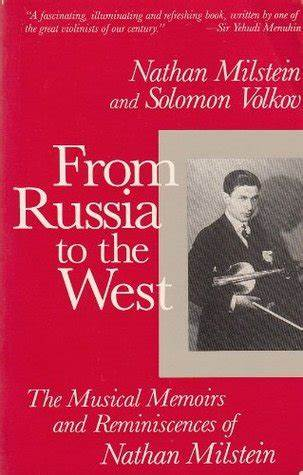
Due to the times they lived in, the memoirs or biographies of some of these great musicians make for gripping reading, but most are oop. I have Nathan Milstein’s oop From Here to the West, and it will make you laugh and cry at the same time. Ditto Rotislav Dubinsky’s Stormy Applause: Making Music in a Worker's State (which I also have, also oop). In the shaded text below are some great pages that I found on the net. Stalin and Prokofiev famously died on the same day and the Borodin Quartet was called to duty, and so was David Oistrakh etc, I assure you reading it is worth your time.
On March 6, 1953, at 5 in the morning, the telephone rang. I picked up the receiver and heard the voice of Yaroslav Alexandrov.
''You know why I'm calling so early. . . .''
''Has the inevitable occurred?''
''Yes. Vice Minister Kholodilin himself called me; they need a quartet. I'll let you know when and where. Be ready. Tails and black tie.''
''I don't have a black one.''
''Get one! Make it yourself. I'll call back.''
Five minutes later, the phone rang again.
''Are you ready? Leave now. We'll meet in the Composers' House, and from there to the Hall of Columns.''
''Why the Composers' House?''
''Oh, you don't know yet. . . . Prokofiev also died. At the same time.''
''What a nightmare.''
''Kholodilin said to bring Tchaikovsky.''
''For whom?''
''Both.''
''That's no good,'' I said. ''Prokofiev didn't like Tchaikovsky.''
''Want to call the Vice Minister yourself?''
He hung up.
The streets were still dark as I passed through side alleys to the Composers' House, where Prokofiev's body lay in its coffin. In the lobby, several composers were standing, smoking. I shook everybody's hand. In the hall, a closed coffin stood alone in the center. A funeral wreath leaned against the piano.
Vice Minister Kholodilin appeared.
''Hurry up!'' he said. ''Where is the quartet? We've got to hurry. It will be difficult to get through the crowds.''
The rest of our quartet, violinist Yaroslav Alexandrov; cellist Valentin Berlinsky, and Rudolf Barshai, our violist, arrived together.
''It's already impossible to get through the center,'' Alexandrov explained. ''We had to go around.''
''Get your instruments ready,'' Kholodilin hurried him. ''What are you playing?''
''You suggested Tchaikovsky.''
''We also have Beethoven,'' I put in.
''Tchaikovsky is good,'' Kholodilin said. ''We'll begin right away.''
The wreath was laid on the coffin. Everyone in the hall, including the workmen, stood silently. Kholodilin gave us a nod, and we began the slow movement from Tchaikovsky's Second Quartet.
We had played about half of the movement when Kholodilin stopped us. ''Enough, fellows. Time to go.''
Moscow's streets were filled with people heading toward the center of the city. At Pushkin Square, we could get no farther. ''There's nothing we can do,'' Kholodilin said. ''I'll call the police.''
We waited a long time. Finally, about 20 policemen, all large men, appeared. The policemen formed a ring around us, firmly linking their arms, stepped back a little and with a running start pushed into the crowd. We moved forward a bit and came to a stop. The three largest policemen drove a wedge into the crowd. The rest rushed behind them, pulling us along.
Several times, we were squeezed by the crowd. We held our instruments tightly to our bodies and swam with the current.
All the side streets were full of people fighting their way into the main stream. There were still a few blocks to go.
The policemen worked twice as hard.
Suddenly, it became quiet. We were brought to the stage entrance of the Hall of Columns. I fell to the floor, exhausted. Kholodilin leaned against the wall, breathing heavily. He wiped his forehead, looked at us and asked, ''Still alive? Then let's go.''
We climbed up the long stairway to the hall. Next to me, holding his chest, walked the composer Mikhail Rauhverger.
''What a misfortune! To think that a week ago we were sitting together at the table.''
''At the table?'' I asked him, amazed. ''How come?''
''At his place. He was showing us his latest composition.''
''Oh, you mean Prokofiev. I thought . . .''
''No, no. Of course, I meant Prokofiev. I wanted to ask you; why did you choose to play Tchaikovsky?
Please understand me, I like Tchaikovsky very much, but Prokofiev. . . . You see, his taste was different.''
''I know,'' I said. ''But we were told what to play.''
''Even at the funeral?''
''At the funeral, before it, and after.''
He smiled. ''Oh, I see.''
The State Orchestra was already seated on the stage with their conductor Alexandr Gauk standing at the podium. More musicians crowded quietly backstage. Kholodilin stood up on a chair and looked around above everybody's heads.
''Where is the quartet?'' he demanded. ''Get on stage. Sit down and watch Gauk. You begin as soon as the State Orchestra finishes, and continue until the Bolshoi Orchestra takes their places. Then I'll tell you what to do next.''
We sat on the corner of the stage. I glanced at Gauk and gave him a slight nod, but he did not respond. A look of horror was fixed in his eyes.
In the center of the hall, surrounded by three rows of guards, Stalin's body lay in an open coffin. From behind a curtain, a group of high-ranking party leaders emerged and proceeded to the coffin. I recognized Vyacheslav Molotov, Lazar Kaganovich, Georgi Malenkov, along with Lavrenti Beria, the chief of police. David Oistrakh walked past us, violin in hand, and stood next to Gauk. Oistrakh raised his violin, Gauk his baton. The hall was filled with the sounds of Tchaikovsky's ''Serenade Melancolique.'' Oistrakh played with a deep expressive tone.
A river of humanity flowed into the hall. There was loud sobbing, cries and howling.
We saw a tall, gray-faced man walk up to Oistrakh.
''Suslov,'' Alexandrov whispered to me, referring to Mikhail Suslov, the leading Soviet ideologue.
Oistrakh, still playing, bent over and was told something. His playing sped up, becoming lighter and less expressive. Suslov returned to the honor guard.
We kept our eyes on Gauk. He conducted the last chord and held it a long time, signaling us with his frightened eyes. I raised my violin and nodded back. As the orchestra players quietly left the stage, we began to play Tchaikovsky's Second Quartet for the second time that morning. Then the stage filled with members of the Bolshoi Theater Orchestra. The new conductor was terrified as well. I turned to him and he immediately started the orchestra without giving us time to finish.
Since we had no further instructions, we sat at our places, listening to the music. When the orchestra stopped, a piano started up from the other corner of the stage.
The violinist Pavel Mirsky, holding his case, walked to the edge of the stage and looked sadly at the coffin. Two men in identical suits ran up to him, tore the case away, pinned his arms behind his back and dragged him away. After the piano, a choir sang, then Oistrakh, Lev Oborin and Svyatoslav Knushevitsky played the first movement of Tchaikovsky's trio.
AT 3 O'CLOCK, THE GOVERNMENT leaders reappeared. In the same order, they proceeded to the center of the hall and surrounded Stalin's coffin.
I put my violin into its case.
''Don't go too far,'' Alexandrov said. ''They could call us any minute.''
I walked into the foyer and saw Oistrakh sitting by the window. I bowed from a distance. He held out his hand.
''I heard this is your second funeral today.''
I nodded.
''How was it there? Many people?''
''About 15.''
''So few? Prokofiev picked the wrong day to die.''
We spoke quietly to the strains of solemn music from the hall. Musicians walked by and bowed to Oistrakh. Oistrakh nodded back to each.
For some time, we listened silently to the music. Then Oistrakh said, ''The main thing is not to lose your identity and to continue working.'' He looked me in the eyes and smiled. ''You have a quartet. That is such joy! You can forget everything else in the world. I'm playing a lot of chamber music these days. Tomorrow we were going to give the first performance of two trios, but because of the mourning, all concerts have been canceled.''
''For three days?'' I asked.
''Yes, three days.''
''And we have to stay here?''
''I'm afraid so.''
''It's a pity we don't have a chess set,'' I said. ''I was in such a panic this morning that I forgot everything.''
''I have a pocket set,'' Oistrakh whispered.
''Do you think?''
''We can cover it with music.''
He placed the small chess set in the score of a trio by the composer Arno Babadzhanian. I called my moves in a whisper, and he carefully moved the flat pieces. He played very well; the time was unlimited, and the mournful music pleasant.
LEV OBORIN BROUGHT us back to reality. He bent down to Oistrakh and said, ''Babadzhanian is beside himself. He says you have been studying the same place in his trio for two hours now.''
Then he looked at the music. ''Oh, that's what it is! Very ingenious. Bravo!''
''How are things in there?''
''About the same as before. It's impossible to get out. I'm hungry. Whatever there was in the buffet is all gone now.''
I remembered that I had eaten nothing since early morning.
''Do we play again?'' Oistrakh asked.
''Not today.''
''And the quartet?''
''I really can't say. If they don't bother you, that means you're not needed.''
''Well, then?'' I turned to Oistrakh. ''Shall we finish studying the rest of the trio?''
''Why not? Only let's turn pages from time to time.''
We played several more games. Gradually, it grew darker and more difficult to see the pieces.
''Shall we stop with this one?'' Oistrakh suggested. ''I think we've spent the day very fruitfully.''
PUBLIC ACCESS TO Stalin's body had ended for the night, but we remained in the Hall of Columns. People slept backstage and in the foyer, in chairs and on the floor, wrapped in overcoats or just in their tuxedos. Avoiding the sleeping bodies, I walked through the foyer and came to the front stairway. There, too, people slept, but there were a few free steps. I sat down and closed my eyes.
I immediately saw that morning's crowd, with myself in the middle of it, being swept in one direction, then another. People with distorted faces stretched their hands toward me, grabbed my violin, reached for my face and hair. Someone behind me grabbed my shoulder and started to shake me. The violin slid out of my hands and fell in the mud. Immediately, people stepped on it, there was an unbearable noise, I tried to bend down, but they held me and shook me. . . .
I opened my eyes. Alexandrov was shaking me by the shoulder.
''You know how to sleep! We have to go. They're starting again. We play before the orchestra comes.''
I straightened my back and got up. ''Did you sleep?''
''Not a wink. All night, Kholodilin and I were making a schedule. Let's go.''
Carrying our instruments, we came out on stage and sat down. We played, the orchestra took their places, we finished, and while the orchestra began playing, Kholodilin left us the day's schedule on Alexandrov's music stand. We were to remain on stage and fill all the gaps between the orchestras. They changed, but we stayed. Over and over again, we played Tchaikovsky's Second Quartet. Everything began to appear unreal, repeating itself as if in a strange dream. And again, people walked in, heads bare, looking at the coffin with the same expression of grief and humility.
Toward evening, I fell asleep with my violin in my hands. Alexandrov nudged me. I fell asleep once more and he nudged me again.
''Don't fall off the chair,'' he whispered. ''We have to play now.''
When it grew dark, the doors were closed, and we left the stage, scarcely able to move our stiff legs. We sat on the steps where I had slept the previous night. A young musician from the Radio Orchestra, Dimitri Shebalin, approached us and sat down. From his pockets he took out a bottle of wine and some paper cups, and said, ''Well, what are you going to do?''
''Drink,'' I said.
He broke into a wide smile. No one had smiled here for the last two days.
''Sounds good to me,'' he said, filling the cups.
''Why not? The king is dead, long live the king!''
''Quiet, quiet,'' Alexandrov said. ''The king is dead, but still. . . .''
THE THIRD AND final day came. We still had had nothing to eat. Contact with the outside world was maintained only by those who could make their way back after going out into the streets. They said that people kept coming and coming. An enormous jam developed from which there was no exit, and new people kept squeezing it tighter and tighter. At first, trucks were used to restrain the crowd. But the pressure grew even stronger, and the trucks themselves were eventually swept away by the flow of people.
Late in the evening, we put mutes on our instruments and began Tchaikovsky's ''Andante Cantabile.'' We played quietly, without vibrato, the way Russian folk songs are sung. The delicate sound of the quartet drowned in the incessant noise of the slowly moving crowd. We played through the middle and suddenly the quartet sounded louder.
I looked around the hall. The procession had stopped, only the soldiers remained by the coffin. The orchestra had disappeared; we were on stage by ourselves. Kholodilin walked up and said, ''Another five minutes and that will be all. You can go home.'' We played through to the end. The last sound faded away, and we walked off the stage.
- ROSTISLAV DUBINSKY
Postscript: The tragedy in Ukraine has seized the world’s imagination. Why War? With time, different narratives and views have manifested themselves, especially in this part of the world. There is no doubt that there is a big power struggle with big money behind. Behind the absolute tragedy, this is the dirtiest politics I have witnessed in years. I’ll be succinct - let’s just say while I condemn Russia’s act and any war, I am also not at all in sympathy with the US and EU and NATO for their long-time actions and private motifs. If America really promotes human rights and not selectively turns a blind eye due to oil money and geopolitics, let an American president sanction and sever relationship with Saudi Arabia’s disgusting Crown Prince (who is not increasing oil production) and do justice to Khashoggi (it’s been 3 years). As for war criminal trials, don’t forget American presidents and generals who manufactured excuses to invade another country. As a member of the Asian-American community, whose lives are being imperiled in the US right now, I think the US has to own up to its own dark present and past history rather than spreading information that it’s the world’s savior. Enough of this ghastly stuff.
07 March, 2022
DIY Ground Box using Tourmaline stone chips
Revision 3/13/22: E Lo has changed the box to a wood one. Boc now housed in a Cuban Cigar Box! :-) Smoky, heh?
Inspired by mrgoodsound's post, one day after work, I went to a Hifi shop selling their own brand of tube gears and a lot of gadgets.
First I bought some spikes for my speakers at 22 USD for a set of 6. While they didn't seem to change or improve the sound, the good thing is it's easier to move around and adjust (compare to my plastic pads glued under the speakers stand's base).
Then I saw a box made of 3mm solid copper that was full of stone chips. The guy told me that it is a Grounding Box and just the copper box costs almost 400usd!
There are some really polarizing views in various hifi forums on the use of the uber expensive ground boxes like those by Entreq, Audio Revive, Synergistic Research and the latest "cheaper" one from Kojo (almost 400usd still!) Some despise these as snake oil and some claim they lead to substantial improvement in sound quality.
But it also comes to my mind that the Tourmaline stone chips sells only for less than 20 USD per kilo! So I immediately think to DIY one of my own. I bought a kilo of Tourmaline stone chip and went home and grabbed a plastic takeout box and some unused 47Lab cables that were just lying around.
It took me less than 30 min to trim the cable and fill up the box with stone chips and I also threw in some RCA connectors and Wood Cubes that doctorjohn gave me, plus some black stones from a bracelet. I may put other stuffs in it later. The uy told me to fill it up to 80% and then cover it up and I did exactly the same. I then hooked the Box up to my 47 Lab Gaincard, which does have grounding posts for each channel.
Before I had this idea, I have always heard a pop sound through my system as soon as my wine fridge compressor stops. So I'm damn sure grounding of my system was poor. Part of the reason for the grounding experiment is to eliminate the pops and the box seems to work on this.
OK, enough of the preparation and words, the most important question is how does it affect the system or not affect it? It does changes the sound, and also in a good way! I immediately noticed the noise floor was brought down and details from the background that was hiding before have become so clear that ambience sound is more obvious. Music instruments definitely sound more defined. Sounds like knuckles knocking on the body of the guitar, plucking of string, and the different kits in the drum set are much easier to follow and interesting to hear/see. Without altering the sound signature, it improves the clarity of the system by a significant margin.
After I experienced the beneficial effect of Ground Box, I wondered what would it sound if I grounded my Wattson Emerson? The effect is smaller but is noticeable. Everything improves slightly in a good way! But still I don't think I 100% like what I have heard.
Now the system sounded drier and less airy but instruments were playing more convincingly and obviously clearer. Bass quantity was less than before, a tad tighter though. Separation was better as noise floor was brought down further. I kept comparing and the change is not small at all! Well, it did not seem to sound quite right yet. I then detached the earth from the Emerson DAC. Instead of earthing the amp and preamp in series, I earthed them separately and, voila, everything was back to normal. Images fleshed out; separation improved; Warmth and Air returned. Seems like this is the best combination so far! One must go through trial and error. Also on a YouTube video, a guy also advises to use a meter to test the voltage drops at different points (screws, connectors and chassis) to find the lowest voltage drop for best earthing location! And the drop can be varying in each and every screw indeed!
IMHO if one takes the snake oil view since manufacturers charge outrageous money for it, one simply loses another good opportunity to improve one's system. Next, I'll get a wooden cigar box for my ground box chassis and see how it's like😉.
02 March, 2022
Streaming Classical Music
Streaming Classical Music (22-3): A Potpourri
Revised 3/3/2022. A bit of expansion here and there, and a citation.
Brahms I likely play Brahms Symphonies even more than Bruckner, for the simple reason that they are shorter. Not many recent cycles thrill me, not the Nelsons, nor the Ticciati. But I was pleasantly surprised by Christoph Eschenbach’s latest one, with the Berlin Konzerthaus Orchestra (Berlin Classics), for the beautiful sound of the orchestra. Grant you, Eschenbach is a veteran and first recorded a decent cycle with the Houston (Virgin), but the playing cannot hold a candle to this one in terms of idiom and sensitivity. Thumbs up, Berlin has so many good orchestras (and the current BPO ranks last imho)! Another good one, coupled with an excellent MacMillan piece, is the highly charged Symphony 4 by Pittsburgh/Honeck (RR), but my heart (as of now) belongs to Eschenbach, who has been otherwise hugely inconsistent on records and in concert in my experience! Piano Concerto 1 I am a sucker for the piano concerti. I was really surprised that Geoffroy Couteau’s account with the hitherto unknown (to me) Lorraine National Orchestra under David Reiland provided sympathetic support (La Dolce Vita). Surprisingly decent! Yet not so, as Couteau was 2005 International Brahms Competition winner and had recorded the composer’s chamber music in an extensive and well reviewed series for the same label. Also, the standard of regional orchestras throughout Europe are just astonishing; often they are more interesting than bigger names.
Berlioz After an excellent /Vaughn Williams Symphonies (LSO Live) release, Antonio Pappano, a personal fav, produced this excellent Requiem with the great Concertgebouw (RCO Live). He has made many a splendid discs with his highly colorful Santa Cecilia Orchestra (the best in Italy now), in repertoire one doesn’t always associate with Italian orchestras, including a wonderful Rachmaninov Symphony 2 (EMI/Warner). Speaking of lesser orchestras, it has always been my conviction that under a great conductor they can transform themselves. This is why I follow conductors rather than orchestras. You only have to see that the BPO produced nothing much memorable under Abbado and Rattle to understand. The VPO fares not much better, though their playing has retained a wholesomeness whereas the BPO had unfortunately not. In case of Italy, one only needs to hear the wonderful Mozart and Beethoven recordings made by Peter Maag with the unsung Padova e del Veneto Orchestra (ARTS). Incidentally on this label there is one of the best Beethoven piano concerto cycle, with Galina Vracheva and the Kiev Chamber Orchestra under Roman Kofman. It hurts to imagine that some of the male instrumentalists may be toting guns now rather than their instruments (Ed: the day after I published this article, I read in the SCMP about Ukranian musicians in Korea returning to take up arms)! What courage, what patriotism and, most of all, what a tragedy! We better get back to Berlioz: another excellent recording is Les Nuits d'Ete with the perennial Pasdeloup Orchestra under Wolfgang Dorner (Gramola). Stephanie d'Oustrac is the excellent soloist. This interpretation has plenty of atmosphere and a luxuriant texture, which more often than not is missing in rival accounts.
Tchaikovsky Out of the blue, we have a really solid cycle. Very few cycles are successful, particularly when it comes to the earlier (and weaker) symphonies. Most famous conductors in concert only do 4-6. I have long followed Paavo Jarvi, who is almost an antithesis of his father Neeme, preferring to go after details than the broad strokes. His recent cycle with the Tonhalle Zurich (Alpha; excellent sonics) is highly refreshing. Each one pays dividends. Some of the best Tchaikovsky I have heard in a long time. Come to think of it, his several Bruckner recordings with the Frankfurt SO, which were good, have been out of the circulation (RCA/Warner). Incidentally, a little known good Bruckner recording by the Zurich forces is by the great Rudolf Kempe (now on SOMM; I have the original BASF LPs)
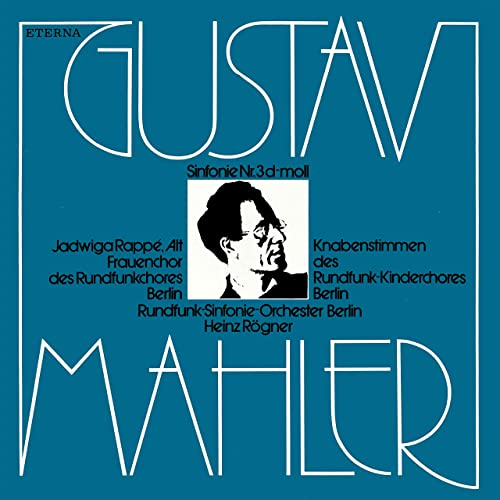
Heinz Rogner I have long sung praises of this solid conductor in Bruckner (with his Berlin Radio Symphony; Brilliant Classics). MDR Klassik has just released an excellent set of live recordings with the MDR Symphony (Genuin), and it is solid music making. But, most surprising of all is his recording of Mahler 3, also with the Berlin Radio Symphony (Eterna) - this is a long symphony but it is so good that I have played it a few times and this version now shares top honor with my long time favorite Horenstein/LSO (hard to source now; Originally on Unicorn LP and CD; also Nonesuch LP; once contained in a cheap Brilliant Classics Mahler complete symphonies black box, all oop; now on expensive Pristine Classical).
Shostakovich Just as Teodor Currentzis put the Siberian MusicaAeterna on the map, Dimitry Liss had done the same for the Ural Philharmonic Orchestra. Their latest recording is a very good Symphony 15th (Fuga Libera). The playing is intensely colorful, an absolute wonder, though perhaps a little mystery is missing - this symphony should feel like something is fading... Otherwise, there have been little of note on the symphony front (Noseda/LSO continue to bore). Liss/Ural concerto recordings with the volatile Boris Berezovsky (Mirare) are also well known. In any case, I urge you to stream everything the Liss/Ural do. Liss also records with the Phil Zuidnederland (Fuga Libera) but this Dutch orchestra, though very good, does not have the color of the Ural forces (I hope Liss changes them in due time). The music making (Tchaikovsky Symphony 4, Berlioz Symphonie Fantastique and Shostakovich Symphony 10) is highly satisfying, but the recordings are a little bass heavy in a swimmy acoustics, OK but not as good as the Ural recordings on the same label.
A Little Baroque Bach Keyboardist Jorg Halubek has directed his Il Gusto Barocco in a very solid set of Brandenburg Concertos (Berlin Classics), which have served me many mornings. Leclair This composer imho is hard to serve. No matter in the old days (3 appeal to me in baroque, Arthur Grumiaux, Ida Haendel and Lola Bobesco) or now (HIP) not too many recordings are memorable. In the Violin Sonatas David Plantier and Les Plaisirs du Parnasse (Ricercar; a good label for baroque chamber music) did a very good job (on the smooth side). His Duo Tartini has recorded some good works of, of course, Tartini (Muso). But for even more flair, listen to the Leclair Violin Concertos played by Leila Schayegh and the La Cetra Baroque Orchestra Basel (Glossa). For excellent Telemann playing, Stream his Overtures played by the Orfeo Baroque Orchestra led by Carin van Heerden (CPO series). Pristine recorder playing, with excellent dance quality in orchestral support.
Music with Organ (and Trumpet) Gambist Romina Lischka and organist Marni de Cat gives us a very pleasant disc of Bach (Ramee). Lischka also directs the Hathor Consort, which has given us (and I have praised it before) a ravishingly beautiful Biber Requiem on the same label. This label is very interesting for its coverage of obscure baroque composers and use of many historic organs. For more conventional Bach music, I was surprised by Norwegian organist Kare Nordstoga’s Toccata, Preludes and Fugues (LAWO). The thrice familiar D Minor (BWV565) sounds less “majestic” but more organic and dynamically miraculously scaled to me. Bravo! This album is just one of many on the label. Even more surprising is his partner Tine Thing Helseth in Magical Memories of Trumpet and Organ. What a find! Trumpet and Organ music are not uncommon, and certainly not a new thing. Decades ago I had enjoyed the albums Maurice Andre recorded with Marie-Clair Alain (Erato). These two were giants of their instruments; while I have many organists I like as much, to me Andre has never been surpassed in classical trumpet. Neither Hakan Hardenberger nor Alison Balsom measure up to Andre’s humanity. Whatever he plays (from Bach to Jolivet) one listens with a smile. Imagine my surprise when I get the same feeling with Helseth!!! On the said album, the warmth of the playing is utterly beguiling. I just played this one album all morning. It showcases the trumpeter’s personal favorites and has mixture of traditional and classical stuff. Included is Mouret’s Fanfare and of course that brings back memory of all the transcendental Masterpiece Theatre stuff I watched! Younger readers, accustomed to streaming on demand, will not understand the earnestness we older generations wait for our favorite shows on TV. When Mouret sounds, I know there’s at least 40 minutes of gripping stuff to watch (like Brideshead Revisited and Jewel in the Crown). Ah! Well, back to Helseth, she’s certainly no Tiny Thing, but a giant of the trumpet! I understand she dapples in other genres, which I’d be eager to hear (Ed: I just found out there is quite a bit on Kuwo, which I shall try out)! This is the kind of trumpet album even our friend Vivek will enjoy (he famously said: "...I now realise that I like jazz artists who don’t hit higher notes often..." LOL), Incidentally, organ recordings are proliferating at a fast pace and there are so many excellent organists around. For another version of Bach’s Toccatas and Fugues (which are among his best works), Elena Privalova (Quartz) is highly satisfying. As an aside, Messiaen was a great organist and composer. One outstanding recent release features 3 pivotal works played brilliantly by the great Bavarian RSO under the always dependable Kent Nagano.
More Accordion Contemporary Blaszewicz’s Sonata and Double Concerto music for Violin (K Mikolajczyk) and Accordion (I Jedynecki) with the Silesian PO under MJ Blaszczyk (Dux) is a complete winner. It sounds fresh and challenging. Now to Ksenjia Sidorova, whom DG markets as a “crossover” artist. But her earlier recital albums (Champs Hill) are much more rigorous and impressive, featuring modern composers such as Berio and Schnittke. Equally good is her Piazzolla album (Alpha). There is some passion there, ironically missing in many people who promote the composer (like Kremer and the vast Dutch bastion, including Isabelle Van Keulen). The younger and more heart-on-sleeve classical generation is more equipped to tackle Piazzolla (outstanding examples are Katherine Hunka/Irish Chamber O (Orchid) and Karen Gomyo (BIS), both of whom I have previously highly praised). Here, may I remind you to play the master’s own recordings so as you’d not forget how the music should go. There is a huge amount out there (of variable sonic merit) which you should explore. I’d just like to recommend some late works, such as The Rough Dancer and the Cyclical Night and Zero Night (Nonesuch).
More Transcriptions I am a fan of transcriptions, and spend much time listening to them, especially piano ones. One of the most curious one lately is Hummel’s transcriptions of Mozart Piano Concerto 24 and Beethoven Symphony 1, scored for the unusual combination of piano, flute, violin and cello, well performed by keyboardist Aurelia Visovan and Friends (Ricercar). Visovan is 2019 winner of the Musica Antiqua Competition Brugge (fortepiano) and here plays a Graf. She can also be heard as harpsicordist in Ligeti's riotous Hugarian Rock on an unusual album that pays tribute to keyboardist Gordon Murray and his harpsicord collection, Harpsifly (Gramola). The interesting albums features 5 keyboardists and 5 replicas of famous instruments, and you will be surprised how different they sound. And if you haven't heard Ligeti's harpsicord music, you MUST! When it comes to Beethoven symphony transcriptions, even big names Ax, Ma and Kavakos have recorded an enjoyable 2 and 5 in more conventional Piano Trio (Sony). Back to Mozart, don’t miss the series of Lachner transcriptions of the Mozart Piano Concertos, beautifully performed by pianist Alon Goldstein and the venerable Fine Arts Quartet (Naxos). The latest DG issue of Principal Harpist of the estimable Bavarian RSO Magdalena Hoffmann Nightscapes is also surprisingly excellent. I have grown impatient of DG's current way of recording young artist in miniatures, but this one proves a good surprise.
Chopin Issues always come at a fast pace. DG had recently released fine recordings by Jan Lisiecki and Seong-Jin Cho, but they pale in "individuality" next to the highly eccentric Ivo Pogorelich (Sony). Is that good or bad? You should answer your own question. For me, Pogorelich’s funereal tempo works at most half of the time. Nocturnes are somnolent, but the intrinsically graver Fantasy in Fm and Sonata Bm work better. I shall give it more tries, as to me it’s a lot better than his last Sony Beethoven and Rachmaninov album. Pogorelich is always controversial, but so be it. Come to think of it, Sony has a penchant for signing on pianists who greatly distort the text. Think of Volodos, though he can be astonishing, but Khatia Buniatishvili? Just wilful populism that goes nowhere musically. Pogorelich? He is inching in the latter's direction.
Historical Treasures For those who like fine sound, the great Igor Markevitch has finally received his due. DG has issued its edition, whereas his Philips Legacy now appears in a Decca box. There is nothing that this composer cum conductor does not do well. One can start with his Tchaikovsky, still tops. In lesser mono sound (though not bad at all) Dimitri Mitropoulos and Arthur Rodzinski (Sony) have finally received their dues. If you do not always need the best sound, you should sample some of these 2 legendary conductors' work. But my nominations for the finest releases in this department go to, first, the Beethoven Piano Concertos by Rudolf Serkin and Raphael Kubelik (Orfeo). Serkin was in his 70’s, yet these live accounts convey true collaboration, where the musicians breathe as one. Incredible and what concertos should sound like but rarely do! Now my top recommendation (sound is excellent). Second, due to the death of Fou Ts’ong (sadly from Covid), his long neglected Columbia (Sony; fine sound) and Westminster recordings have been revived. His Chopin, particularly the mazurkas, have long been legendary among connoisseurs, but his Mozart can be equally disarming (EMI, Westminster/DG and Polish recordings, all in fine sound). For those interested, in his later life he recorded much great music for the UK Meridian label (all oop, though can be streamed).