Showing posts sorted by date for query Fosgate. Sort by relevance Show all posts

10 September, 2023

Western Electric 124 Langevin 102 LS3/5A


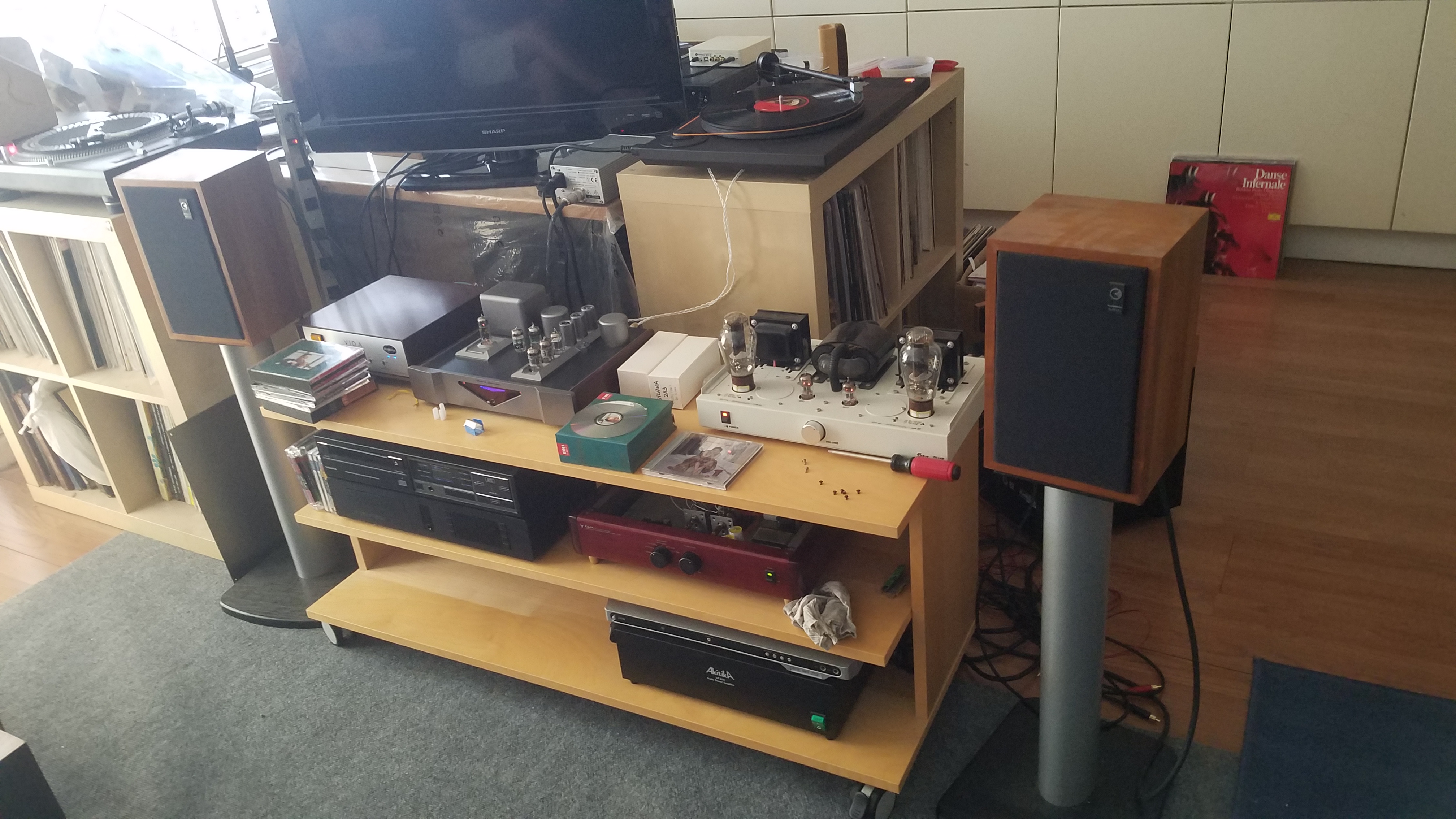
Click pics to enlarge. WE124B on the floor. Micromega Stage 2 CDP and Yamamoto CA-04 Preamp on the upper shelf. On top, from L, Aurora Vida with Cinemag 3440A on top, Fosgate Signature, Sparkler CDP (unused) and Elekit TU-8300 (unused).

Letter from NYC (23-12): Labor Day Weekend+, Part III (Monday), Chez Andy et Moi

Written in Shenzhen

(continued from Part II (Sunday)) I'm not sure how this came about. Western Electric must have been mentioned at some point in Andy's now much expanded (and very busy) Wechat group. In any case, I was the only one with some WE stuff, and the crowd wanted to hear them.

In Preparation and My Perspective You can imagine I had a busy morning. As it was going to be quite a few people, it had to be in the LR, where I had my LS3/5A system. The WE124 monoblocks had lied dormant for several years. It was not too much trouble getting them into the LR. I hooked them up to the Yamamoto CA-04 Preamp and they gradually came to life. Familiar and intimate sound that is very different from the 300B I had been listening to (and which Sam heard in Part II). In a small way, as the Yamamoto now has a pair of tiny WE 403A inside, it is a "full" WE system, LOL! Well, the 124s have all Sylvania tubes (6J7s and 6L6GAs) though, very importantly, the rectifiers are now WE274B! My WE friends may snicker, but I think it still delivers a reasonable fascimile of the WE sound. You may ask, what's the difference between the 300B amp and the WE124? The WE obviously has a fuller sound and is more powerful. Its air is smoother than 300B but some may like the more overt sound of the 300B. Most importantly, the WE has more of a subtle rhythmic savvy that befits all music. Also, I had actually taken out the WE106 but somehow I could find only one 274A and so had to drop it this time.

My HK taskmaster icefox (@E) again enslaved me, this time via remote! He all of a sudden mentioned the Langevin 102 in the Wechat group. He had heard it to great effect in HK apparently. So it took me quite a while to extricate this heavy beast from my dedicated horn room. It had not been used for a long time too. My unit uses no WE tubes. I swapped out the Yamamoto and the sound was a little congested at first. It opened up a bit gradually but was not as transparent as I had remembered and wrote about. I just let it run.

Chez Andy Just before noon, I walked all the way to Andy's place in Auburndale. This had actually been planned the previous week, before all the recent madness descended upon us. As usual, we casually listened to some records on Andy's mellow Altec A5 (if you search the blog [upper left corner] for "Andy + A5" you shall find lots of piecemeal bits I wrote. To sample, perhaps this and this to start? Andy prepared Beef Noodle Soup, his specialty, and we drank and ate. One funny thing is Andy opined that no wine ever can pair with the noodle soup. I'm rather less picky. I particularly enjoyed a Nono/Berio record; somehow the European Avant-garde (old guard by now), whom I favor, deliver a narrative (unlike much modern music) that sounds particularly good on horns.


About 2 hours later, the crowd descended upon Andy's. Philip, who had dim sum before, came with Johnny. MJ arrived around the same time, separately. They much enjoyed the A5 for a while. Somehow, we found out Johnny had not eaten lunch yet and Andy's Beef Noodle Soup saved the day for him. One recurrent theme during our meets is Bossa Nova. The laid back style is particularly suitable for horns. So a bit of Gilberto was played wherever we went.  Then we all squeezed into into MJ's car and headed for my place.

Chez Moi I had bagged up all Andy's wines, which we continued to enjoy at my place. Kevin joined us later. I used my Micromega Stage 2 almost exclusively. We played a lot of CDs. The system sounded good but something was missing. I swapped out the Langevin and back went the Yamamoto. All the air and soundstage came back. I reckon I need to re-run in the Langevin for quite a while. Next time maybe. I also demo'ed the el-cheapo but excellent 16 bit TDA1543 Magnavox, which is so different from the 1-bit Micromega. As Phil's CDP had gone south, I lent it to him to play CDs. Meanwhile, the horn room was active. A couple of people went in and I played a couple of tracks. I could not man 2 rooms and it was under-utilized. I also took out and played my Sonus faber Electa Amator II, which is more powerful and quite different from the LS3/5A.

The big question is: did they get what is the fuss about WE? I'm not sure at all. The small system was certainly not at the rarified level of my 133 in HK (also a different pair of 124 here), all utilizing big Tannoys (like our friends' GRF's). Even in HK, I had friends who failed to grasp what it's all about. The LS3/5A is a small loudspeaker that should be appreciated within its own envelope. But, I maintain, if you listen hard, it can still reflect what the equipment is largely about, in a subtle manner that big loudspeaker users may not be used to (or unable to mentally switch over in an instant). To me, the real distinction of WE is very subtle, an extra tug here or there, an accent that one never notices before, and a breathing whole. I'd think on the day I ended up likely demonstrating what an LS3/5A system can achieve more than what WE sounds like. It's like the effect of the WE274 rectifier (the real one, like what I used, not replica), which does not shout at you but instead persuades. I'd say the air and refinement of the system was excellent. It was also a demonstration of what near-field placement can achieve. I note that few of our friends employ near-field placement, and that is an important divide. For myself, I try my best not to have the loudspeakers against the front wall, as in-room confers a much wider soundstage and ambience (or venue and hall sound). Music is not just about texture and impact, though these are important. Next time, whenever that is, I shall try to have a larger pair of loudspeakers in my LR (maybe my Martin Logan Source). Or maybe I shall take my WE to their large systems!

Nice Coasters from Taiwan! Chez Andy

26 August, 2023

LS3/5A Chartwell Audiomaster Rogers Yamamoto CA-04 Douk E6


Click pics to enlarge. Chartwell LS3/5A. On top of rack, Fosgate Signature Phonoamp and Elekit TU-8300 amp. Beneath, Micromega Stage 2 and Magnavox CDB-262, Yamamoto CA-04. Incidentally, the LP Danse Infernale in the background is one of my references. The Boston Pops/Fiedler Night on Bald Mountain is my favorite, bar none in performance and sonics, more exciting than the venerated LSO/Solti (Decca), which seems plain vanilla in comparison. It can often be found in dollar bins.

Letter from NYC (23-8): Small but Beautiful

Update 8/30/23: A few edits, including important clarification on the LS3/5A shootout - the Audiomaster won all hearts.

It has been a little over 2 months since I left China for NYC, where I spent all my time except for 2 weeks in July in Chester, UK. In the one and a half month here, I really haven't done very much except lately I have upped my written output for sure (I think around 10,000 words in the last few days). I have mostly sorted out my accounts. Sometimes it's exasperating dealing with financial institutions, including the IRS. Everything takes so long.

Given that I am by myself, I wake up even earlier than usual, around 4:30 am! I go to sleep around 9 pm. Maybe 2 or 3 times a week, I'd meet up with friends for a lunch gathering. I don't spend much time preparing food, and 2-3 times a week I'd just take out from the local Senior Citizen Center. Otherwise, aside from running errands and shopping for essentials, it's all time at home, much of it spent listening to music, sometimes while writing. I like moving about in my large LR more than being cooped up in my dedicated listening room (even if it has my reference gear it is more of a sanctuary when there are others around), so up to now I have only listened to the small LR system. Whether for review purposes or not, I rotate things in and out, and here are some brief notes:

Harbeth P3 ESR SE vs LS3/5A In my recent posts, including reviews, I have used pics of the Harbeth and LS3/5A. I acquired the Harbeth not long before I left NYC in 2020 (review). Fact is, a few weeks ago the original owner Leo would like to buy it back, and I obliged. I slotted in the Rogers LS3/5A (black badge, serial # 5,xxx). Haven't used the Rogers in quite a while, but in an instant I knew it's a worthwhile change. By now I'm in an even better position to talk about the differences between the two. Although both classic English loudspeakers with shared heritage, differences are obvious: 1) the Harbeth is smoother and reaches deeper; 2) despite a somewhat slower transient, the LS3/5A nonetheless is livelier and more dramatic; 3) despite many reviewers' talk (most often wrong, even downright stupid) on neutrality, as a whole the LS3/5A is more truthful. Sometimes it will show a little more the warts and fraying edges of recordings, but that is what a monitor is supposed to do, and a monitor it is. Still, I had much enjoyed my time with the Harbeth, and recommends it.

Preamp Rotation First I used my Shindo Monbrison. But as soon as I started to try out different phonoamps I switched to Yamamoto CA-04. The reason is very simple: the stock vintage RCA connectors of these Shindo's lose connectivity often (AD mentioned this in one of his Shindo reviews). If one has to plug and unplug often, a switch is mandatory. Yamamoto vs Shindo These have very different design and sound. I wrote about the difference in 2020, and things haven't changed. This time in the Yamamoto I have been using exclusively the WE 403A.

Douk E6 This belongs to the above section but due to the epic nature of this comparison I give the Douk E6 its own subheading. I borrowed one of Andy's many units. It has the stock Chinese tubes, with O-Rings for damping. The caps had been changed to red Audiophiler MKP 250V 1.0 uF (marked 105J). These look similar to the ones I used. PS was a small 5V USB Charger. vs Yamamoto As well as I know the E6, I was still astonished by the sound. The most significant change is a larger sound field with fleshier images (befitting a DHT) and even more air. This is consistent with my experience but now the comparison is with a preamp whose second-hand price is 20 times the cost. One interesting observation is that the clicks and pops and LP artifacts are particularly highlighted. I think this is a result of the incredible high frequency extension, the high gain and transient speed. The Yamamoto is perhaps more controlled with large scaled music and its midrange (with the WE tubes) and rhythm a little more layered. But the E6 held its own for sure and I only continue to use the Yamamoto for the better connectivity. Note that this is the first time I have compared an E6 to estimable preamps (though my HK and NYC circles have, all to the same remarkable conclusion of equality, if not superiority). Remarkable!

Analog Rotations I have been logging this. In case you have missed them, more substantial articles are on Sun Valley SV-EQ1616D and Fosgate Signature Phonoamps, and MoFi Studiodeck. Since the arrival of the Studiodeck I have been using it mostly, with the Fosgate Phonoamp. Very contented, but I hope I can stir in something a little more exotic before I leave NYC in early September. In recent days, I have gone through 3 symphony cycles: invigorating Beethoven by Munich/Kempe (Seraphim, sound good despite being quadraphonic); magisterial Dvorak by BPO/Kubelik (DG; stupendous sound); flawed but worthwhile first Sibelius cycle by Boston SO/Davis (Philips, good but not top sound). You shall be amazed how time flies when one listens to the greatest music.

Digital Duties As here. I actually listen to quite a bit of CD, especially Jazz. Like Miles and Coltrane. Particularly fine sounding Rachmaninov Symphonic Works from Concertgebouw/Ashkenazy (Decca). Ever heard Patricia Barber's Companion (Blue Note)? Fabulous sound and one of her best. Have you noticed one thing? I haven't streamed the whole time! I actually miss it, but the very weak data handling of my phone is not up to it.

SE Amps I started with the small and  convenient Almarro A205A (EL84), then two 300B amps, the AES SE-1 and Elekit TU-8300 (first review and review after mods and updates). The Almarro does a fine job driving the LS3/5A but the 300B amps open things further up. AES has fixed bias adjusted through a single 1/4" TRS phone jack in the back (I use a connector with my multimeter). As the bias is for both tubes, and tubes may not be balanced, it's better not to bias high. Mine (Shuguang) was set pretty low, at 90 mA total (for both channels). This time, I operated the Elekit as an amp (Yamamoto  AES vs Elekit Using the same 300B tubes, despite being biased lower (the Elekit is autobias), the AES sounds more powerful. The circuit may have something to do with it (traditional vs constant current source, respectively) but I'd say the AES has the better transformers. Tonally the Elekit is airier, more resolved and on the neutral side, and the SE-1 is a little more centered on the midrange. Both are very good. Andy and Kevin have heard them both and voiced no serious preference. With my guests I also rolled in the Philips JAN 6L6WGC (which I liked) but it seems both of them preferred the 300B. I think the Elekit is sounding the best as it ever has. I actually wonder if it has finally starting to break in. You see, I don't think I have had more than 300 hours on it altogether, a significant fraction from this time around! And now being summer, I may not bring in the 6C33C Almarro 318B. Instead, if I have time I shall try some more powerful Push-Pull Amps on the LS3/5A!

Subwoofer After a while, I brought in my very modest Pioneer SW-8 subwoofer.  Finding the setting took a little more time than when I used it with the Kilpsch Heresy. I estimate the final Crossover Frequency to be around 80 Hz (I remember in HK it was even higher, but it was a different sub) and Volume was just a touch (less than 1-hour on the dial). With even the little bit added, the music is more dynamic. When Kevin and Andy visited I demonstrated to them and Kevin correctly said with the sub on the soundstage expanded. There are very few albums on which the presence of the sub can be suspected. A success, but I know all about it from my experience in HK.

Rogers vs Chartwell vs Audiomaster As both Kevin and Andy liked the pair of Beydas clone I brought to Andy, I invited them to my place for an in-depth session with 3 pairs of the real thing, all 15 ohm versions at that! First, we listened to the Rogers (black badge; serial # 5xxx), which had been resident in the system for a while before they came, and it was very nice. When the Chartwell (serial # 3xxx) was substituted, we all heard more treble and a leaner balance. Andy remarked it had less bass. Part of this could have been because the Rogers was in use before they auditioned, whereas the Chartwell had been in the closet for years. After their visit I just continued using the Chartwell, and really do not feel now that they lack bass in any way, though it is true the treble is a little more prominent (mirrors my experience in HK). As a whole, I enjoy its tighter grip on material as well as better dynamics; its sound is likely closer to modern variants. Finally, it was the turn of the Audiomaster (serial number not obvious). More than Rogers and certainly Chartwell, I have used this pair on and off over the years, always with great satisfaction. It is a little darker but, oh, how relaxed it is! Both Kevin and Andy were thoroughly charmed by the Audiomaster. Too bad we did not have on hand the Beydas to compare! It should be noted that Chartwell and Audiomaster are much rarer than Rogers, especially so in America.

Xinshi 新时 597 Passive Horns In many of my more recent articles, these appear atop the loudspeakers. They enhance the sense of air. After the pair was handed to Kevin, I immediately noted a diminution of air in the system. This incredible thing is now a necessity in any system. Next time I come back to NYC, I shall bring a pair along.

The TV Long time readers with eagle eyes will have noticed that in 2020 the TV was on the rack, whereas now it had been moved to the large work table behind. It cleared much space for gear, but that was not the point. Experienced audiophiles know that a large center object, aka the TV, messes up the soundstage (can be better if a thick cloth is draped over it). By doing that, the soundstage immediately deepened, significantly. I usually never sit in the center, close to the right speaker when I'm on the sofa reading or computing, and further right on the dining table when working or eating. No matter, the soundstage is much improved, and quite impressive. Advantage of being alone.

TV Sound My Sharp, circa 2010, is certainly not shap in picture and a lousy one when it comes to sound. As I watch quite a bit of TV, be it old TV series or B movies, I struggle with the sound as well as clarity. The older movies and series are definitely lower in sound volume and often muffled. Perhaps they are playing bad (low res) copies. I borrowed a couple of DVDs (Unberable Lightness of Being and Two for the Road) from Andy and found the sound of the replay (through my Sharp TV), even from my top-tier Sony BDP-S5000ES, better than TV but still totally underwhelming. I finally could not stand it any longer and fed the optical out of my TV into my Micromega MyDac DAC and then into my regular system. Much better, but still not enough. You simply do not watch a modern movie (Unbearable) with a SET amp! LOL! I know I can probably do better by configuring my Blu-Ray player and, yes, more wattage will be a different story, but so much for now.

 Audiomaster Crossover

Innards of the modified Elekit TU-8300

Douk E6 in action

25 August, 2023

Fosgate Signature Phonoamp Sun Valley SV-EQ1616D

Top rack, from L: Aurorasound Vida, Fosgate Signature, Almarro 205A; below: Yamamoto CA-04.

Review: Fosgate Signature Phonoamp
NYC Analog Log (23-4): Sun Valley EQ-1616D, Part II

Sun Valley SV-EQ1616D, Part I

Fosgate Signature Phonoamp

First Impression Very soon after it came out in 2010, I bought one. It's amazing that I have not formally reviewed this, one of my staples, even though I have commented on it many times, starting with my 2011 Retrospective

...Ever since it came out it has garnered much attention, including a review in TAS. There is also a nice review in Audio Beat. This is one of those rare phono preamps with a fully active MC pre-pre section. As noted in the Audio Beat review, the 60 db gain for MC may be a little low for some people but it is perfectly fine in my case, even with the very-low-output Denon DL-304 (0.2 mV), since I mostly use preamps with high gain and efficient speakers. I am happy to report tube rolling is a breeze as the phonoamp does not seen to run the tubes unduly hard and many NOS tubes sound quiet in it. One thing that puzzles me about the industrial design: the two round cans flanking the tubes lead one to think they are input transformers; no, they aren't, this is a strictly active device and those are for decorations only. Incidentally, I think there is a new 10% price hike, but you can still find many selling at the original price of USD 2500. Review later...

Design A word on the patented, and unusual design (the Manual can be downloaded here), in Fosgate's own words:

The design is the result of more then 100 different hand built preamp circuits dating back to the 1970s.
  • All amplification is accomplished with the SRPP (push pull) configuration for the best possible linearity, lowest noise and distortion.
  • No solid-state devices are placed in the signal path and a tube is used for the high voltage rectifier.
  • The power supply is very different and contributes to the high performance. There are no regulated power supplies. Each tube stage is powered by a separate storage capacitor that acts like a battery. These storage capacitors are very large (10 to 20 time's oversize). The power supply simply holds the voltage across the capacitors like a "trickle charger". PC board layout is "Dual Mono". The channels are located on opposite sides of the circuit board in near mirror image with dual triodes in a row down the center.
  • The first stage has no NFB to interact with the cartridge. The second and third stages are enclosed in a single feedback loop incorporating both positive and negative feedback.
  • The RIAA network is divided into two sections, one passive and one active. The upper half (above 1KZ) is accomplished with a passive network between stage one and two. The lower half (below 1KZ) is accomplished with an active network around stage two and three
Tubes The Fosgate is not demanding on tubes. The stock tubes are not bad at all, but I have swapped in all old-stock tubes, with small but audible improvement in sound: V1/2, Amperex Holland 6DJ8; V3/4, RCA 12AX7; V5/6, stock Philips JAN 12AT7, more recently Mullard ECC81. One should view V1-V3 as within the MC section, and V5/6 as within the MM section. While V1/2 and V5/6 should be matched, V3 and V4 can be viewed as the bridge and they don't have to be identical, enabling one to roll in different tubes. Manual also says you can roll in a 12AT7 in V3 to have a little more treble air. As the unit is perfectly fine sounding I have never tried it. My 6X4 is an old Motorola.
 
Version 1 vs Version 2 Mine is V.1 (the "V" not to be confused with designation of Tube position above), and I have always been puzzled by what is the difference. There is no mention of any revision in circuitry or cosmetics. Finally, I think I have found the answer. In one of the For Sales Ads for V.2, I saw that the rectifier is 12X4, not the 6X4 of the V.1. Voila! The same rectifier with a different filament. As tubes always escalate in price, it's totally understandable why they switched to the cheaper 12X4, which unlike 6X4 is much less used in vintage gear (an exception is the popular Dynaco PAS 3). Minor change indeed, so if you're looking for a second-hand unit (especially after this review), both will do.
 
Over the Years I have enjoyed this phonoamp for many years, in all of my stations and with many of my TTs and cartridges, always with satisfaction. I mentioned it on several occasions:
 
In this article I said:

...The next day I connected the Linn/Koetsu rig to the Fosgate and, as they say, the rest is history. In this system, the Koetsu did even better than on the AQVOX, and perhaps even better than on the Aurorasound. The Koetsu did everything the PC-1 did, but at a somewhat smaller scale, but I feel it has been optimized. What amazes me is that the all-tube Fosgate yields not one iota to either the AQVOX or Aurorasound in the transient portrayal of the leading edge; every emphasis is microdynamically portrayed, no mean feat, with the additional benefit of a smoother sound...

And in this article I said:

...I have never really written a formal review for the Fosgate, but it was in my Best of 2011 article. It has been one of my mainstays and here I have to sing its praise again. Its superb design allows pure tube MC amplification without the use of SUTs, a feat rarely accomplished (this also meant tube rectification for lower noise). A bargain and wonder, but one that is little appreciated. The world is not fair, right?

vs Sun Valley SV-EQ1616D

After I thoroughly evaluated the Sun Valley (SV), it was only natural that I made the comparison with the Fosgate. In design and ergonomics, there are superficial similarities and differences. Similar: both are tube-rectified, not so common at any price; both have tube MM sections. Different: critically, the Fosgate has an all-tubed MC section (a rare beast) and the SV a FET Headamp (common); usefully, SV has 2 inputs while the Fosgate only has 1; usefully, the Fosgate has Loading Selector (100, 300, 500, 1K and 47K ohms), while the SV has none (the MC is loaded at 50 ohm); not so usefully (for most people), the SV has various bells and whistles for EQ; of debatable efficacy, SV also has a Mono button (taken from the L channel).

Sonically, please first refer to the SV review, Part I linked at the top. I used mostly my Yamamoto CA-04 Line Preamp, AES SE-1 and Elekit 8300 300B amps driving various LS3/5As. All I have to do here is to tell you how the Fosgate trumped it:

  • Macrodynamics (and Gain) This is the most important difference (the divide is big). Now, remember I use the SV's own FET headamp, and have an active Line Preamp with Gain to help. They have probably about the same gain, but the Fosgate sounds much better, unfolding loud passages with more force, yet with more detail, air and refinement, and even less noise. As mentioned in Part I the SV does better by dynamics with a SUT, yet it loses much finer details, especially compared with Fosgate.
  • Microdynamics WIth classicals, in the softer passages, such as the Tapiola mentioned in Part I, SV regains a little ground. Its more overt manner (within its comfort zone) makes the Fosgate sound a tad cool, yet the Fosgate is no slouch and within the whole sweep of music this is not at all sufficient to turn the tide. Add the dynamic findings together, I'd think the SV, with or without SUT, is more suited to smaller scaled music, like jazz or vocals, whereas the Fosgate can do everything well.
  • Loading I note that with the Fosgate I loaded the 2 Denon DL-103 (stock and with Midas) at 300 and 500 ohms (little difference), a theoretical advantage over the SV when its FET section is used (50 ohm). Yet it should be noted that I still prefer the Fosgate over the SV used with SUT (when there is little loading concern). The performance of SV surely can be improved by using more and more expensive SUTs, but is that the way to go?
  • Resolution and Air The SV in any configuration is a little less resolved. And both have very good tubes in them.
  • Mod Potential I note that Andy's SV already has V-Caps in them (Kevin opted for Mundorf instead), and the Fosgate is stock, with WIMA caps (pic below). Upgrading them is a definite possibility.
Summary
  • Fosgate Signature This is a Masterpiece. Achieving this level of quietness with pure tube circuitry is a miracle! Jim Fosgate had passed at the end of 2022 and it's regrettable we shall not have more innovative designs from him! It's too bad that it has long been discontinued. Second-hand units are probably not too hard to find if one is patient. I don't think it was that popular in its time. One reason for that is likely because a few users in forums posted on the lack of gain in their systems. In this world where many people use Passive Preamps or Preamps with little Gain, that can happen quite often (and indeed with that Audio Beat reviewer). I always say, and I repeat, if you are into vinyl, you should have plenty of gain at the preamp. Little or no gain at the Preamp ruins a lot of analog and SET experience, and people never learn. Just numbers won't do, and Straight Wire with Gain is no more than wishful thinking. My Denon DL-103 is nominally 0.3 (often a bit higher) and I never have any problem. Have you noticed that almost all reviewers now just use their SUTs? This is to sidestep precisely this problem, and also why many more people use SUTs now with MM phonoamps, though I prefer an active MC stage whenever I can. There have been very few notable all tube MC Headamps (whether standalone or built into a phonoamp or full function preamp). Tall achievement! If the SV is Class A in Stereophile, the Fosgate is A++!
  • Sun Valley SV-1616D While I think this is a very good tube MM (and a competent hybrid MC) phonostage, I think it's on the pricey side (even as a kit).  If you add SUTs for MC use it's even pricier. Its Bells and Whistles are likely to be under-used, if at all. On the other hand, if you already have good tubes and SUTs on hand, it's a better proposition. If you see analog in the long term, buying tubes and SUTs are likely worthwhile anyway, just that it could be a lot of money (and no end to it, but that's part of the fun). If you go the way of SUT, I'd advise buying an external one rather than having some custom made ones built into the SV. This allows for flexibility. Personally I do not buy the SV because in terms of MM phonostage, many of the built in phono sections of vintage full function preamps are just as good, or even better. The Citation I is the best example. If you use its Tape Out it is a formidable phonostage. Similarly, excellent phono sections are the rule rather than the exceptions in older preamps. Just to toss off a few in my collection: MFA Magus, various Counterpoints and ARCs, Melos, etc. And among more recent stuff, second hand markets can still offer good value. An old Shindo Preamp not only offers a great preamp, but one with an exceptional phono section. Not cheap, but worth consideration for a vinyl lover. Of course, there are those unwilling to navigate through the vagaries of the second-hand market - I understand. I personally puzzle at the Stereophile Class A rating, when the FET headamp is basically brushed over, and contingent upon using a SUT and expensive cartridge as HR did. But then, many other things in Class A probably shouldn't belong there in the first place!


20 August, 2023

MoFi Studiodeck

Click pics to enlarge. AES SE-1 300B amp; Fosgate Reference phonoamp; Audiomaster LS3/5A; in far corner, Elekit TU-8300 300B amp.
Review: Mobile Fidelity Studiodeck
NYC Analog Log (23-3): C/P at its Highest!

Note: The first part of this article (in blue shade) is copied from a recent post that alerts readers of the sale. If you have read it before you may want to skip this part.

These days I don't often casually browse around the internet, my daily forays usually mostly limited to news, email checking and maintenance of this blog, in a word targeted and short. So I cannot even recall how I discovered this.

I had long been interested in MoFi's ventures into consumer audio, and I must say they have done it with style and substance. I purchased the Studiophono (contribution by Tim de Paravicini) and it is still competitive in its price class (here). At the time, I too wanted the Allen Perkins designed Studiodeck (or the Ultradeck) but refrained as I had too many TTs. BUT, now, with the substantial discount it proved impossible to resist. I opted for the deck without cartridge (USD 899) as I don't need the MM Studiotracker of the + version. Note that there is also an even cheaper "Foundation" version (USD 799), which does include the MM cartridge but is without the dust cover and HRX feet - well worth considering too.

I got it yesterday and of course immediately set it up. It deserves a lengthy report, which I shall write in due time. Suffice to say for now it compares favorably (and beyond) to my standard, the Technics SL-1200 Mk II, and that's no mean feat. I am writing this just to alert our readers.

Our author Shawn P told me that this was on sale too in Hong Kong (agent: Radar) for an even lower price, 5,800. Wow! Too bad the sales was over.

As a final note, unlike most lower priced offerings (and even some expensive ones) the arm is fully adjustable (VTA, Azimuth, etc). Because of its 10" effective length, unusual for a "starter" deck, it's necessarily a little larger in footprint than usual (19.5" by 14.25") and may not fit on some racks if you are not putting it on top.

If you are looking to upgrade, say, from your U-Turn, low end Pro-ject etc, this would be my choice. I'd pick it over Rega P3 (even P6) for example. In fact, money permits, this would serve the starter right off the bat too (perhaps with a Studiophono). For less money, my recommendation for starter deck remains Audio-Technica AT-PL120. This is not just for newbies at all: you'd have to spend a LOT more to get better performance. If you are experienced and want a second deck with full features, consider this moment!

-----------------------------------------------------------------------------------------------------

The above Primer just about covers all the salient points! Below I shall give more details, especially on aspects of design, including some that I have reservations about (fortunately these are peripheral issues).
 
It is important to note that, given the clout of MoFi, the internet is laden with reviews of their TTs, from trade mags to webzines. Ponder this: The majority of reviews are on the more expensive Ultradeck+ package, which include MoFi's own MM cartridges. No MC. I have no doubt as configured they sound good, but they do NOT qualify as thorough reviews. Most of these reviews, particularly those from big guns, only use the supplied MMs and do NOT attempt to evaluate the TT with other cartridges. That is completely irresponsible and, frankly, smacks of conspiration to promote MoFi's own cartridges. Thumbs down! Read all of them, and there are a couple on the cheaper Studiodeck and a comment here or there. Make up your own mind. This is why I don't even provide a link and why I think this review is special. I am an MC man!

Packaging, Unpacking and Installation It arrived quickly in a HUGE box. The TT and the Cover are in an inner box, cushioned in the corners by large foam brackets. Unpacking was easy and installation intuitive that the small manual is hardly needed (except for where to position the anti-skate wire knot); it is too sketchy by half anyway. 
 
The Plinth and Footers The Constrained Layer Plinth (one layer of aluminum inside, as opposed to 3 in the higher level Ultradeck) feels solid and knocking on it (with or without footers on) yields only a thud without much decay. The somewhat delicate spring-loaded HRX Footers are screwed on (I see it is sold by Music Direct separately for $199, surely an afterthought). My IKEA Kallax shelf unit is mass loaded with LPs and solid but its top is not quite level, so, with the help of a bubble, the footers allowed me to level the TT. Nice!

Dust Cover The smoked plexiglass cover is significantly heavier than the usual ones (say, the one on my Technics SL-1200). Unusually, the hinges on the cover and the receptacles on the plinth have no metal parts, instead made of some kind of polymer (rather than hard plastic) and are not completely rigid. The lips on the cover have a bit of yield. The weight, the pliancy and the spring loaded footers add up to mean that the cover should be off when playing. The lid when lifted fully back is at an obtuse angle with the plinth (surely so designed because of its weight) and that will wreak havoc with the spring loaded footers and TT level. Quite unlike my Technics and Pioneer TTs which allow me to play LPs with the lids open (at an acute angle) with no fear.
 
The IEC Power Inlet The plinth is not thick and the receptacle is in the back. The stock power cord is surprisingly robust yet not overly rigid (good in my book). If you use heavy aftermarket power cords, especially the kind with silly monstrous connectors (which is unlikely for people who use this deck), you should avoid having the cord weigh down the TT in the back. So, dress the power cable so the left rear corner is not weighed down.

The Arm looks to be reasonably well made. The straight main length is metal (I don't like the imprinted MoFi logo and thin white line). There are 2 joints. Like a lot of other arms, the shorter weight bearing rear section looks to be joined to the main by a rubber/polymer insert (if you go to MoFi's site for the better pics you can see a ring between the 2 sections). The counterweight is lined inside with rubber-like material for grip onto the arm. The other joint is similar, this time affixing the plastic headshell (with offset). Just to the rear of this joint on the underside there is a small screw which allows one to adjust azimuth (not in the manual). A plastic platform is collared around the arm base and holds the Arm Rest, Arm Lift and Anti-Skate. The Arm Lift is nice in quality and usefully a side screw on the collar allows one to adjust its height. Caveat: if the lever is pulled down too much too quickly the lift actually doesn't go all the way down. In my experience, a similar thing can happen on some other arm lifts. After the lift goes down and settles, pressing the lever a bit more will actually prop up the lift too. So do it gently with this turntable. Another small issue: out of the box I thought the arm lift well has bottomed out; it turned out what I thought was the black bottom was a black plastic protector for the shiny metal well and has to be removed - took me a while to figure out! The Arm Base looks to be plastic and a side screw enables adjustment of VTA. To their credit, MoFi supplies 2 small allen wrenches for all these adjustments. It should be noted that the 10" arm's effective mass is 30g, which favors low compliance cartridges.

Headshell, Cartridge Mounting and Alignment Surely MoFi wants you to buy your TT with their own cartridges, so MoFi doesn't make it easy on you. They provide NO templates for cartridge mounting. Thumbs down! I quickly used the Shure tracking weight gauge and the paper template that came with my Thorens TD-309 (Baerwald) and installed my Denon DL-103 (inside daiwok's Midas aluminum shell; some application notes here). With a little shim and VTA adjustment, done. I should also note here that the Finger Lift is awfully short - my fingers are slender and I can't imagine what it's like for those with stubby ones. - very dangerous. Cartridge Clips The captured ones look to be of good quality, but they cannot accommodate an odd ball one like the mono Denon DL-102, which only has 2 pins and requires 2 leads for each channel, achievable only by an open-back pin design.
 
In Play The motor is quite strong, much more so than, say, my Clearaudio Concept. It is high torgue, starts with a "kinky" snap on the belt, and reaches speed within seconds. Not as fast as direct-drive but impressive nonetheless. It should be noted some designers deliberately choose low torgue, particularly with motors mounted on the plinth, for reduction of resonance; that shows Allen Perkins is confident about his plinth's ability to drain away unwanted noise. Without a mat, when I apply the ancient Discwasher dust brush lightly, there are minor slippages but that's OK. Some reviews praise the Record Weight, but as a rule I don't like the sound of weights (deader) and don't use them. Initially though, another issue shows up a design fault: The On-Off Button is too close to the Headshell. Like many old-timers, I am used to using my fingers rather than the arm lift lever (the latter in down position). When I lowered the needle manually with my thumb and index finger, my other curled up fingers would accidentally hit the sensitive On-Off button and turn the TT off. I had to learn to work around the button and remember this, but it was not difficult. This is a case where the (good) industrial design is at odds with function. And, worth a mention again, when in play I can knock on the plinth with modest force and neither see nor hear anything untoward.

The Phono Cable The Studiodeck comes with an RCA cable, with ground wire. It's soft and looks between routine and bespoke. Sonically it really surprised me, as it doled out a fully fleshed out sound, perhaps rounded off a trifle at the frequency extremes, yet eminently musical. This really pleased me, even more than what the unassuming stock cable of the Thorens TD-309 did. Users should start with this cable. I rolled quite a few and ultimately settled on the Kimber KCAG. It is said in one of the Ultradeck reviews that its included cable is made by Cardas (the Ultradeck tonearm wire is too, whereas the Studiodeck is OFC copper). So this may or may not be by Cardas but I'm pretty sure it's bespoke as it has MoFi imprinted connectors. It's a good starter. My various Gotham cables all work very well too. Although I don't use it now, I give a thumbs up to MoFi here for attention to detail. In my system, I don't even need to connect the ground.

Sound This TT came very soon after I started investigating the Sun Valley Phonoamp, so the listening notes apply here, and below in blue shade I quote from my review (roll down to last article or here). Skip if you have read it before.

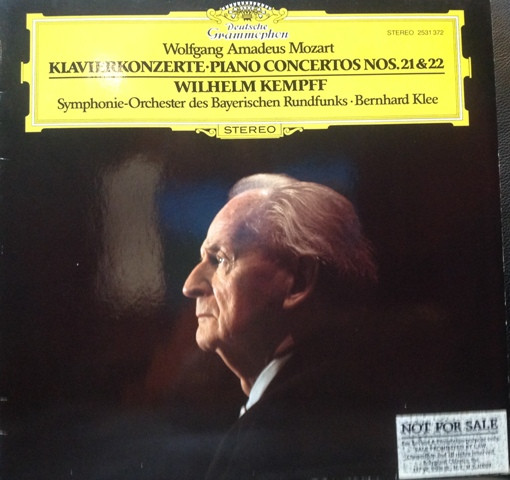
I will illustrate this with 2 LPs I acquired on my recent UK trip (see in pic at the bottom). This pair proves to be so revealing of the analog system that I have stowed them into my pile of Test Discs! Paavo Berglund is a Sibelius specialist noted for his 3 complete cycles of symphonies. In this sonically excellent digital LP, the Finlandia is supposedly the centerpiece. While the account is excellent, it does not quite have the sheer opulence of the same orchestra under Ashkenazy (digital Decca recorded by Kenneth Wilkinson), nor the romantic sweep of the Halle under Barbirolli (also on EMI, ASD). What's makes it a demo disc for me is the Tapiola. Like many other Sibelius tone poems based on Nordic myths, it's not at all an easy piece to bring off, its many rather still moments of beauty demanding the utmost of the conductor's skill at piecing things together. The Sun Valley elevates the atmosphere (which means everything in Sibelius) to a rarefied level, revealing playing of the utmost sensitivity and beauty. I don't have Berglund's other versions on hand, but this version is still available as a Seraphim CD release at some vendors. The LP is likely uncommonly seen. Even more surprising is the Brahms Double Concerto on EMI. This is a recording that musically is almost the complete opposite of the much vaunted recording of Oistrakh/Rostropovich/Szell (also on EMI). The very different (more subtle) personalities of Ferras/Tortelier/Kletzi present a less heroic interpretation that honors the work for its refinement and interplay. The dialogue between the 2 great soloists was learned and deep, blending perfectly with the Philharmonia (at its peak) under the equally elegant Kletzi. It's a whole fabric in a work that can sound disjointed. Yet another example is a late DG recording of the immortal Wilhelm Kempff. The seamless rapport between the soloist and the BRSO under Klee is priceless (more so than the pianist's earlier Mozart concerti recordings). The very subtle but myriad colors of this pianist are utterly spellbinding. Now, I have concentrated on classicals because that's my benchmark and I firmly believe no review is near complete without playing a lot of classicals (which is why I abhor Ken Kessler). Suffice to say, the few vocals and jazz I played were done very well too - no problem there.

vs Technics SL-1200 As I used both TTs in my evaluation above, it is more instructive to tell you the differences between the two. Regular readers would know I hold the Technics in high esteem. AND installed on it is nothing but the same Denon DL-103. First, the chief technical differences in the two TTs: 1) the Technics is famously direct-drive, a technology that has in recent years come back with a vengeance, whereas the MoFi is belt drive; 2) the MoFi arm ls longer and heavier, so more advantageous for the low compliance Denon DL-103 (I have added weights [Blu-tac'ed coins] on the Technics arm); 3) By its added weight the aluminum shell for the Denon supposedly confers advantages, but results can be mixed (should you like read the link provided previously). Despite the differences the two decks have the same, rather unmistakably glorious, sonic imprint - that of the Denon DL-103. But differences are there: Rhythm is a strong suit of the direct-drive (and some say suspension TT, but I demur) and the Technics is famous for that. The Technics is perhaps a smidgen faster in transients, but the MoFi is no slouch at all. Occasionally, the Technics can be too much of a good thing, as one senses a bit of an insistence to its rhyhm and pace - there is no such feeling at all with the MoFi; Smoothness Even on a heavy arm the Denon DL-103 can be a little bit grainy in the treble. The Technics can be slightly aggressive too in this respect. Perhaps with the higher mass of the arm and cartridge shell, the MoFi is a little smoother in the treble. A couple of reviewers irresponsibly made the observation that the last bit of air is lacking in the MoFi, but that is only because they only used the supplied MM cartridges. A good MC would bring all that out; Dynamics I give the nod to MoFi. In orchestral fortissimos the MoFi feels effortless, more so than many other TTs. In a crescendo, the MoFi makes you feel the volume of the orchestra is increasing incrementally over the span of it, whereas lesser TTs just sound pressed or peak out early (similar to power amps).
 
Summary on the MoFi Studiodeck Amazingly, there is no significant weakness. It plays with both Rhythmic Finesse and Dynamic Composure. Magnificent! Yes, there are small caveats, but they are insignificant. Now, who is this deck for? I say, for everyone, including newbies. Except for those starting out, who may have no cartridges on hand and only an MM phonostage, I'd recommend considering dropping the +package(s) and opt for just the deck. If one just want to taste MM and move on, many cheap ones can be had. An obvious choice would be the venerable Audio Technica AT-VM95 series (I'd pick the cheapest 95C, conical, $39), descended from the legendary AT-95 (on which many more expensive MMs [like Clearaudio] are based upon, only replacing the plastic shell with aluminum, much like what people do for Denon DL-103). I'm sure the MoFi MMs are even better, but then MMs are not MCs in my book. SO, you owe it to yourself to use an MC on this deck. The Studiodeck represents true economy, as I am confident you can use it with cartridges and phonoamps that are way more expensive than its price and still be satisfied. Right now I am using the Fosgate Signature phonoamp with it. In fact, if I have time, I might install my Koetsu on it! I am sure an incremental improvement can be obtained with the significantly more expensive Ultradeck but, unless there is a sale, I'd not consider it. The Studiodeck is likely the sweetspot.

Thoughts on the Technics SL-1200 There are at least tens of thousands of the old productions (Mk I to Mk 5) out there. Significant attrition due to heavy DJ abuse does not stop many of these to be available second-hand, but prices have climbed steadily. In 2016 Technics revived new productions (as well as its most iconic SP-10). The first ones are very expensive upgraded ones (G, GAE etc). By now, however, the technology has trickled down to the newest SL-1200, the $1,100 Mk 7. Unlike its very expensive brethens, there is almost no coverage in the audiophile press, and that's too bad. For a little more, the updraded SL-1200GR can be had for $1,800. And there is another worthwhile contender, the $1300 SL-1500C which dispenses with all the speed controls (that we don't use), adds auto return and upgrades to the GR motor. These are the TTs I'd buy in this price range (also the MoFi).

Thoughts on Denon DL-103 What more can I say? It's a classic that delivers all the drama inherent in the music, all for very little. There are nerds out there who insist that without proper loading and heavy arm it is unlistenable - don't let them deter you.

Primary
TT on IKEA Kallax shelf unit. "Midas" Denon DL-103, Fosgate Reference Phono
Oliver Sayes 71A SE amp.

18 August, 2023

Sun Valley SV-EQ1616D


Click pics to enlarge. In front is the Fidelity FR-3G SUT. Note Andy's excellent Bell 3DT 6V6 PP amp on the floor in the back.

NYC Analog Log (23-2): Sun Valley SV-EQ1616D Phonoamp, Part I
Letter from NYC (23-5): Onward with Phonoamps, I

Updates 8/19/23 A few more lines added in Shortcomings section; more links added. 8/18/23 5 hours after first publication. Loading and Gain specs and discussions added. Other minor corrections.

Before I left NYC for Hong Kong in Oct 2020, from conversations with distributor Victor Kung I already knew about the Sun Valley 1616D series kits. I knew I had no interest in the Preamp, which is basically a tube-rectified Marantz 7 (one reason is I have heard a lot of DIY stuff in similar vein; another is I have the real 7C; yet another is it doesn't look like it will deliver the dynamics that I need and prefer) but I was debating whether to get the Phonoamp kit. Not many modern phonoamps, kit or not, are tube rectified (although my Fosgate Signature certainly is). When it comes to vintage preamps and integrateds, many of their MM phono sections are, though as part of a tube-rectified global supply. A good example is the Citation I, which many in our circle employ, at least via tape out (like Andy) for its excellent phono section.

What finally deterred me was the thought of building it. I was approaching my departure and a look at this kit made me say no at that time. Given its myriad features, 3 knobs and 4 toggle switches, wiring is complicated. It's not a difficult build per se, and with the low voltages and current, mistakes shall not be deadly nor costly, but it will take a LOT of sorting out. Lots of resistors and even more wires. You need to have patience.

The kit sold very well, even before HR's Stereophile review came out soon after I left. After reading the review, Andy decided to order one from vkmusic, and both Kevin and Mark followed suit. Andy is an old hand, but his eyesight is not quite as before, so building it took him a week (albeit not in a hurry). Kevin took 2 whole days of absolute concentration; his build uses all direct soldering and dispenses with all the screw terminals. Mark has yet to build his.

Andy's Unit I didn't hear it at Andy's place. The day I took the Arcam rPhono to him I took the Sun Valley home; it was light and small enough for my backpack and 40 minute walk. His has the optional V-Caps. Also tubes recommended by and sourced from VK: Psvane 274B, Brimar 12AU7 and 2x Amperex 12AX7. That must have cost Andy quite a bit! The rectifier is ungainly in size and I left it at Andy's, not wanting any transport accidents.

System As seen in above pic and described in my last article (just roll down or here), I started with Technics SL-1200 Mk II with Denon DL-103, Shindo Monbrison, Almarro 205A EL84 SE amp and Harbeth P3ESR SE, with the 新时 597 passive horns. As you shall see in the coming installments of this log, the system underwent various changes, but that doesn't change the findings at all. During this period, I also slotted in the Yamamoto CA-04 preamp, AES SE-1 300B SE amp, Rogers LS3/5A and the new arrival MoFi Studiodeck. You shall hear about the latter 2 in detail very soon. I put it in my system, then I rolled in the nearest rectifier to me, the 60's old-stock 5U4GB in Andy's Bell 3DT amp, also on loan. Incidentally, although my articles try to focus on a central piece of gear (or issue), they more often than not meander a little with the introduction of variables and re-visits of other gear,  but I maintain these shed light on many of these equally interesting "ancillary" gear - we have all watched drama and movies where the supporting actors steal the limelight, or have heard albums where sometimes the "sidemen" seem more riveting than the singer (like Nils Lofgren in The Boss' band). This benefits me, as well as more experienced readers - reading the "fine print" matters, and sometimes is the real fun. The system context is much more important than whether a piece of gear is good or bad, and it's never completely black and white. As you follow this log, you shall note the pics show the system changes in small but significant ways. The journey shall chronicle some in-depth comparisons that I should have made a long time ago and the "surprises" I had along the way.

Looks YES! Just Great! I love Hammertone.

Initial Impressions At this point (it will change later), basically it's Sun Valley (circa $1,500 as tubed, not cheap at all, and that's the kit version only!) vs 2 much cheaper ss phonoamps, the Arcam rPhono and MoFi Studiophono (same link as in above System section). I used the flat settings, and with its own FET MC section (more below). While there are some significant caveats (more later too), for this tube lover the contest is not close. The ss phonoamps, best buys as they may be, in comparison seem to paint in broad strokes, whereas the brushwork is much more finely etched in the Sun Valley. One thinks of tubes as being smoother but that is not always true. Case in point, the Arcam is actually smoother in many ways, but the Sun Valley beats it handily at its own game, namely rhythmic finesse, or PRaT. Music is simply more articulated and nuanced. I will illustrate this with 2 LPs I acquired on my recent UK trip (see in pic at the bottom). This pair proves to be so revealing of the analog system that I have stowed them into my pile of Test Discs! Paavo Berglund is a Sibelius specialist noted for his 3 complete cycles of symphonies. In this sonically excellent digital LP, the Finlandia is supposedly the centerpiece. While the account is excellent, it does not quite have the sheer opulence of the same orchestra under Ashkenazy (digital Decca recorded by Kenneth Wilkinson), nor the romantic sweep of the Halle under Barbirolli (also on EMI, ASD). What's makes it a demo disc for me is the Tapiola. Like many other Sibelius tone poems based on Nordic myths, it's not at all an easy piece to bring off, its many rather still moments of beauty demanding the utmost of the conductor's skill at piecing things together. The Sun Valley elevates the atmosphere (which means everything in Sibelius) to a rarefied level, revealing playing of the utmost sensitivity and beauty. I don't have Berglund's other versions on hand, but this version is still available as a Seraphim CD release at some vendors. The LP is likely uncommonly seen. Even more surprising is the Brahms Double Concerto on EMI. This is a recording that musically is almost the complete opposite of the much vaunted recording of Oistrakh/Rostropovich/Szell (also on EMI). The very different (more subtle) personalities of Ferras/Tortelier/Kletzi present a less heroic interpretation that honors the work for its refinement and interplay. The first time I played this UK pressing with the Arcam it didn't register as much (I have it before on an Angel LP). When I played it through the Sun Valley I was quite astonished by how much more I enjoyed it. The dialogue between the 2 great soloists was learned and deep, blending perfectly with the Philharmonia (at its peak) under the equally elegant Kletzi. It's a whole fabric in a work that can sound disjointed. Yet another example is a late DG recording of the immortal Wilhelm Kempff. The seamless rapport between the soloist and the BRSO under Klee is priceless (more so than the pianist's earlier Mozart concerti recordings). The very subtle but myriad colors of this pianist are utterly spellbinding as rendered by the Sun Valley. Now, I have concentrated on classicals because that's my benchmark and I firmly believe no review is near complete without playing a lot of classicals (which is why I abhor Ken Kessler). Suffice to say, the few vocals and jazz I played were done very well too - no problem there, and you shall find many examples in HR's review. For my serious reservations, see below.

MC Section All of the above findings were heard through the Sun Valley's own built-in FET headamp, the small board mounted on the side (left in bottom pic). This is unlike HR's review, where he basically uses his expensive Step Up Transformers (SUT) into the MM section. He only gives the MC section a brief mention, and it seems I rate it higher, but then you should know I frequently prefer active headamps to SUTs. Given current practices, I seem to be in the minority. Mind you, except for initial testing after the built, Andy didn't use the MC section, so I basically ran it in for him. I should also note here that I did not use an MM cartridge for my time with this unit. Loading For the MC section, vkmusic lists the loading as 50 ohm, but the manual says "Corresponding Cartridge MM (47k ohm), MC (20-50 ohm)". That is weirdly worded. Does that mean only 20-50 ohm cartridges are recommended? I do know a few phonoamps have the lowish 50 ohm as fixed loading (100 is more common choice), but I shall note here that theoretically this is certainly not ideal for my Denon DL-103. With the Arcam rPhono and MoFi Studiophono I was able to use 300 and 500 ohm, respectively. I mention all this for completeness sake, but I am not one who obsesses about loading - note the good result described above even with the "incorrect" loading (tube magic helps).

SUT into MM Section I did test this out with my trusty vintage Fidelity Research FR-3G. It is modest in cost and works very well with the Denon DL-103. Indeed, the high impedance setting is likely specifically designed for this cartridge, deservedly prevalent in Japan (and elsewhere). I think you will have to fork out several times its cost for a modern product to compete (as an example, I prefer the FR to the Lundahl that is built into my Shindo Monbrison.) As expected, this imparted a bigger and warmer sound and improved the dynamics. However, this came at the expense of some treble air and, more significantly, the loss of some of the wonderful rhythmic zest I heard before. Although I have other esoteric vintage and modern SUTs (like the popular and excellent Cinemag 3440A), I didn't bother to try them out and reverted back happily to the built-in FET headamp. SUT matching can be as rewarding (or frustrating) as tube rolling. Don't forget one also has to roll an extra pair of cables for best result and that's surely a chore.

Gain The manual lists the following: "Gain: MM35dB, MC +22dB (High) * Gain can be selected the cartridge output (HIGH/LOW) (HIGH when selected +4dB (MM)/+2.5dB (MC)". vkmusic changes the second part to "(LOW when selected -4dB (MM)/-2.5dB (MC)", which is perhaps just a little more clear. I take it to mean maximal MC gain is 22 db + 35 db. From my experience, I think the spec for the MC section is overly "optimistic". In my case, using the Denon DL-103, the LOW setting, supposedly only 2.5 db lower in gain, is much less, and basically useless. More on gain below in Shortcomings section.

Tube Rolling As Andy's unit came with costly good NOS small tubes I didn't roll those. Although neither the manual nor vkmusic is totally clear about this, I don't think the 2 12AX7 (V1 and V2) should be substituted with cousins U7 and T7. But V3 can, as in Andy's unit's use of U7 (it seems VK himself prefers a little softening). This is not surprising at all. The manual for my Fosgate states that the 12AX7 (V3 of the all tubed MC section) could be replaced by the 12AT7 if a little more treble is desired. I did roll the rectifier. It's one of the overkill aspect of this design. For the 3 small tubes a small 6X4/EZ81 would be more than enough (my Fosgate Signature 6-tube phonoamp uses one, as do too my Shindo Monbrison and Citation I preamps, with just one supplying the plethora of signal tubes). The octal base is certainly a conscious move to appeal to those who want to roll a larger variety of tubes, including the most iconic rectifiers, like the WE 274B. I tried a few. An old ST 5U4G was better than the GT 5U4GB, but my favorite turned out to be a 1952 5R4GY, which imparted more refinement (5U4 has a bit of grain). Worst was the 5Y3, which sounded flaccid. Of course one can also try 5AR4 and its likes but I didn't as I always prefer the direct heated rectifiers when it comes to the octals (note that the 6X4 is also indirectly heated). If you, like me, have a bunch of rectifiers it can be fun rolling them, and rectifiers are known to make as much difference in the sound as the tubes they supply. The sound difference is likely in good part due to the difference in voltage drop, which affects the gain somewhat (the 5AR4 should have the highest gain due to its smallest voltage drop). I should note here that Andy has rolled quite a few rectifiers and prefers the PSvanve 274B replica for its smoothness, though he notes it is a little opaque in the lower reaches. Also note that the manual mentions 274B, 5AR4, 5R4, but not 5U4.

Bells and Whistles I only tested out the Roll Off briefly. Engaging it certainly changes things the way a Treble Tone control would, but I left it defeated otherwise. Since most of my LPs are RIAA, I didn't test out the various EQ curves as I never find it particularly useful nor necessary (several of my vintage preamps, like Marantz 7 and Citation I, can perform this function). Personally, I'd have preferred a variable MC loading feature over these EQ's.

Cables Like with all components, cabling is critical. Through the course of this romp I largely used the Gotham 2111 (EMT replica) but I also tried Gotham DGS-1, GAC- 2, -4/1, GAC-1 Ultrapro and DIY 47 Lab, especially when the rectifier is rolled. So I'd not recommend any in particular.

Shortcomings While the Sun Valley excels in uncovering the minutiae in the grooves, and in the most meaningful way, it does have serious weakness in Gain and Dynamics. This is certainly so with the stock FET MC section. Even with my Denon DL-103, which has average output for an MC, the Gain is on the low side and I had to rely on more gain from my tube preamp. Even with MC cartridges of lower impedance than the 103, users of passive devices or 1:1 TVCs will have a good chance of being dissatisfied. I personally have no issue with this really as I can crank up my active preamp. I have said this many times before, and will again: For those who play vinyls, an preamp with gain is not an option but a necessity. However, what concerned me more is something else. This is not the most dynamic of phonoamps: with the orchestra in full throttle, there is loosening of the fabric and some coarseness. You may wonder, because you may have read about its vivid nature and even "explosiveness", so why a different opinion here? Well, if you play a jazz or pop LP the alternative narrative is definitely true because it's much easier to get the max out of those genres. That holds even for much of classical, especially baroque, chamber music and solo instruments. MY litmus test for dynamics is large orchestrals (as it should be), which is what I am talking about. With this kind of music the Sun will play loud but lose control and compress a little more than desirable. It is arguably less dynamically controlled than even the 2 budget ss phonoamps I compared it to in this article. In this aspect, of paramount importance to a listener of big orchestral works, I'd not even try to compare it with my big ones, the all-tube Fosgate Signature, the LCR Aurorasound Vida, Parasound JC3 and the transimpedance AQVOX (despite its high impedance the Denon works great in this phonoamp). Now, yes, some of this particular shortcoming can be ameliorated by using a SUT and the MM section only, but it is not a complete cure. Sound is definitely bigger when a SUT is used but, as mentioned, this has its own trade off. Even then, the dynamics is not quite up to the big ones or, say, some full function preamps (like my Shindo Monbrison). Now, even more than before, it is fashionable to use a SUT so this is likely not of concern to those interested in this product. A tubed active headamp (section or stand alone) is after all quite rare. And yes, I'm aware that there are those who will immediately disqualify me for "incorrectly" using the 103 on medium mass arms and loaded too low to boot; well, there are many places in the chain that can compensate for "non-ideal" situations. Why do we roll cables, I ask? For my money, I'd prefer a totally "incorrect" 103 over the ridiculously over-rated and popular Hana's. Yup, I know from my experience with the Hana SL. Insider news: the innards of the Hana's are vastly inferior to the Denon DL-103.

Caveats  I encountered a curious problem. One day, I turned the unit on and it sounded faulty, with drop-outs and distortion, or even no sound at all. I suspected a contact problem and flipped the several toggle switches to and fro; turned the knobs too every which way. Finally it went away. I called Andy and he said it had happened to him too, especially after changing something. I don't know whether it's this particular unit or not. The Japanese love these little switches and I concur and think of them as sonically transparent. The ones on my various gear have never developed a problem. Quality issue? Who knows! For what its worth, let it be known that Kevin's unit is fine.

A Formidable Rival I'll let the cat out of the bag here. For my taste and the music I listen to most, the Sun Valley was trumped by one of my big guns. Can you guess which one? It's so easy but if you can't, stay tuned for the next episode, when I shall do my summation on the Sun Valley.

 Primary


01 August, 2023

Mobile Fidelity Studiodeck

Click pics to enlarge. Studiodeck with "Midas" Denon DL-103. Fosgate Reference Phono. Oliver Sayes 71A amp,

Alert! Mobile Fidelity Studiodeck on Sale!
Letter from NYC (23-2): Starter, or Main Course?


These days I don't often casually browse around the internet, my daily forays usually mostly limited to news, email checking and maintenance of this blog, in a word targeted and short. So I cannot even recall how I discovered this.

I had long been interested in MoFi's ventures into consumer audio, and I must say they have done it with style and substance. I purchased the Studiophono (contribution by Tim de Paravicini) and it is still competitive in its price class (here). At the time, I too wanted the Allen Perkins designed Studiodeck (or the Ultradeck) but refrained as I had too many TTs. BUT, now, with the substantial discount it proved impossible to resist. I opted for the deck without cartridge (USD 899) as I don't need the MM Studiotracker of the + version. Note that there is also an even cheaper "Foundation" version (USD 799), which does include the MM cartridge but is without the dust cover and HRX feet - well worth considering too.

I got it yesterday and of course immediately set it up. It deserves a lengthy report, which I shall write in due time. Suffice to say for now it compares favorably (and beyond) to my standard, the Technics SL-1200 Mk II, and that's no mean feat. I am writing this just to alert our readers.

Our author Shawn P told me that this was on sale too in Hong Kong (agent: Radar) for an even lower price, 5,800. Wow! Too bad the sales was over.

As a final note, unlike most lower priced offerings (and even some expensive ones) the arm is fully adjustable (VTA, Azimuth, etc). Because of its 10" effective length, unusual for a "starter" deck, it's necessarily a little larger in footprint than usual (19.5" by 14.25") and may not fit on some racks if you are not putting it on top.

If you are looking to upgrade, say, from your U-Turn, low end Pro-ject etc, this would be my choice. I'd pick it over Rega P3 (even P6) for example. In fact, money permits, this would serve the starter right off the bat too (perhaps with a Studiophono). For less money, my recommendation for starter deck remains Audio-Techica AT-PL120; for a little more money, perhaps the Technics SL-1500C. This is not just for newbies at all: you'd have to spend a LOT more to get better performance. If you are experienced and want a second deck with full features, consider this moment!

01 January, 2020

Hunting Discovery Repitition New Software vs New Toy


NY Diary (20-1) Jaded?
HiFi Basics: The Joy of Hunting and Discovery, and The Cost of Repetition
HiFi Basics: Looking for and Listening to New Music Material vs New Gear

Note: Today I went over my unfinished articles (many over the years) and was shocked to discover this one, which I thought I had published, but perhaps I accidentally reverted it back to draft form, perhaps to alter something, and then forgot. In any case, it is here, and apt for New Year's Day, for many the day one faces the aftermath of excess.

This article may appear rambling, but it has a logic of its own. The first section starts with how I look for new material to listen to. The second deals with how I look for audio gears. In both, I make some generalizations and dispense some "advices". Recurrent themes are The Joy of Hunting and Discovery, and The Cost of Repetition.

For how I gradually built my system and evolved into an audiophile, a related and relevant article would be the first part of this article.

Keep in mind that, occasional straying notwithstanding, I am still basically value inclined and buy mostly second-hand gears. This goes for software as well as hardware. There is no hurry.

When we say New York City is the greatest city in the world (for me it certainly is), we mean Manhattan. As one who now lives in an outer borough, I regret the lack of a multi-faceted cultural life, particularly since I had once lived in Manhattan for 15 years. Due to current family obligations I do not find that much time to go into the City. Basically I only go to Manhattan when I go to a concert at Carnegie Hall (less so Lincoln Center). When I do go into the City I go out of my way to spend up to an hour browsing for used records.

Looking for and Listening to New Music Material
This is the greatest joy of all, and all music lovers should do that. To me, an ever expanding musical experience is what properly drives the audio experience. The more music one consumes and knows, the better the audio system is likely to sound. Audiophilia detached from music appreciation is hazardous to your well-being, not to mention your ears and wallet.

The Radio In my era, this was very important. I started classical music just by listening to the radio. Ah! The Joy of Discovery! For how I evolved, read the first part of this article. Even today, as FM stations are in decline, there are still good radio stations around. Add to this Internet Radio and Podcasts, one has a good choice. Even if you have a large music library, sometimes, not knowing what comes next is a lot better than staying in your own cocoon.

Reading Fortifying oneself by reading is of immense importance in any human endeavor. This is precisely why modern social media is seriously lacking: you are much more likely to read what others feed you than to research what should be important to you. In my era, once I got into classical music, I read some books from the library, but what I found most informative were liner notes on the back of LPs (and CD booklets), which I always read. This is one thing that is seriously lacking in modern digital media, be it streaming or hi-res files. I also loved the huge compilations, such as the incomparable ALL Music Guide series (one for every genre, each an epic survey in one thick book, still available on Amazon). Particularly, I learned a lot about rock and roll and jazz reading them. Now it is online (point your arrow at "discover" to select your preferred genre) and I still consult it for various items from the library, which frequently are missing the notes. This is the wikipedia of recordings - make sure you use it! For classical music, another of my favorite webpages is musicweb-international.

Browsing for Used LPs and Dollar Bins and Used CDs Shopping for vinyl has been a habit of over 40 years. It reached a peak during the early 90's when CD was starting to overtake LP. For a while I visited the Tower Records Annex almost every night. Though I am now much less often on the move, The Joy of Hunting is still very much on my mind. Although I buy mostly dollar LPs now, and frequently come up empty-handed, the occasional find is enough to keep my going (like the 2 LPs pictured above). I also buy an occasional bargain-bin CD. If you live in a big city and still buy vinyl (or CD), I urge you to get away from the screen, stop buying re-issues and start scourging for used media everywhere, and don't be afraid to get down on your knees for the dollar bins! BTW, in case you don't know, I believe the CD will never die and actually will be slowly more collectible than now.

Recently I added one more chore to my Manhattan routine.

Browsing CDs at the Library This is actually my preferred way of keeping up (to a degree) with new releases. Readers who read my musical recommendations know that I borrow often from the HK libraries when I was there. They also know I wrote about the lack of good music at my local Queens library now. The Central Queens Library at Jamaica has a lot more but nothing remotely like Manhattan's Performing Arts Library, and if I have to take public transportation I might as well go to Manhattan. So I updated my Manhattan library card and added visiting that library to my Manhattan routine. Which is why you sometimes see relatively recent issues in my capsules. That library has rows and rows of CDs (some SACDs) (haven't tackled DVDs and BRs yet). Even before I enter the premise, my heart starts to beat faster - that's The Joy of Hunting! No different from going to a record store, except that this is free. On my last trip I concentrated on the large scaled music of my favorite composers, Bruckner, Brahms, Mahler etc and borrowed 25 items (many contain more than one CD). If I don't like a recording I just stopped listening to it, it is that simple, whereas if I had bought it, I'd likely try again to no avail or go into regret mode. The only catch is that they cannot be returned to the Queens Library, so a bit of careful planning is needed. It's too bad I can't visit as often as I like. I asked the clerk and she said some people come in with 3 cards and borrow 150 CD's! If you have a nearby library that has a good collection, visit often!

tchaik6honeckListening Among the crop, there were 3 Bruckner 5th's (Rosbaud/SWR; Herreweghe/HM; Klemperer/Testament), 2 Bruckner 3rd (Rosbaud/SWR; Nelsons/DG), 2 Mahler 5th (Ivan Fischer/Challenge; Adam Fischer/CAvi) and 2 Pathetiques (Honeck/RR; Fischer/Challenge). Much as I love all of these pieces, listening to different versions in a short time blur their distinctions. Aside from different sonic merits, my memory seems not to acknowledge that much significant musical difference in the performances of the 3 Bruckner 5ths. Can that be the case, or have I paid The Cost of Repetition? I think so but, the good news is, a really fresh perspective still duly stood out, like the two recordings pictured, and that is The Joy of Discovery. Incidentally, concerning Reference Recording, touted in hifi circles, I think the quality is over-rated (I actually called up Andy about this, and he concurs with me) and the two SACDs in this crop (the other is Honeck/Beethoven) just sound lumpy to me.

Streaming Although I don't currently do so, I approve of streaming, much more than downloading and purchasing hi-res files. The sound is actually much less important than accumulating experience through browsing (with the advantage of sampling). Through Streaming, young people and music lovers are experiencing The Joy of Hunting and Discovery, and audiophiles should emulate. Some of my friends in HK, like icefox, do so. There are many ways to stream, but even via lowly bluetooth it can still be fun (an experience is recorded at the last section of this article)!

Shop for a New Music Experience rather than an Audio Experience!

Looking for and Listening to New Toys
Make no mistake, this can be a great joy but for the uninitiated there can be a lot of frustrations and traps. Some of the related and relevant issues have been treated in a previous HiFi Basics column (part of this article). Here are further thoughts parallel to the section above:

Reading When it comes to audio gears, it is a whole lot more complicated than reading about recordings. Basically, the relationship between manufacturers and an audio magazine (trade or internet) is a calculated one; too many commercial and non-audio factors are involved. Whereas, for a review of a recording, it is much simpler, as evidenced by the fact that negative reviews are gratifyingly common. I do read the trade magazines, but I look at them as useful sources of information, not truth. I don't often buy new, but as a result of reading I certainly have done so a few times (particularly phonoamps, like my Fosgate Signature, Parasound JC3 and the LCR Aurorasound Vida) but I'd not buy anything more expensive than those based on what I read in the magazines. As for the web, I can only say many sites are just as commercial, and not worth reading about. Again, use them as source of information, but take in all the hyperboles with a coarse grain of salt. YMMV.

Used and Vintage Equipment Another reason most magazines are not worth reading is because most only deal with the present. That is a big mistake. Context is important, and knowledge of hifi history and vintage equipment is a plus. This is why I value HiFi News (dedicated in-depth vintage articles) and Stereophile (which keeps archiving valuable old articles by the likes of J Gordon Holt, an excellent critic) much more than everything-newer-is-better TAS. A few webzines also have some writers with at least some vintage knowledge and perspective (like TNT, and sometimes dagogo, among others), and they are usually the better ones.

Sourcing Used Equipment The Good Old Days In the heydays of hifi, before the advent of the internet, there were many ways to buy used equipment. A friend introduced me to Walter Bender's Audiomart (a useful thread here), a subscription pamphlet that had a huge listing of used equipment. That was how I got my Eico's and a pair of Motiograph's (I think the seller was named Sunny and he taught me a few things). But it was easier for us in big cities, where there were many audio stores around, where we got exposure to a lot of used and vintage equipment. One could walk into Manhattan's Audio Exchange's basement and see a roomful of McIntosh and Marantz among other lesser known but equally desirable stuff, and that was where I bought my first serious turntable, Thorens TD-125 with an SME cutout and a pair of Dahlquist DQ-10 (covered in this article; I think it was circa 1985). I still remember the salesman, a tall guy with leather jacket who looked like a Harley rider. It got even crazier after 1992, when I went back to HK for my unexpectedly long teaching stint: there were so many shops selling second-hand and vintage hifi (I am sure more than any city in the world) that I basically went browsing everyday after work (second-hand CDs too). The great thing about HK is that you can find products from everywhere, including many excellent Japanese vintage equipment unobtainable in the US. Of course, I ended up buying much more than I ever need but it was a great learning experience! Ah, The Joy of Hunting and Discovery! Ebay The next wave that shook the world was of course Ebay. Unfortunately, I was not a very early purveyor, as prices just shot up. Still, in the late 90's I was basically hooked and bought a lot of equipment and tubes. What made it special is that there are pictures, so we get to see real pics of what we have only heard of before and even more of what we have never heard of before. Of course, a lot of audio trading platforms followed suit, but none was as educational as Ebay, where one doesn't just buy (I have never sold) but also learn. For a vintage afficionado, The Joy of Hunting and Discovery! But then, after several years accumulating and even duplicating stuff ("cannot resist that bargain") I was getting burnt out, and that is The Cost of Repetition.

Listening I don't have to tell anyone reading this that listening to a new toy can be fun, but I do want to remind you that it can easily also be a disappointment, especially if you believe in all the hooplas dished out by the audio press. Unless you are a beginner, the joy of listening to a new piece of gear (even one that you love) is likely a lot less than discovering a new piece of music that you love. The law of diminishing return really applies to audio (and collecting CDs and LPs too), no matter how much money you throw at it. That is all OK and expected. What I really want to explore are the pathological types of audiophiles, and I count myself as one.

Overstocked By this I mean too many possessions, for which I am guilty. As one gets on in age and mortality looms larger, it is something to think about. For practical and psychological reasons, selling is a lot harder than buying. It is quite likely none of your family shares your passion for audio, and they certainly don't know the worth of your stuff. Moreover, unused gears tend to break down, repair is a hassle and you get next to nothing by selling as is. Do you face all these problems? If so, trim your possessions for a better state of mind. If you have too many CD players or amplifiers or what not, you are paying for The Cost of Repetition. I certainly am.

Overstuffed By this I mean too complicated a system configuration, for which I am not guilty (multiple sources don't count in this). Whether in art or cuisine, practitioners and connoisseurs know the meaning of economy and scale - it is best to have not too much nor too little. But audio is different, a more private affair, and we are both the practitioners as well as our own audience, making it harder to develop a critical facility. If you ask me, many of the systems I have encountered are overstuffed. Offenders are many in both the digital and analog arenas. CAS people can fiddle endlessly with computer parameters, connection, clocks etc, whereas analog addicts lust after turntables bigger than your seat, fiddling with pumps and vacuum, constantly adjusting intricate arms that make them curse every time. And then there are the myriad cables, accessories and tweaks that mostly change the sound for the worse.

Overly Trustful/Hopeful By this I mean a certain naivety in audiophile beliefs, a misplaced trust in reviews (whether magazines or online) and peers, rather than one's ears: Upgrades I don't have much sympathy for this. Why is Mk II better than Mk I? And why didn't they design the improvements in the first go? The worst example is Wilson Watt/Puppy, basically incoherent loudspeakers that went through 7 or more iterations, each lauded by the press as a significant advance, while the unreasonably loyal customers paid through the nose for Wilson to learn how to make a proper loudspeaker. Absurd. No self-respecting artist will make "incremental improvements" to his work. As for upgrading to the next level product, that is likely just as bad and as much a rip-off. The best example is probably Audio Note UK, whose upgrades are based on the same things, just adding over-priced components to the same circuit. Unfortunately, their business model is successful and copied by many others. And mods! All these mods that promise to take you to the next level and what do you end up with? Selling at a greater loss than usual, of course. In my opinion, the biggest victims of upgrades are those with less money, who'd cling onto this slow upgrade thing as a line to advancement. I'd rather spend money on trying things that are very different. An "upgraded" X is still genetically X, but a Y or Z may pay different dividends. Cables This is now regarded as an essential part of the system, and I agree cables matter. BUT, being a satisfied long-term user of professional cables, I despise the expense and cost of the so-called high end cables. I have heard systems cabled with all top-of-the-line Siltech, but they did nothing for me - colored and unnatural is what I'd say. Also, cables are so system dependent that I really do not think reviewers should review, let alone recommend, audiophile offerings. Accessories The press (particularly TAS, as in Cables) is again most contemptible in this aspect. Power Conditioners, all manners of isolation devices and room treatment - how do you properly review them? Treat these as anecdotal, but it is BIG business! If you have even a little bit of DIY trait, you can invent some yourself. Breakthroughs and Menu du Jour For those more endowed, the hyperboles of the press lead them to try one thing after another. Don't forget, solid state was a BIG breakthrough, and what happened? Tubes came back. I don't mean to demean innovative circuits, for they are deserving of praise (Berning's MicroZOTL comes to mind), but "breakthrough" is an overused word. And in terms of the best sound obtainable, there has been no overall improvement in the history of hifi. Don't let the press fool you.

I have to stop here, as I am repeating myself somewhat. Happy New Year!