11 June, 2011

CD recommendation: Jazz and Pop


I have quite a few Shirley Horn albums, but this is is surely the most satisfying all around and with all the star guests a must-have. Pristine sound.

A wonderful late album of the great Lou Reed. Surprisingly full-bodied sound and a good wake-up call. Click to read the Christgau review.

While I enjoyed the danceable Franz Ferdinand (try the groovy Track 5), I find KT Tunstall even more to my liking, more naked, more direct, more classic rock. Click on pics for more info.

However, all is dust when I put on this Hendrix anthology, which starts with Purple Haze. Love that guitar!!!


This CD surprised me. Previously I had heard several Paul Motian albums that were in the classic ECM atmospheric manner. But this one, Lost in a Dream, has really beautiful saxophone playing by Chris Potter. I found out later it has been rave reviewed. Live from the Village Vanguard, and deservedly so.


Rhino's 6 CD set commemorating the 40th anniversary of Woodstock is simply fantastic. The live recordings are very realistic!


08 June, 2011

The Yumcha Diaries 飲茶後記: 04/06/11 Tannoy Canterbury SE

click on pics to enlarge

Tannoy
Canterbury

Vinyl Talk: SME, Kondo, TW Acustic Raven, mono replay
Audio Note M8 vs Kondo M7
The Yumcha Diaries 飲茶後記: 04/06/11

June 4th, a date we shall never forget. In view of recent events in the Arab world, perhaps it is even more poignant. How lucky it is to be alive and well, having dim sum with good friends! On this date, JC is around town and we welcomed him. I was also very glad to see BenYC, now a brave father of three! Also present was a new friend and fellow Tannoy Canterbury user, SG, whom JC and I visited just a few days ago. After yumcha, we visited him again.

SG lives in a house, and the large, beautifully adorned living room is on the first floor. Of his equipment, the analogue rigs, preamp and of course the loudspeakers have long been of great interest to me, so unlike my usual practice I shall introduce them in more details:

Analogue 1 (stereo): SME 20/12A with SMEV12 arm-Kondo IoM to Kondo KSL SF-Z to preamp
Analogue 2 (mono): TW Acustic Raven One-SME M2-12-Audio
Publish Post
Technica AT33 mono to YS Audio Concerto Plus
Digital: Cary (not heard)
Preamp: Audio Note M8 with phono
Amp: Goldmund Telos (not sure 350 or 250)
Speakers: Tannoy Canterbury SE
Cables: Furutech mostly

SME 20/12A (official literature) has been well and widely reviewed (HiFi News, Stereophile, HiFi Choice ). It is the SME turntable that I once thought of buying. It took quite a struggle to banish the thought and save myself some money by sticking to the classic Garrard and Thorens. As mentioned in one review, sometimes people thought of SME turntables as dull, but I had heard the regular SME20/2A to excellent effect before (here). The SME M2 series (official literature) on the other hand has always been eclipsed by its own more expensive stable mates as well as older 3009 series widely available in second-hand. I like the looks, basically modernized 3009s and have read the few reviews (tnt, the crazy Romy the Cat, and curiously HomeTheaterReview) with interest, though I never heard one before.

Kondo Io-M (official literature) is probably one of the least known items in the Kondo line. While there are many people who use the Kondo SF-Z step-up transformer, few actually use it with the Kondo cartridge. The Io-M belongs to the group of hi-end Japanese cartridges that have very few coil windings, powerful magnets, low impedance and usually low gain (Air Tight's PC-1 is an exception). Personally my own experience is that really low output cartridges (including Ortofon's classic MC-3000 and 5000) are all exceptional in sound if your setup can handle them. I actually have this cartridge and in the near future you shall hear more about it, after I finish re-vamping my analogue rigs here in HK. For the moment let me just tell you that I did briefly test this cartridge when I bought it second-hand, and it was dynamic as hell when played through my EAR 912 preamp.

TW Acustic Raven One too has been widely and well reviewed ( TAS; 6moons has the best pics as usual). I noticed because it fits with my concept on what is a good turntable, which is counter to the current trend of massively overbuilt monsters sporting huge chunks of acrylic and polished metal, gaudy in looks and underwhelming in sound.

Mono cartridge is now all the rage
I have long wanted to have a dedicated mono LP source and in NYC this last time I set up my humble (and surplus) Audio Technica AT-PL-120 turntable for the purpose. Perhaps the very heavy Denon DL-102 mono cartridge (the only one I have) is a mismatch or simply too new, the sound is good but not excellent. So I am still looking for improvements. In case you don't know, mono replay has now entered the mainstream hifi publications! And numerous hi-end companies are putting out mono cartridges.

Audio Technica AT33 is an evergreen in the company's stable. Unlike many of its sharper sounding stablemates the sound of this cartridge is full bodied and mellow. However, it has a tendency to sound too complacent and bringing out its ultimate performance is perhaps not as easy as it may seem. In this aspect, I much prefer the company's other perennial, the hugely under-rated OC-9. This new AT33 mono version is a special edition.

YS Audio Concerto Plus (official literature), which I have heard to good effect in the showroom, with its unusual feature of London ffrr and Columbia curves, is a good buy for a second setup.

Audio Note M8
I am familiar with AN. My journey started with the Kit One, and later at various points I owned the M2 preamp and built the kit preamp with phono (sold). I still have the kit 4 and the earlier DAC-2 (non-oversampling, transformer I/O, Burr-Brown PCM63).

I have heard the AN M8 (official literature) several times before. It is interesting to me this time because we could compare it with the Kondo M7. Both contain much silver though the designs are drastically different. The Kondo M7 is a minimalist design (M-1000 is much more complicated), relying only on execution and few superior parts. The AN M8 on the other hand, has regulation and silver output transformer coupling (like the Wavac PR-T1) and is loaded with components. The AN M8 is fairly well known and reviewed in Asia, but has seen little formal reviews in the West.

Tannoy Canterbury (official literature)
And now for the piece de resistance. After Danz, whose system you have read about several times on this Blog (here, but much changed and in need of update), SG's is the 3rd Canterbury I have personally come across. Incidentally, another Patrick recently just heard our Canterbury's and decided to just acquired one, so we shall soon be a quartet. Formidable!

Although outwardly it has remained the same, Canterbury has gone through several iterations. I believe the concentric driver, an (alnico) Alcomax 3 magnet system with Pepperpot Waveguide, has remained mostly the same. (1) The first generation (which Danz has) has foam surrounds. (2) Next in time is my HE version, which stands for "hard-edge", the retro-styled accordion-like cloth surround. I am not sure what else the HE "improved" over the first version. I think they both use Van den Hull cabling. Speaker connection panel on the back is rectangular, bi-wire posts and a ground post. I have no details on other cables and components used in the crossover. (3) The current SE version has the same surrounds as the HE and has a circular plate for WBT binding posts (which I don't like). Cabling and crossover components have some changes. The change from VdH to Acrolink cabling is definite (and imho probably for the better, having personally a low opinion of VdH), but I am not sure which of the other crossover components, if any, is new. Official description (bold type by editor):

"...The Canterbury SE benefits from Acrolink cable right through from terminal panel to crossover, crossover to drivers and the LF board wiring itself; not forgetting the bi-wire links. Cables produced by Acrolink use self-stipulated 6N copper, constructed using the same process as is used with wires for semiconductor devices, which require a guarantee of high quality. More precisely, the purity of the copper needs to be over 99.9999% and the total of any impurity metals must be less than 1 part per million. The quality of this cable ensures that a powerful yet delicate and natural, fast response is accomplished throughout the signal path.

Very low loss laminated iron core inductors on the LF ensure that there is less resistance between the amplifier and driver, resulting in superior bass control. High purity silver (99.99%) link wires maintain signal path integrity on the separate HF crossover board and for the HF feed capacitor Hovland Musicaps are used with a special Tannoy DMT™ (Differential Material Technology) isolation sleeve. Hovland Musicaps are renowned for their exceptional dynamics, speed, focus, correct timbre and depth of field, and true inter-transient silence. Separate layers of polypropylene film and conductive foil deliver superior clarity of reproduction that metalised capacitors cannot match.

High quality ICW Musicaps are used in other areas. Vishay thick film non-inductive resistors are used in critical areas, with extensive heat sinking where necessary. The stable component temperature provided by the heat-sinking feature ensures maximum reliability and an even and consistent sound quality..."

I am not sure either how much of the current Canterbury Spec's differ from the previous ones. I'd think very little:


Recommended amplifier power50 - 275 Watts
Continuous power handling140 Watts RMS
Frequency response28Hz - 22kHz -6dB
Sensitivity96dB (2.83 Volts @ 1 metre)
Nominal impedance8 Ohms
DRIVE UNITS
Dual Concentric™ high frequency51mm (2.00") with aluminium alloy dome, Alnico magnet system with Pepperpot Waveguide™
Dual Concentric™ low frequency380mm (15.00") treated paper pulp cone with HE twin roll fabric surround. 52mm (2.00") round wire wound voice coil
Dispersion90 degrees conical
CROSSOVER
Frequency1.1kHz
TypeBi-wired, hard wired passive, low loss time compensated 2nd order LF, 2nd order compensated HF.
Adjustment+/- 3dB over 1kHz to 22kHz shelving,
+2dB to -6dB per octave over 5kHz to
22kHz slope
CONSTRUCTION
Enclosure typeDual variable distributed port system
Volume235L (8.3 cu.ft)
Dimensions1100 x 680 x 480mm
(43.50 x 26.75 x 19.00”)
Weight63kg (139 lbs)
FinishWalnut veneer with solid


First Visit
Finally we are getting to the visits, and I am running out of time! Our first visit was preceded by a very brief sojourn at my place, where I played for JC and SG my full Kondo setup of M7 + Ongaku. Although my setup is new and audition brief, I am confident the Kondo signature sound was easily heard.

At SG's place, we heard only vinyl and the sound was a little too restrained, not a sound I was familiar with. But then SG's pair was bought from someone who said only 100 hrs has been put on them, so no more than a few hundred hours. The brochure says 20 hours of relatively high-level run-in, but I think it is much longer than that. My pair of HE took more than a hundred hours to wake up, and the previous owner has had it for years (in a smaller room though).

Like a good audiophile, SG had almost all his stuff on heavy (wood) racks and gears were placed on various tuning devices (which I usually avoid). The Goldmund Telos were placed on Nordost Pulsar Points over a Solid-Steel amp rack.

JC, a previous user of Goldmund, suggested removing the Nordost devices. It took a while, but the result was mind-boggling. Music became much more lively. Then we proceeded to remove the amp rack. With the amps on the floor now, there was further improvement, but not quite of the same magnitude as removing the Nordost devices. So much for isolation devices (at least for power amps).

Then, I noticed the Canterbury was really raised above the floor. Apparently, at least in the SE version, there are 3 spikes at the bottom which one can use as feet in lieu of the outer cabinet (the four edges not always balancing on non-flat floors). I suggested removing them and the casters beneath. To my ears, the sound opened up further.

One musical example shall suffice. On vinyl, in the famous scene from Phantom, at first we heard no menace from the Phantom, the organ lacked support from below, and Sarah Brightman was shrill. After the simple 3-steps, the phantom regained a much wider chest, the organ started to growl, and Sarah Brightman became at least tolerable, such was the release of music. Last, but not the least, the mono setup sounded at least as good as the stereo, attesting to the excellent performance of the AT33 cartridge and YS Audio phonoamp.

Second Visit
After yumcha, several of us headed again for SG's place (Thanks to whlee for trucking my Kondo and Wavac back and forth; the Ongaku was too heavy to be moved around). I noticed the sound was a little more restrained than when we left after the first visit. No wonder, SG had the speakers back on their spikes and casters. But, to each his own.

We first substituted the M7 phono and M7 line for the AN M8. The sound became a little more open, detailed and refined, but the difference was not significant enough for me. Then we substituted the Wavac MD-300B amp for the Goldmund.

Now we're talking! The Tannoy sound I know so well was back! Every character in the Phantom became energized, including the organ. :-) Well, if you don't believe a 300B amp can reproduce the organ better than several hundred watts of ss amp, you should have heard it. Yes, there was some clipping in one channel, but I think that may be due to tube bias. Incidentally, the Goldmund I think is a digital amp, and so far none of that breed has convinced me.

It was wonderful to meet another Canterbury user. SG has actually used several pairs of Tannoy before, including vintage ones, and he has also been a previous tube user. His next step (so many options!) shall be of great interest, but I am sure more tubes and SET amps are in the horizon.

postscript
During the second visit, I was perplexed by the lack of difference between the AN M8 and the Kondo M7. What concerned me even more was that I did not hear the sound of Kondo M7 (even if the amp is not Kondo) at SG's place. Back home I decided to reproduce the system. Driving my Canterbury with the Wavac, the sonic signature of the M7 line preamp was still very much in evidence, though less than when used with the Ongaku. I'd venture to guess in SG's place something in the tuning devices, cabling, power treatment of the source and preamp, or whatever totality had produced too strong a sound of its own, hence obscuring what should have been obvious differences. In my place, I use simple (but best for me) cabling (Gotham), no tuning devices and certainly no power treatment. Less is often more.

05 June, 2011

Kondo Part I

Kondo Part I
Kondo KSL-M7, KSL-M7 phono, KSL SF-Z and Ongaku


買了二手 Kondo Ongaku 已有一段日子,最近有個難逢的機會,痛定思痛下,購入了整套二手 Kondo KSL-M7。有人會說我瘋了,但我不介意,因爲聲音實在沒話説。在今天這個滿天叫價,每天都有山雞變鳳凰的時代,是個少有地具有獨門功夫,有真價值的品牌,非一般所謂名牌可比

我會慢慢開始寫我的 Kondo 體驗,但這篇是介紹一些其它我覺得不錯的文章。Kondo 雖然有名,但有關文章卻不多,我也希望在不久的將來我也貢獻一點。

臺灣的音響共和國是個有水準的網頁, 下面一些文章有全面的介紹及寶貴的技術上的資料:

日本 Kondo KSL-M7 前級
Kondo與Wavac初體驗
Kondo華麗銀之聲(一)Factory Tour 1
Kondo華麗銀之聲(二)Factory Tour 2

I recently bit the bullet (some say I have gone mad) and acquired a full set of Kondo M7 (line amp + separate phono) with the KSL SF-Z transformer. They perform miraculously , at a higher level than I imagined (even if I knew this setup well).

But this article is not the review yet. I'd like to introduce the Chinese reader to some worthwhile reports in the links above.

02 June, 2011

Group Review: 8 Phonoamps (ARC, AQVOX, PS Audio, Musical Surroundings, YS Audio, Linn, Elekit)

Group Review: 8 Phonoamps
ARC PH-1 and SP-9, AQVOX 2CI mkII, PS Audio GCPH, Musical Surroundings Phonomena II, YS Audio Solo 2, Linn Kairn, Elekit TU-875
Vinyl Talk: Phono pre-preamplifiers
Vinyl Talk: How good are outboard phonoamps?

In this age of the line preamplifier, many people actually prefer outboard phono units. For people like me though, who have held on to vinyl through the birth, middle age and old age of CD, full-function preamplifiers with built-in phono stages are still de rigeur.

It can be said many of my reference (tube) preamplifiers (Nagra PL-P, EAR 912, Verdier Control B, Shindo Monbrison, not to mention older units like ARC SP-10/11, Melos 222, Counterpoint SA-3000 nor truly classics like Marantz 7C) have built-in phono sections of exemplary quality that cannot easily be outclassed by even expensive outboard units. That said, occasionally I do play with some, and recently I tried or (re-) tested quite a few while setting up my various setups in NYC.

For the record, I prefer at least some tubes in the phono section (even with my efficient 100 db horns). I used mainly 3 turntables with my SET setup (see also sidebar) and this rambling review is in no particular order:

--Thorens TD-124/SME 3009 S2 imp/Denon DL-304
--Clearaudio Concept/Koetsu Black
--Audio Technica AT-PL120/Denon DL-102 (mono)

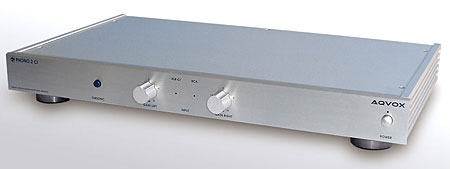
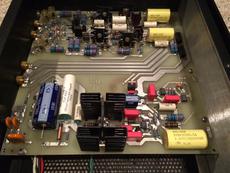
AQVOX 2CI MkII
This one intrigued me the most. Ever since I read Fremer's review in Stereophile I have wanted one, not because of Fremer, but because of the design. Not because of its fully balanced nature, but because of its innovation. My experience with this phonoamp tuned out to be exactly in line with the very thorough report in Stereophile, as well as reviews in tnt-audio and 6moonspositive feedback and particularly from 10 AudioSalute!

The seller of my unit had balanced tonearm cables whereas I do not, and was not about to re-terminate. So I started with the RCA inputs. It performed well but not quite distinctively. So I moved onto the XLR input. Not about to buy their own adapters, I decided to use my cheap Chinese XLR to RCA adapters. I knew this would not work as is, and certainly no sound was obtained by plugging them in directly.

I opened up the adaptors and saw that pin 3 is tied to pin 1, and that is the connection you have to break (pin 1 should not be used). Some quick de-soldering action later, voila! And what great sound! One play of Kondrashin's Philips LP of Shostakovich Symphony No. 15 and I decided it is going to be a long-term relationship. If you know this symphony, you will know that the equipment's main job is to (1) portray accurately the battery of percussion; (2) to convey a certain quality of life ticking away, an enigmatic quality. You may think (1) is not so difficult, and certainly the AQVOX performed miraculously in this aspect. Certainly, I tried the same LP on various phono setups, including tubed ones, and AQVOX's performance remained unrivalled. Even more importantly, it conveyed (2), proving it is not just merely an analytical machine, but a master communicator! A winner!

Audio Research PH-1(PH1)
It is interesting to study how ARC makes phono equipment. Indeed ARC played the most important role in keeping tube preamps and tube phono equipment alive during the transistor years. All the older tubed SP series (which they in recent years revived a little) preamps have built-in phono sections (seriously speaking, they are only MM stage) of superb quality. I have owned and am quite familiar with the SP-3, 6, 8, 9, 10 and 11. In HK, until a few years ago I used the SP-11 MkII as my reference (still with me). With my sensitive horns, the lowish phono gain of the SP-11 (higher than the others) was enough even with my MC, the Denon 103. During these years, ARC made the mostly solid-state MCP series of phono pre-preamplifiers to satisfy the requirements of increasingly low output MC cartridges.

In 1989, ARC abandoned the SP series and introduced the LS series linestages. Of course, they needed to make outboard phonoamps to go with these, and the PH series was born with the introduction of the solid-state PH-1. Since I have always had ARC SP preamps around and they have superb phonostages I did not really need to try these out.

When ARC introduced the tubed (actually hybrid) PH-3 I did try it out. The sound was not quite like the phonostages of the SP series: less full bodied even after tube-rolling, a lighter sound. But its Achilles heel was a lack of dynamics. The nominal 54 db gain was a bit over-rated IMHO. I sold it after a while.

Fast forward to now. Recently I got a PH-1 (full info here) in excellent condition, and I was surprised by its performance. At 48 db, the gain was low and I could not use it with my MC's even with my horns. But partnered with step-up transformers the sound was crisp and full, dynamic and lively, in the best of the ARC tradition.

There is an interesting review of PH-1 by Stereophile-Robert Harley. There is also an interesting comparison of PH-1 vs PH-3 in Audiogon. For me, the PH-1 is a keeper, a better phonoamp than the later, popular and rave-reviewed PH-3. For one as dedicated to tubed phonostages as I, that says a lot. YMMV.

Musical Surroundings Phonomena II can be quickly dismissed. Although it has enough gain for my MC cartridges, and loaded with features, I found the sound curiously lacking in finesse. It has good bass and reasonable dynamics but, most annoyingly, strings lacked sheen. I played several Heifetz mono LPs through the Denon DL-102 mono cartridge and the violin sound was so lackluster it was not better than the AT's built-in phono!!) A switch to the ARC PH-1 immediately restored normalcy. So much for all the rave reviews; it turns out the small prints are much more important than the rest of the reviews.

PS Audio GCPH (Stereophile, What HiFi?) fared much better (see also my previous experience). You can frequently find this phonoamp discounted and so it costs just a little more than the Phonomena, but its performance is in another league. There is just more music, and it performed evenhandedly with all set-ups. MM and MC alike. Heifetz? Yes, I recognize the sound, though I still give the edge to the PH-1. For a cheap full-function phonoamp, the GCPH is well worth considering.

YS Audio Solo 2 Phono pre-preamplifier
And now for something different, but what exactly is a pre-pre? Well, if a phono preamp is like foreplay (which is after all something before amplification), a pre-pre must be what happens before, I guess perhaps seduction, or whatever it takes to get to foreplay.

The active phono pre-pre is now a rare bird and no longer fashionable. In this high-noise age, it is no wonder stressed out audiophiles demand low-noise, and for additional gain when using low to ultra-low MC's usually opt for the even older but quieter technology of Step-Up transformers. An additional powered unit and an extra set of cables certainly can be cumbersome. But I have always thought the active pre-preamplifier has a valid reason for existence, as transformers can be colored and bandwidth-limited, and I still own the wonderful Klyne SK-1 as well as the Mark Levinson JC-1DC (one day I hope to acquire a Counterpoint SA-2). For myself, and perhaps I belong to a minority, if gain, noise or tonality are not issues, I prefer the potentially greater dynamics of fully active amplification rather than having a transformer in the signal path, but as always experimentation is the key here.

YS Audio Solo 2 is that rare bird. As a matter of fact, I cannot think of another CURRENTLY produced phono pre-preamplifier!! And it is one with a twist too. It is basically a solid-state device, but with a tube regulator (solid state rectification >> solid state regulator >> 6N3 regulator >> to gain stage)! I got it in HK but took it to NYC, where I proceeded to try it out in august company. Using the Chinese stock tube it proved immediately a winner. I set all my MC/MM full function preamps to MM and connected the Solo 2 with Kimber KCAG. As expected, it immediately proved its superiority over the JFET section of the Elekit TU-875. More importantly, it was not shamed by the step-up transformers inside the Verdier Control B as well as the EAR 912. Noise is acceptable for use with my Tannoy Canterbury HE, Gain is very good and sounds like more than its spec of 20 db. In NYC, it proved quiet enough to use with my 100 db YL horns. I also tube rolled a bit. The WE 396a proved superior, though a little noisier than the stock 6N3. Unfortunately, my Bendix 2C51 on hand proved too noisy in this circuit. But it is amazing the tube regulator has such effect on sound.

Why not get a free line preamp with your phonoamp?
Outboard phonoamps come in all sizes and prices, but I can tell you one thing: it will take quite an expensive phonoamp to outperform the phono section of (usually older) full-function preamp. And so it makes sense to buy an older full function preamp and just use its phono section via the tape loop. In such case, you would not want a bulky or hot tubed unit, but there are ample choices.

An example is Linn Kairn with Brilliant power supply. Used in MC mode, it has high gain, is quiet enough, and tolerant of loading (works equally well with my Denon DL-304, Koetsu Black and Ortofon MC-5000). Some say it is as good as the Linn Linto. I don't think so, but the performance is certainly very good. For the same price as an outboard phonoamp, you get a full preamp and remote facilities (the preamp ain't bad, but I am a tube man)!

Of course, it would be even better to go tube. Here, you'd want a unit that is not too bulky or hot. I highly recommend the hybrid ARC SP-9's phono section, which offers 46 db of gain. The vinyl replay is pristine, quiet and nuanced, and if I am forced I'd think perhaps even better than the PH-1 . The whole preamp uses only 2 tubes and is only warm to touch. I bet its line section will outperform almost all solid-state preamps in overall strength. Considering its price is only a little more than the PH-1, I think the SP-9 is as good a place to start with tube phono as any. As a matter of fact, the SP-9 is really hard to beat in overall performance, even with much more expensive equipment. It serves as a benchmark for me (see here).

If you're willing to build it yourself, the Elekit TU-875 full-function preamp is a no-brainer. Its MM stage is fully tube, liquid and airy, the MC is more than useable and quiet (though as noted not as good as the YS Audio Solo 2). It is small and simply wonderful as a phono unit, and you get an excellent line section. More on this preamp later.

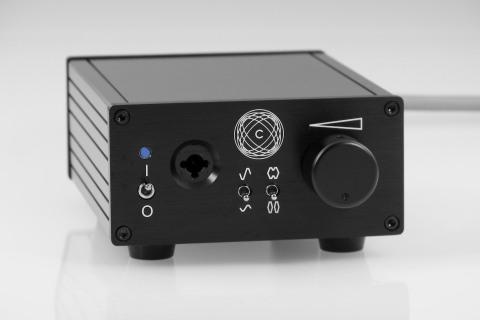
Brief Review: Meier Corda Swing

Brief Review: Meier Corda Swing

By chance in NYC I saw a friend's Meier Audio (Corda) Eartube, a long discontinued German headphone amp manufactured by Audio Valve. I was quite taken by its look, and did some research.

Meier Audio (Corda) has gotten quite a reputation, though it doesn't have a tubed model now (whereas Audio Valve does).

By chance I saw this budget model named Swing (official info) for sale at a good price on Audiogon, and I liked the look and bought it on impulse. In NYC I use the cheap Audio Technica ATH AD700, which does not present any problem.

The sound is finely detailed, yet not at all etched. Compared to the earphone output of my Nagra PL-P (through transformers), there is less bloom, but more extension at both ends. Some may prefer one over the other, but the Swing held up impressively well. For the AD700, which has a benign impedance, the low gain setting is enough, though the high gain setting has more oomph. The crossfeed matters little to me. Next time I think I shall bring it back to HK to test it with the much more difficult Sennheiser HD600.

Recommended. I think if I get the chance I shall get the Eartube.

23 May, 2011

Brief Review: Sony SCD-XA5400ES and BDP-S5000ES

Brief Review: Sony SCD-XA5400ES and BDP-S5000ES

I have long been a fan of certain Sony digital products. Many of their 16-bit and even some higher bit CD players certainly belong to the digital hall of fame. But these days we don't see Sony producing too many good audio products, so it is gratifying to encounter these two. Both I got very recently, so this is more a preview rather than review (perhaps I shall write an overview one day).

BDP-S5000ES as CD player
Sometime ago my friend princetonsound told me his Taiwanese friend was mopping up the recently discontinued Sony BDP-S5000ES flagship Blue Ray player. Besides the sterling picture quality, the sound was said to be quite good and the current steep discount in the US makes it a great bargain. And it was made in Japan (likely the last one of its kind), a sure guarantee of flagship quality! He got one, and so did I, for less than $400.

I used it as a CD player, and indeed the sound after break-in was impressive. If you listen casually, it will sound at least the equal of older but quality CD players like the Rega Apollo and Meridian 506.24. I did not do an A/B comparison, but substituting the British players brought perhaps a tad more rhythm and pace, a little more musicality perhaps, though at the expense of details. The sonic fabric is of one piece and wholesome. For an entry to middle level system this player can face off many dedicated CD players and is highly recommendable.

I don't even have one single Blue ray disc, but that may change. I have not even tested its DVD performance! I did get an HDMI cable and it worked. Next time perhaps.

Useful link: Home Cinema Choice review

SCD-XA5400ES
This one made news when it first came out. As Sony's only flagship SACD player in a while, it is descendant of its acclaimed predecessor, SCD-XA9000ES. Although the lighter built, cheaper price and lower number suggest a lesser product, it was rave-reviewed, generally regarded as an improvement, and awarded Class A+ in Stereophile. Many people bought it and then send it for after-market mods, which I'd not do.

It was discontinued and there were once substantial discounts on the Internet. Then it appeared largely sold out and the price of the remaining offerings went back up. I decided not to buy it until very recently, when I discovered a large new lot available from an Internet vendor at just a little over $800. The price was impossible to refuse and I bought one. This one though is not made in Japan, but Malaysia.

I actually had very few SACDs in NYC, so I played mostly CDs. The sound was pristine from the first disc, and did not require much burn-in at all to sound good (in contrast, the BDP-S5000ES had noticeable grain initially). Sound was so good I did not even bother to substitute another player. This is definitely a high-end player that would not shame itself in much more expensive company. No, it is not the equal of my Ensemble dichrono/Hi-dac combo (what is?), but it never puts a foot wrong. One thing though, the SACD sound output is quite a bit lower than the CD, and that makes comparison difficult. Hurry up and buy one if you're in the USA!

In the USA, at this time, this is a remarkable bargain. If you're interested at all, don't procrastinate and act now! Send me an email to tell me you like it if you do.

Useful link: HiFi Choice review, stereophile review

W3H1: Where can you buy that connector?

W3H1: Where can you buy that connector?

In hifi we sometimes are frustrated by unusual connectors. RCA and XLR are common and adaptors are easy to get (if not always of best quality), but we sometimes have unusual connectors for subs, various mini-XLR's, professional connectors for umbilical cord links, not to say firewire etc. It is often difficult to source these.

Indeed most often we don't even know the name of these connectors. How do you go about asking or searching on the net?

My Elekit 8230 and 8300 power supply use this type of (I presume) computer connectors. The male is already fitted onto the power transformer, and you only need to solder the female onto the appropriate voltage slot on the circuit board. Once soldered, the 7 pins would be very difficult to DE-solder and remove. Hence I was faced with the difficulty when I decided to take my 8300 to the USA. I didn't want to de-solder the connector from the existing 220V slot, and thought it would be easier to solder a new one onto the 110V slot.

My search was futile. Apliu Street didn't have it. I thought I should be able to find it in 華強, but wrong! I didn't want to order from RS or Mouser for such a small thing. Finally I asked the Elekit dealer in HK, cnamusic. They didn't have it, but Mr Lau was nice enough to request it from Elekit Japan. How nice of them to send it quickly! Many thanks to both cnamusic and Elekit!

Here in NYC, I spent less than 15 minutes making the conversion. The amp is singing beautifully with my horns!