Review: iFi iPhono, Nagra BPS
Talk Vinyl: iFi iPhono vs Musical Surroundings Phonomena II (also Nagra BPS, Audio Technica AT-PEQ3, AQVOX 2CI and Fosgate Signature)
Talk Vinyl: Naim Nait I vs Jolida JD-9 vs MFA Magus B vs iFi iPhono
 Part I: iPhono
Prologue
Part I: iPhono
Prologue When I first wrote about the iFi iPhono (
here) almost a year ago, I could not find any reviews. Subsequently, a few appeared, and here are some links:
Reviews:
AnalogPlanet;
EnjoytheMusic;
MonoandStereo
Interview:
Designer Thorsten Loesch Interview in MonoandStereo
First, A Long Digression 好事多折磨
In case you wonder why the real review of the iPhono took so long, it was because it was to be months before I actually heard it in my own system! It went through several guest systems before joining mine. I would like to spend a little time describing the journey as some of the results add to my understanding of this unit, and I'd also detour a little to write up briefly on some other phonoamps I have encountered. In case you cannot wait, you can jump to the real review below. I'll give you the conclusion on iPhono first:
the iPhono is a wonderful phonoamp, but it may take time and care to reveal its considerable strengths.
Detour: First Impression of iPhono (by others) My unit finally arrived about one month later. As I usually do not have time to spin vinyl these days, and as my usual abode has no vinyl set-up, I asked
friend A (vinyl and tube fanatic who uses Quad ESL-57) to pick it up for me and test it out. After a short try he told me the sound was not bad but a little too thin for his taste and I completely understood because I know he likes vintage equipment and a fatter sound. Then I asked him to pass it to
friend B (vinyl and jazz fanatic who uses Mark Levinson to drive big MBL speakers) who likes his music big and upfront.The iPhono did nothing for him in this system either. So far, things did not look too good...
 Detour: My Second Impression of iPhono
 (first was at the dealer) actually took place on foreign turf! Friend B decided to renovate his apartment. He had to move temporarily into a smaller place where he listened to a pair of
Quad ESL-57 placed side-by-side with reinforcement by corner placement (see pic). This actually sounds a lot better (fuller bass) than many "normally" placed ones! The little
Nait I amplifier did a good job driving them. On the day I went to pick up my iPhono we actually did a
small session of phonoamp shootout (MM only). The turntable used was a
Linn LP12 (Valhalla) fitted with a
Decca arm and
Decca Maroon cartridge. Loading was at the standard 47k, so some may argue about that.
The result was not surprising.
The iPhono easily bettered the Nait. The ultra high-gain hybrid
Jolida JD-9 (a unit bought in Shanghai) was more overtly exciting than the iPhono but less refined. The owner had also borrowed my
MFA Magus B, and on this occasion it was used as a phonoamp via its Tape Out. The MFA was decidedly the best, and that did not surprise me as its phono section is amongst the best I have heard, very quiet for a tubed unit as well.
 Review: iFi iPhono
Shortly after I reclaimed my unit I took it to
New York (thanks to its
universal PS, one reason I bought it) where I finally had the chance to really test it out during the nearly 3-month stay. I knew that it was probably not run-in, so it was one of the first things I plugged in! In NYC I spin vinyl almost exclusively. Equipment used this round:
Analog 1:
Linn LP-12 Lingo/
Ittok LV-II/
Airtight PC-1
Analog 2:
Clearaudio Concept
/Koetsu Black
Analog 3 (mono):
Thorens TD-309/
Denon DL-102
Other Phonoamps used:
Fosgate Signature (my experience
here);
AQVOX 2CI MkII used only for MC (
here);
Musical Surroundings Phonomena II (
here);
Nagra BPS;
Audio Technica AT-PEQ3 (only MM)
Digital: Ensemble
Preamp:
Manley Neo-Classic 300B
Loudspeaker/Amp 1:
Magnepan MG 1.7 (used with
Sunfire 300 amp)
Loudspeaker/Amp 2:-
YL Acoustics 4-way Horn Speakers (used with
Wavac MD-811 SET amp)
 My previous phonoamp group review
 covers some of the units on hand for comparison, so it is relevant for this article. I dare you to find a more detailed or useful iPhono review! :-) I must have played more than 100 LPs during my stay, but I will single out 2 of them. The Unicorn
Horenstein Mahler 3rd (in the US also on noisier Nonesuch) is a magnificent recording of a magnificent performance, with a huge orchestra and more than one chorus! Note that this famous recording is
now on HDTT reel-to-reel tape!The
Miles Davis Tutu is of course classic and one of my favorites, still Marcus Miller's best effort. There are many passages of complex instrumental interplay that tests the phonoamp's savvy. Another reason I use this LP is because I have the CD and I use them to make sure both the digital and analog rigs are balanced. Vinyl enthusiasts should do this often; too often they tweak so much that the sound is way
off.
Observations I am not going to give a blow-by-blow description of how various LPs sound with the iPhono. It is not necessary, because (thankfully for all the right reasons) its sound really does not stand out. But over the few months I made some observations that I think are interesting:
- Note 1: My impressions are almost exclusively based on the MC setting (I do not listen to MM much, though the mono Denon DL-102 uses the MM setting). For MM, usually I'd prefer tubed amplification.
- Note 2: I got so caught up by my listening that I did not spend any time evaluating the equalization curves (though I have many mono LPs). After all I do believe the basic aspects of the phonoamp are much more important.
- Run-in I suspect the unit needs quite a bit of run-in. I am sure it had a lot less than 20-30 hours on it when I got it back. Initially the sound was a little uninspiring, but I just played on. Read on.
- Vibrations I have said before that my racks in NYC leave something to be desired (placed on stone slabs on thick carpeted wood floor). Certainly, it made my preamp prone to microphonics. I found out the light and slim iPhono was quite susceptible to vibrations! I could hear a trace of smearing much like microphonics in nature. Putting two Vibrapods (here) underneath immediately cleaned up the sound and gave the impression of more solidity. I also noted that the susceptibility to vibration decreased with time and run-in; I wonder why? I also tried Tony's trick of putting some books on top but in my setting that did not reap extra benefits, so for the entire duration in NYC only the Vibrapods were used.
- Background Noise (lack of) You should note that among the battery of phonoamps here iFi is one of the few that fearlessly publish various specifications (AQVOX and Nagra do; Fosgate and Phonomena don't). One listen and you know why: one is immediately impressed by the extremely low noise floor (Signal to Noise Ratio 82dB). This is black background unusual for a budget phonoamp, indeed unusual for any phonoamp! In comparison, it is as quiet as (or quieter than) the more expensive AQVOX and battery operated Nagra (no mean feat!) and certainly quieter than the (pretty quiet) Phonomena II and Fosgate Signature (which is excellent for a tubed unit). This low level of noise, especially in MC, is quite an accomplishment. Now, that brings up the next question/observation.
- Dynamics, or Is there Life in Low Noise? This is a little hard to describe. Experienced listeners know that with lowered noise and darkened background often comes a degree of "reticence" in the music making, as if the baby has been thrown out with the bathwater. It is often debated whether the "diminished dynamics" is just erroneous human perception. In such cases, often the music only comes to life when you crank up the volume. Now, personally, especially as a tube and vinyl person, the debates aside, I am not obsessed by noise level but I do think any component/system that cannot be enjoyed at a low volume, that does not have good microdynamics, is bad, period. Not so the iPhono - in my reference systems it performs just as well (and sounds just as as well and quiet) at all volume settings, with all kinds of music (unlike the Phonomena II). Its dynamics are properly scaled. In the grand opening of the Mahler, the iPhono puts you in a mid-hall perspective. In contrast, the Phonomena II is upfront. While the latter may have more overtly exciting bass and slam, overall its presentation is falsely highlighted dynamically. As the movement goes on, with the iPhono one is aware of natural progression, of unfolding drama, whereas the Phonomena II increasingly seemed to be a pastiche of highlights. I do think the composure demonstrated by the iPhono means that while it will work best in a balanced system, in less ideal circumstances I rather think it should work better in an over-energized system than one more sedate. The corollary is that the iPhono, unlike much modern hifi, does not set out to "impress" - it rather demands you to listen carefully (and you can do that at low volume!)
- Hall Sound Experienced listeners listen for the hall sound, or that of the recording venue. In digital, a good example of the faithful rendering of hall sound would be the 16-bit TDA1541 chip; nothing else since has really come close (all you have to do is compare a 16-bit Revox B226 with a later delta-sigma Revox C221 and you will know what I mean, though the latter is a very fine machine otherwise). The iPhono is exceptional in this regard. The Mahler just heaved and sighed, bathed in the hall acoustics. I am not surprised, given that designer Thorsten Loesch is a fan of the 16-bit chip! In contrast, the upfront Phonomena II gave no clues to the hall, a serious failing to my ears.
- Rhythm and Pace The iPhono is excellent in this regard. The flow of music is always natural, yet not without a spring in the step. Take Tutu as an example, the various instruments were not unduly highlighted but the delicate interplay came over as part of a whole fabric. The Phonomena II on the other hand seemed to be more visceral initially, but soon I got worn down by a certain uneasiness - the music just did not flow as the phonoamp imposes its own insistent quality.
- Gain The gain of the iPhono is pretty standard. Since my favorites are big orchestral music I use the +6 db setting. At high volume, I do find it a little more dynamic and not much noisier. The gain is sufficient for my Koetsu Black, Air Tight PC-1 and Denon DL-304.
- vs Fosgate Signature In some ways the iPhono breathes in a way not unlike the Fosgate. The tubed unit has more bloom (as it should) and dynamics, though comparison gives credit to the iPhono for running it close in its fine grain, details and smoothness, an achievement for a solid-state unit.
- vs AQVOX 2CI MkII The AQVOX is quite a different beast in its design. Used in balanced mode it has higher gain (though reduced by my use of an adaptor I am sure). The AQVOX is more overtly exciting and dynamic than the iPhono, though the latter runs it close in details and S/N ratio. I love the AQVOX and it shall remain one of my references, but comparison certainly made me respect the iPhono!
- vs Audio Technica AT-PEQ3 (only MM) Michael Fremer (Stereophile, Vol. 32 No.12 December 2009) had this to say abount the AT: "How about a sweet sounding starter phono preamp that lists for
$119...? It's the Audio-Technica AT-PEQ3, a little plug'n'play box with a
wall-wart power supply that's quiet, sounds clean and surprisingly
dynamic, and get's the job done remarkably well.". Using the mono DL-102 I did compare this against the MM section of the iPhono and Phonomena II. The AT-PEQ3 is more like the iPhono in reduction, a unit that lets the music flow naturally, unlike the upfront and unnatural Phonomena II. Of course, it has appreciably less details and dynamics. I also briefly added a step-up transformer for MC use - not bad! A fine unit at the price!
- vs Musical Surrounding Phonomena II If you have read this far you know that I do not much like the Phonomena II. Yes, I much prefer the iPhono! To me, all the praise heaped upon the Phonomena II just shows how wrong hifi has become.
Conclusions
- The iPhono is unusually fine-grained and quiet (not just at its price, but comparable to most products regardless of price). It makes the music flow naturally, and has excellent rendition of hall sound. It doesn't play to the gallery, instead rewards in the long term.
- The iPhono compares well to more expensive phonostages (even to the Nagra BPS reviewed below), and so is surely a BEST BUY. I think mid-priced phonoamps, not to mention budget ones, will have a hard time going up against the iPhono.
- In the company of all the phonoamps I have, for three months I listened mostly to the iPhono (save for comparison purposes); that should tell you more than this review how satisfying the iPhono is!
- Take time to run-in and check for isolation.
 Part II: Nagra BPS
I have always been a fan of Nagra and have owned its tubed full-function preamp, the wonderful
Nagra PL-P (
my reviews here and
here) for a number of years, so I am quite familiar with its phono sound. Recently I acquired a BPS and took it to
NYC, where I tested it by the side of the iPhono.
Whereas the phono section of the PL-P preamp and the newer VPS phonoamp are tube-based units,
the BPS is a solid-state device. Although tube-based, the VPS uses solid-state devices for its last 16 db of gain (unlike the PL-P, which I think is all-tube). Like its more expensive brothers,
the BPS employs transformers (wound in-house) for MC step-up function. Like the PL-P, the
BPS is battery-operated, though in a simpler manner by using a simpler 9V cell. Thus, you can infer that the BPS is no cheap compromise, as borne out by its sound.
The BPS (
official literature) has been well reviewed (using multiple high-end cartridges) by
TAS and
Stereophile.
6moons has a review too but it is limited to use of the Denon DL-103.
After spending
so much time writing on the iPhono, I am going to be a lot briefer when it comes to the
BPS: simplement fantastique!
Observations
- Much of what I wrote about the PL-P (links above) can be applied to the BPS! Indeed, comparing the BPS to the PL-P (from memory, though I did have the PL-P on hand but did not fire it up) is not unlike comparing the iPhono to the Fosgate (see above).
- The battery-operated BPS is very quiet. But the iPhono is subjectively equally (perhaps even more) so. In this regard, the achievement of the iPhono is outstanding. If blind-folded and asked to tell which is battery operated, I just may say iPhono!
- The BPS is fast and has a leading edge that is just right in speed and sharpness. Its superb microdynamics make music easily come alive. In these respects I do prefer it to the much cheaper iPhono. Here, for the same reasons that I detailed in the section on background noise in the preceding iPhono review, I should say I am not usually a fan of batter-powered equipment, but the BPS does not suffer any of the shortcomings of battery operation. In terms of macrodynamics, it is certainly not wanting. In some regards, sonically it resembles AQVOX the most.
- Like the iPhono, if you don't use care in cabling tonally the BPS may be a wee tad towards the lean side, but still far from lean (think Phonomena II). It has just a tad more bloom than the iPhono. In both my systems, it rendered everything faithfully and, importantly, delightfully. I am not sure what the 6moons reviewer was talking about when he mentions the mid-bass/bass. My opinions are closer to the TAS and Stereophile.
Conclusion
- The BPS, though not cheap, is actually a Best Buy! It is now one of my references.

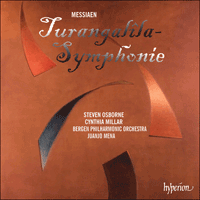 The Messiaen is stunningly recorded, brimming with details.


 Led by the former leader of the Borodin Quartet, the immaculate playing that surpasses almost any current ensemble I know.
 Magnificent performance by young and gifted conductors!





 Posts
Posts