20 January, 2022

Saint Saens


Streaming Classical (22-2): Saint Saens
Basic Repertoire (22-1): Saint Saens


With this post, I will renew a feature: posts dedicated to the works of one (or more) composer(s) that constitute Basic Repertoire (label: Classical Music - Basic Repertoire). I obviously won’t first write on giants like Bach, Beethoven, or Mozart, as they had produced way too many great works to be treated adequately in a shorter article. Let’s start with someone who is known but not nearly as well as he should be.

Last year was the Centenary of the death of the great Saint Saens. This was not lost on many quality record labels, which for the last few years had issued a lot of recordings, especially of his lesser known works. The discography has been immeasurably enhanced. First, recommendations for the audiophile favorites pieces.

Symphonies No. 3, “Organ Symphony” is well known. While no recording can fully capture the concert experience, many are positively stirring. The classic BSO/Munch probably cannot be bettered (RCA Living Stereo), and I also highly recommend Detroit SO/Paray (with no less than Marcel Dupre at the organ; Mercury Living Presence) and OSR/Ansermet (Decca). Jean Martinon is also very good (he recorded 2 that are very similar, but the sound qualities are not quite up to those mentioned here). Another very different reading that was recorded upfront is Chicago SO/Barenboim (DG), one of this volatile conductor’s better discs. Naturally, there had been a recent spate of recordings of this warhorse. The piece is so beautiful that it is hard to find a reading that totally disappoints. For a different take, try the very recent Les Siecles/Xavier-Roth (Harmonia Mundi). Rest assured, everything this team does is worthwhile (and in great sound) and the period instrument touches miraculously do not ruin the unabashed romanticism of this score. The coupled Piano Concerto No. 4 is also very nicely played by Heisser.

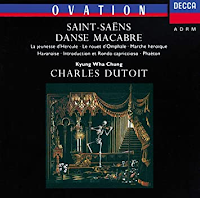
Danse Macabre and other Tone Poems Many of you have known Danse Macabre since your childhood screening of Disney cartoons. I don’t have a favorite but audiophiles swear by the sonically resplendent Philharmonia/Dutoit (Decca Ovation), which also contains the equally delightful work Le Rouet d’Omphale; usefully it also has 2 violin chestnuts described below very well played by Kyung-Wha Chung.

Carnival of the Animals This (particularly The Swan) is of course an audiophile favorite. As everyone probably has his own favorite, I won’t offer a recommendation. Every big name instrumentalist (like Argerich) has enlisted friends to record this work, and choices are unlimited. Find your own pick.

Introduction and Rondo Capriccioso and Havanaise
These marvelous pieces sometimes get played because but they are frequently coupled with audiophile favorites Ziguenerweisen (Sarasate), Poeme (Chausson) and Tzigane (Ravel), as in Erick Friedman’s Violin Showpieces (RCA Silver Seal). The title was for the CD only and the material came from different LP recordings, The CD is long oop and fetches a good sum on the second-hand market. It has also spawned many opportunistic “audiophile” remasterings of no merit (XRCD, LPCD, HQCD etc). The material can also be heard on RCA’s Erik Friedman box, also oop but fortunately available for streaming. If you haven’t heard this album, by all means stream the material and see why it is so famous. I won’t say they are all first choice, but Friedman was certainly in his elements when he recorded them. Listen to them and you will know what is missing in many a performance (say, Mutter). For more violin morceaux, elegantly played, I recommend Tianwa Yang (Naxos).

The above works are about the only Saint Saens I’ve ever heard at audiophiles, but there are several that really ought to be in everyone’s collection.

Piano Concerto No 2 (out of 5) This is the only one played often. Obviously, it has its considerable charms. My first encounter is still unsurpassed: Rubinstein with Symphony of the Air/Wallenstein (RCA Living Stereo; better than his remake with PO/Ormandy). For years, there were no real competitors, but now things have changed a little; as detailed below, some recent piano concertos cycles are just lovely, though Rubinstein still reigns.

Violin Concerto No. 3 (out of 3) is the only one well known and it’s a very charming work. Many legendary violinists (like Szeryng and Grumiaux, but strangely not usually German or Russian ones; as an example, Heifetz never recorded this) have recorded this and I urge you to sample their recordings. For an offering in fine modern sound, I like the swift Kantorow (before he turned conductor), ably partnered by the Tapiola Sinfonietta/Kees Bakels (BIS, part of their excellent complete violin works series).

Cello Concerto No. 1 (out of 2) is the better known one, and has been recorded by many great cellists like Rostropovich and Tortelier, but I recommend a dark horse (Walevska on Decca). Given the large number of good French cellists, there are many good ones among recent offerings; I pine for Bertrand with the excellent Lucerne Symphony under Gaffigan (who can do no wrong; Harmonia Mundi).

What about the rest of the symphonies and concertos? Are they worth our attention? In this age of streaming I’d say it is an emphatic yes. The master’s music is always engaging (even his prodigious youthful works) and it’s always time well spent. If you want to relax after some strenuous listening (yes, good music can be challenging, even relentless), he’s your man.

Symphonies We have treated No. 3 above. As for the rest of the Symphonies (2 more aside from 1 and 2), they have always been neglected. For years we only had the very fine set by ORTF/Martinon (EMI). It is astonishing that just very recently no less than 3 cycles of his symphonies were issued. They are all very fine and there’s very little to choose between them. Suit your own taste. French National O/Macelaru (Warner) probably has the most powerful playing, but the Liege Royal Phil/Kantorow (BIS) play most sinuously (this is an under-sung orchestra). I haven’t heard the Utah SO/Thierry Fischer (Hyperion; not available on NML) but I’d bet they cannot beat the other two. Audiophiles (Americans mostly) tend to praise their regional orchestras to the sky (another example is Kansas on over-rated Reference Recordings) but, sorry to say, despite their power, they often lack the last ounce of tradition, vision and finesse that even “second-tier” European orchestras possess.

Piano Concertos Aside from Rubinstein’s No.2 (RCA, noted above), I have treasured the historic recordings of all 5 by French Doyenne Jeanne-Marie Darre (EMI, good mono). These works have received particularly great attention recently. Aside from the cycle by Descharmes (Naxos, noted below), there are great contributions by Chamayou (Warner), Kantorow (junior; BIS), Heisser (HM, noted above). A feast! Of course, all respectable French pianists of years past have recorded these works, but my feeling is these newer challengers are better.

NAXOS’ Comprehensive Survey Naxos has contributed greatly to the Centennial, All under the guidance of the excellent Malmo SO/Soustrot. Their Symphonies, from a few years back, are no less worthy than those mentioned above. The cello works (Schwabe), Piano concertos (Descharmes), and Violin works (Tianwa Yang) are all top-tier. Sonically very fine too.

Other Works The great composer was so prolific that we all have a hard time keeping up. There are innumerable chamber and solo works, for every imaginable combination. Not to mention vocal works. Maybe another time.

A Personal Favorite The cumbersome name is Caprice d’apres une Etude en forme de Valse (Caprice after an Etude in the Form of a Waltz). IMHO this work is top-tier, no less than any Saint Saens. BUT, it is an arrangement by the great Belgian violin virtuoso Ysaye (loved by the composer himself) that is really astonishing. The above-mentioned Kantorow’s disc of Violin Concerto No. 3 (BIS) contains this, and it is a fine performance, but my heart belongs to an older, more measured, recording featuring Yan Pascal Tortelier (similarly a violinist turned conductor, EMI), now likely only available buried in the EMI/Warner set of Birmingham/Fremaux.
Incidentally, I grew up with Fremaux’s and Martinon’s recordings, and they are still very good, but the modern recordings have sonic advantages.

I hope you have enjoyed this first installment.

17 January, 2022

Subwoofer!!! Wowed!


Click pics to enlarge.

Letter from Hong Kong (22-1): E Lo wowed by Subwoofer

Editor: E Lo actually struggled for quite a while before arriving at satisfaction. This is par for the course. Although I suspect audiophiles secretly dig the frustrations of others (especially if they themselves have been stuck), I am still glad he spared us the details...:-)

All through my hifi journey, I have not been a fan of the subwoofer. I have never craved mega bass; rather I think of myself as one who prefers quality over quantity. Even after having skimmed through many articles about subwoofers on this website, I still did not develop even a slightly urge to try. How wrong was I!

Although I had been contented with my setup, I have not stopped searching for hifi nirvana and was constantly looking for ways to upgrade my system without hurting my wallet. I always believe experience can save you wasting big bucks, LOL! The numerous articles, including DJ's many posts, claim that once hooked up to a subwoofer, one will never let go, and also that there is no need to buy an uber expensive one to achieve the goal. Eventually, I began looking at a cheap 2nd hand one in HK’s most active 2nd market review33.com to see if there was any good deal around. I saw many great brands like SVS, Velodyne etc. Then I noticed that there was an Audio Physics 10" active Sub selling for 200 USD and, without much thought, I brought it home!

I didn't have the luxury to place it at different spots. So, it's sitting next to the right side of my Dynaudio Crafft speaker, with bass driver facing me.

There are a few ways of connecting it and I chose (Hi Level) direct wiring from the speaker binding posts of my 47 Lab Gaincard, which I think is most direct and best way (Footnote 1).

I have then spent months listening to it, experimenting with different settings in gain, volume and crossover frequency, plus the option of using single or dual Humpty Power Supply for my 47.

Single or Dual Humpty This is a love and hate situation. After prolonged listening, the difference is obvious. Single sounds rawer, and grainy, with slight gain in speed but with loss in control, clarity and separation, at least in my setup. With duo Humpties, the overall sound is not slow, nor cool, but just a tad polite, yet with control and stability (Footnote 2).

Part of the politeness I suspect is probably due to the new Gotham speaker wires I was using with the Crafft. It replaced the speedy Mogami I was using before. However, I feel the gain in overall clarity and texture is worth the loss in speed so, for now, the Mogami is used for hooking up the sub (Grimm TPR is still gathering dust).

I finally have to admit while 47 Lab 50w x2 can drive my Crafft admirably, it's still a difficult speaker to drive. With the 100W D class subwoofer, it frees up the Crafft.

Settings on my Subwoofer After much trial and errors (I am going to spare you the pain of going through mine), my settings are: High Gain (Footnote 3), Higher than average Volume and High Crossover Frequency. At least it works for my setup. Crossover frequency is now set to 80 Hz, and Gain and Volume roughly 60% in both. It seems to work fine for me, different from what people generally prefer (lower settings; Footnote 4).

So, do I get thundering bass? To be honest, I'm more interested in getting the "side-benefits" than the added bass oomph. But I must say the result is far more than I had hoped for and I am pleasantly surprised!

So, what did I gain? The bass has indeed absolutely improved in many ways: I have now got real bass - the fullness, the size, the bounciness and authority are there, and the definition of bass has vastly improved.

The bass now does have the scale and authority of floorstanders. Ultimate density and impact are still not the best, but the ripe and sinewy bass is there.

What else? Overall clarity has improved significantly as well; soundstage has expanded; timbre and rhythmic portrait has improved so much that my previous listening experience could be described as behind a piece of plexiglass, or reading with glasses that are under-prescribed. Gone are the slight smearing and smudge!!

Overall, music presentation is analog-like, relaxed, with no digital glare. It is dead on timing, with natural microdynamics, wide soundstage that extend beyond the speakers (if the recordings have it). Instruments separate clearly while seeming to gel with each other cohesively. Timbre is brilliantly accurate’ midrange is clear, free from grain, with no added euphony, and is non fatiguing! Treble maintains the noble and sublime quality of the Esotar tweeter (Footnote 5). Overall, a balanced system with zero MSG and highly enjoyable. It is not type of sound that tries to grab every second of your attention, which can sometimes be too much of good thing and may not be the best especially when you just want to relax and submerge yourself in music.

I especially find it very well suited in listening to pop and jazz. plus a bit of funky and soul music.

Listening to Toto's Taking it Back, the intro phrase that was played three times can be heard distinctly in three positions. First, the left, then moving to halfway between left and middle, and then dead centre. Previously, I did not pick up the progression at all.

Overall, it seems like I'm rediscovering every recording I have been listening to, even songs that I’ve heard 100s of times!!!

To me, this is one of the most substantial upgrades in my hifi journey and I can only regret that I have not done it much sooner! (Footnote 6)

I told my friend Kwong about my experience, and he immediately bought a Rogers AV subwoofer and had some painful experience in setting up. With his Audionet SAM driving the high and mids of his Auioplan small floorstander (and super tweeter), and power amp driving the bass of Audioplan and subwoofer, the improvement is again significant after some very careful adjustments of the settings. Both of us are now happy believers of subwoofers!!

As for you, WAIT NO FURTHER, GO GET A SUBWOOFER IMMEDIATELY, LIFE IS SHORT!!!!!!!

Editor's Footnotes: (1) All active subwoofers offer Low-Level (Line Level) and High Level (power amp output) connections. Each has its advantages and disadvantages - the former likely sees more impedance variations than the latter; (2) The more fluid performance of a single Humpty had been noted by some reviewers before. This raises questions about the use of separate power supplies and monoblocks in "higher end" (and over-kill DIY). Think about this. McIntosh MC40 x 2 and MC75 x 2 are well recognized to not sound as good as their stereo counterparts MC240 and MC275; (3) This appears unique to Audio Physics (imho not a bad company). I know of no sub that has this Gain setting. Mind you, AP designed these for their own smaller loudspeakers, and other users must adapt. It's great the E Lo surmounted the problems; (4) Audiophiles jealously guard their main loudspeakers and are reluctant to "contaminate" the "special" woofers of their preferred speakers. But they are highly mistaken. Better bass delivery eases everything and will open up things, as E Lo had noted. In terms of crossover frequency, I have always found a higher point to be more coherent. Never cross lower than 60-70-80. I assume you are using small speakers; (5) The Esotar is likely the most famous Dynaudio tweeter ever. It was used in many high-end loudspeakers, from Ruark to Sons faber. I still own the SF Electa Amator II, which imho is better than the I, but the I commands a higher price because of the Esotar (many samples have seen repairs). The Esotar is also used in the legendary Extrema; (6) I beg to differ. It takes time, a LOT of time (and money misspent), to mature. If E Lo had done these 10 years earlier, when he was likely more tempestuous, he would have dismissed the whole thing! The subtle changes take experience to recognize. Don't we all regret our many decisions of our youths! Take Home Message: As E Lo implied. the real benefits of a subwoofer are not necessarily in the bass department, but felt in overall musical presentation.


15 January, 2022

Accordion Salon Folk Music


Click pics to enlarge.

Streaming Classical Music (22-1): Byways - Accordions, Folk and Salon Music
Letter from Shenzhen (22-2): Byways of Classical Music


Happy New Year, I have a lot of Streaming advice to air but my compulsive self and penchant for long articles impede progress. So, I decided to jump-start the year on a lighter note. Byways, or Crossovers, or...

Accordion Though familiar to many who listen to folk music, the accordion is not really a classical musical instrument, yet its coloristic potential has been recognized by many modern composers, including (the great) Berio. Today, there are many virtuosi who actively transcribe music for this instrument. For myself, I love the sound of the instrument, as it invokes simple joy and nostalgia (used in many great films).

This is a temporal narrative. Just recently, I was stunned by Russian-Canadian Alexander Sevastian’s Bach recording (Analekta). It is of course a closely miked recording, yet it conveys the bowel sound of the instrument that is not at all unlike the mighty church organ (without the hall sound and reverb). An audio trick, but a good one.

Aroused, I dug more into this musician. I listened to his other excellent albums. Too bad he had recently passed away, but I learned that he was in a “light classical” ensemble called Quartetto Gelato. I streamed some of their albums (Linus, Marquis, etc), not available on NML but are on China’s Kuwo streaming platform. The first one I streamed was Mazurka, and it gripped me. This is a great group, capable of anything. I have long been familiar with “salon music”, from the olden times of Alfredo Campoli to now. Not many albums command total attention. But this group is superior. I urge you to explore. Although I listened to them on Kuwo, I am sure they are on Spotify and Tidal. In the coming days I shall stream more of their stuff.

This kind of ensemble is not uncommon. For Americans, Bluegrass derived Bela Fleck should be familiar, but, for classical oriented person like me, I prefer the Ensemble Gelato, not the least because of the bass weighting of the Accordion. But, I’d take this opportunity to recommend again anything played by banjo wizard Chris Thile, who has appeared with Fleck, Yoyo Ma and the likes (his Sony Bach albums are gems).

As mentioned, the accordion has raised its head in recent times. Even I caught up. Richard Galliano first called, and I cherish his Bach album (DG). And then DG followed with “sexy” Ksenjia Sidorova, whose programs didn’t really arouse me. But then now I have discovered that her earlier albums (Alpha and Champs Hill) contain much more challenging material! You should stream those, rather than DG. This is a serious musician. And now Sevastian, whose recordings are more “masculine” and have much weightier recorded tones than the more refined sound of Sidorova.

When it comes to Accordion, one cannot escape Astor Piazzolla and the Tango. But, as one reviewer remarked, it’s a tribute to these musicians that their best tracks are not Piazzolla!

Russian Folk Music And the accordion’s cousin Bayan. I have long loved Russian folk music. The Russians play their folk music with an orchestra sporting variously sized balalaikas (and the Chinese orchestra copied that with the erhu) with the support of bayan and dorma. One of my favorite albums is the Balalaika Favorites (Mercury). Indeed that is my number one Mercury album, and that says a lot for a hifi addict. For those who can source it, an equally worthwhile album with even more folk music (like Troika) by a more modern iteration of the same Osipov Orchestra is Evening in Moscow (Moscow Nights) 莫斯科近郊的晚上 (Hong Kong label Hugo, 雨果, excellent sonics). I never tire of hearing these.

Salon Orchestras As mentioned, Salon orchestras have long been around. I’d like to remind you here of an audiophile favorite, Maastricht Orchestra’s Serenata (originally on Philips). This orchestra sported crossover prince Andre Rieu but is favored by silly audiophiles for its bird song. However, musically it is pretty satisfying.

Hard to Categorize Finally, I urge you to listen to classically trained Chinese composer Gong Linna 龚琳娜. Her song tante 忐忑, is improvisation based, in an invented “Chinese style” that in my opinion is no less worthy than any of Jazz’ greats. It fully deserves its viral spread and innumerable imitations on 斗音Tik Tok.

I hope this is short and sweet. It has been for me, and I hope so for you too. All the best in 2022.

06 January, 2022

Swan Lake


Click pics to enlarge. Above, note the locked feet in the corps. Below, the esplanade.

Jan 3, 2022, Bay Opera, Opera House
Shanghai Ballet
Tchaikovsky Swan Lake, Grand Version

Letter from Shenzhen (22-1)

With Chinese New Year on the horizon, the lockdown of Xian and a smattering of cases in many provinces surely have put immense pressure on Chinese health officials. Miracle of miracles, a string of performances in Shenzhen, at the Bay Opera, Concert Hall and Grand Theater went on as usual to end 2021 and start 2022. Shenzhen Art lovers had been well served! If not for living so far away, I’d have attended more of those performances, particularly those of the National Beijing Opera (traditional Chinese opera).

I’ll have it out: this was a miraculous performance that will remain in my memory for a long time. True to its name, it was Grand indeed.

The choreographer is English Derek Deane, who used to lead the English National Ballet. This ballet is well travelled and has had many versions and revisions over the years, even an amazing one “in the round” (Derek Deane on 20 years in the Round). English critics were not at all completely impressed, at least equivocal, in their reviews. Witness the Guardian 2016 Review.

This Ballet is one of Shanghai Ballet’s signature pieces and they have taken it on the road often, to great accolades. The SB’s official website (Chinese, English) quotes a Dutch review. Damn! This very production actually toured NYC in 2020, at the start of the pandemic! I don’t usually closely follow ballet so I missed out! Doubly regrettable since it had the estimable City Ballet orchestra in the pit (their excellent Christmas Nutcracker run is a NYC institution). This 2020 Review of NYC performance is excellent, and I urge you to read it as it pretty much sums up my feelings.

I watched the “matinee” performance, as it made the 2 hour travelling each way more manageable. It was a magnificent day and I took in the nearby waterfront like a fish to water. It was reminiscent of Hong Kong, but the air was better and there were less people (even on a holiday), enabling a more leisurely feel.

The leads were performed by the second cast of Feng Zichun 冯子纯 (Odette/Odile) and Tu Hangbin 涂汉彬 (Siegfried). The night before, they were performed by the better known pair seen in NYC and Europe.

The choreography, not so much for the leads than for the corps, is more stylized and geometrically patterned than more traditional versions (here my cheap concession ticket in the balcony, with its aerial view, actually confers an advantage). It was certainly a completely different viewing experience than the ABT and the Russian one I watched decades ago at City Center (NYC). The leads, especially Feng, danced beautifully, technically perfect (axial alignments of the limbs, even in turmoil, as in being snatched by Rothbart, were something to marvel at, not a whit less impressive than her Western counterparts,) even if slightly reticent in emotional expression, particularly as Odile (she is very young). But, of course, for this ballet, the corps have the pivotal role (punt intended). And it is here that the immensely high standard of the Shanghai Ballet manifests itself. Despite the height disadvantage when compared to Western corps, they are truly outstanding, the synchronicity truly astonishing, especially for such a large corps (48 swans in the corps! hence the name “Grand Version”). The way the members daisy-chained and locked their feet against each other (see pic above) was ravishingly beautiful. As was the way they folded themselves on the ground (for Odette, this also signifies hurt). The patterning are purposeful, as they do remind one of flocks of swans, some pronate and some standing. Rigorously regimented as it may be, the beauty is enormous, and is a case of function (emotional expression) following form. I urge you to watch some video clips. There is strangely nothing much on youtube, though there may be more from English troupes like the ENB, which I have not had time to investigate yet. On Chinese Bilibili there are some footages, but they are rather crude in quality:

Excerpts: https://www.bilibili.com/video/BV1LA411e76h/?spm_id_from=333.788.videocard.7

Act III and IV (I and II not available): https://www.bilibili.com/video/BV19q4y1N7Tk?from=search&seid=345722668198498571&spm_id_from=333.337.0.0

Credit must be given to the Set and Costume designer, Peter Farmer. Indeed, when the curtain first lifted, I was under the impression that I was watching a Watteau painting! Of course, that would not have happened without the aid of the superb Lighting by Howard Harrison. A complete triumph for production values.

Classical Ballet is thriving in China, and many provinces have their own troupes. Just a couple of weeks ago, the Liaoning Ballet presented a more traditional Swan Lake. I’d love to have seen it, but one must choose sometimes. The 2 ladies in front of me said the Liaoning moved along more and was more dramatic (likely with cuts). Shenzhen doesn’t have that many full-length ballets, so it’s really unfortunate that these 2 troups duplicate repertoire. That’s a common occurrence even in event-rich cities like NYC, where one could hear several Mahler 5th’ in one year without the other ones.

I love ballet, but I love even more classical music, so my views are dependent also on the musical contribution. So, as in Opera, I am selective. In Ballet, For Tchaikovsky, even if I love musically the most Swan Lake, and I frequently play the whole thing through my audio system, I do think its set pieces, various Pas de Deux (or Trois or Quatre etc) are not as enticing as the Nutcracker, but its almost Wagnerian apotheoses are eminently thrilling. I have still to get into Sleeping Beauty. Otherwise, my hands down favorite is Prokofiev’s Romeo and Juliet, which moves along more than Tchaikovsky’s creations. Ballet is a product of the Romantic era, but acts like Delibes’ Sylvia and Coppelia, good as they are here and there, in inspiration fail to sustain an evening, and are frankly not up to the standards of Tchaikovsky or Prokofiev. I otherwise rather prefer more recent neoclassical choreographers, like Balanchine, who knew his classical music, be it Bach or Stravinsky.

As intimated above, a good Ballet orchestra is an asset. Regrettably, perhaps due to pandemic concerns (just the company without musicians was 100+) this performance was to a taped soundtrack. It was decently performed and the sound was “reasonable” (identifiably solid state and digital) but of course it was not at all like the real thing. There were small gaps which allowed the audience to clap for the performers. This was good. The team all deserved it. Ah, but a live orchestra would have enhanced it beyond measure. Given that the Shanghai environs have some smattering cases, I have no complaints, and am grateful that the performance happened at all.

A Remarkable Success! It is also a testament to the quality of Tchaikovsky’s score, which, no matter your viewpoint, is a masterpiece.


25 December, 2021

Greetings


Season's Greetings
Letter from Shenzhen (21-19)

I have been rather remiss in not having written a Seasonal Greetings earlier. Here in China, there is no Thanksgiving, and Christmas has only a slight commercial presence. Of course, merchants would latch on to any way that will promote sales, so, aside from big supermarket and department stores, one does see a smattering of window decorations. The presence is much less than in Hong Kong, and there is indication that the government frowns upon celebration of Western holidays.

With Covid hovering still above us, and Omicron in the news, I am not sure what to say other than wishing you all well. Be vaccinated, get your booster shots, and exercise caution. Enjoy music rather than equipment.

Our Mumbai friend Vivek, whose writing I have used before, had sent me some videos of her daughter's compositions, played by the excellent Russian teachers at the SOI Academy. As a Greeting, I embed below Night in Jaipur. There are another two:


16 December, 2021

goodsoundclub Podcast

Editor's Note: mrgoodsound's Podcast

We have all enjoyed mrgoodsound's articles. Now, he has started a Podcast with his friend Tom:


It is long but worthwhile. If you want to sample, move your cursor on the timeline and you can see the various topics discussed: Turntables, Streaming, Art Dudley etc.

Shortly, we shall have a link on the right hand bar for the latest episodes.

Tea


Click pics to enlarge. Try not to focus on the Girls. Note the stone slab on which the utensils sit, just in front of the Tea Mistress of the moment.  Behind, various tea cups used by regulars. In the back, packages of Tea. There are actually more male visitors than females, but I take my picks.
 
Letter from Shenzhen (21-18): How I Live, Part IV, Tea

Tea is said to have originated 5000 years ago in China. It was only much later that it went on to Japan, and even later that it was culturally appropriated (to use a currently popular term) by the English and Dutch. Its history is fascinating and you are urged to research it on the net.

Although Westerners (especially the English) drink tea sometimes, due to the dominance of coffee, they don’t consume as much as it as the Arabs, Indians and, of course, the East Asians. In China, Tea is consumed vastly more in the Southern provinces, but that is changing rapidly as the standard of living has steadily improved (the South had long been more economically advanced).

In China, Tea as a leisure pastime is a relatively late arrival but it has certainly blossomed in recent times. Tea Ceremony of variable complexity is performed at the dedicated tea table, with accessories designed for such purpose. Tea sellers do this of course, but a large number of retail businesses do this too as hospitality for their customers. So it is a booming business. The Tea Ceremony has blossomed in economically more advanced Taiwan and Japan long before China. And surely the more complex Tea Ceremony is found in Japan (chanoyu).

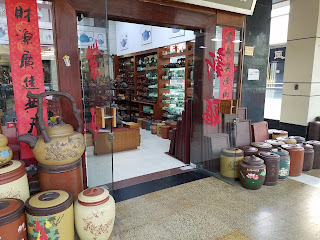
Near my home is the largest Tea Retail complex in Shenzhen, 国际茶都 the (“international tea capital”,) that comprise hundreds of shops selling all kinds of tea and associated paraphernalia.

After introduction by a friend, almost every afternoon I go to one of the shops for some tea, and I have made some new friends. This is likely only Part I.


Shop selling accessories, which can range greatly in price.


Tea Furniture is serious business. I'd love to have some of this.


Huge Complex. The whole thing smells of Tea, which is wonderful.

09 December, 2021

Shenzhen Bay Opera, Qianhai, Mahler, Roast Pig and Snail Soup Noddle


Click pics to enlarge. Above and below show mostly view from the library.

Letter from Shenzhen (21-17): How I Live, Part III, Concert and More

Dec 2, 2021, Bay Opera of Shenzhen 深圳滨海艺术中心
Shenzhen Symphony Orchestra - Lin Daye 林大叶
Mahler 6th Symphony


The Venue
Although I am a die-hard fan of the SSO, I remain flabbergasted by their haphazard approach to concert management. Their last-minute dissemination of concert info is highly irritating, made more so during these covid times. It was a mere 2 days before the concert that I learned of it. It was a Thursday, as they would travel to Guangzhou the next day for the same concert.

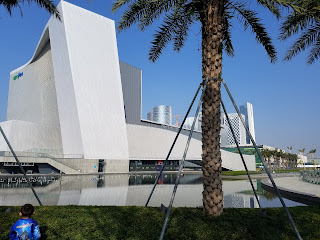
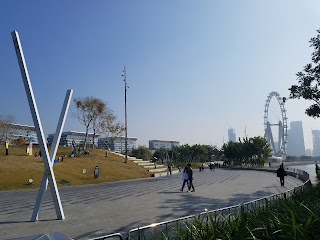
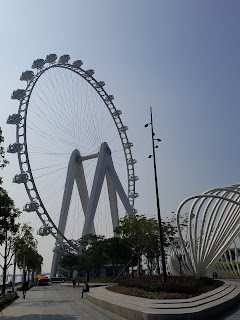
It was a big hassle, as this concert took place in a just recently unveiled new venue far from me, the Bay Opera of Shenzhen, which is in the Baoan Qianhai 前海 CBD area (official link). The area is one of the poshest and trendiest now in SZ. As per the usual for this city, the cultural complex is in a less trafficked area, right next to the district government, and comprise a District Main Library, Youth Center 少年宫 and Concert Hall. In planning, it is highly similar to the older Futian and Longang complexes that I have chronicled, but it is clear that it is more modern, lavish, and “forward-looking”. This complex was invested in by the mega commercial group 华侨城,which is a major player in many of Shenzhen’s mega-venue developments. See my photos below. The “high-class” area is in its last phase of development, seeing a construction of Book City 书城, which will bring in much needed traffic and “culturally related” paraphernalia, as well as middle-class mass-oriented food courts and the likes. It is part of a massive waterfront development that is very impressive, and I have not explored it much. In the distant is a theme park and Ferris Wheel. More later.


The interior of the library feels like a hotel


Below is the less impressive exterior of the Opera House.


vs Hong Kong
The whole complex, which I have not even begun to explore to the full, gives me a sense that Hong Kong’s days are limited. True, there is not much traffic yet, but the infrastructure is at least HK’s equal, and more efficiently dispatched. For a long time, I have been disgusted by HK’s commercial intrusions into ostensibly cultural projects. I personally have long vehemently disfavored the West Kowloon Project. The planning and design had been pretentious, by “prestigious” western firms that have little identification with the Chinese population. Everything smacked of remnants of HK’s colonial past, and its self-aggrandizing international ambitions (an oxymoron these days), have been gravely costly, and will play little role in the future within the Greater Bay, especially now as Western anything is frowned upon by the powers that be. Mind you, I have been saying this long before the current HK scene plays out (it is likely already endgame).


The Concert

Per my previous experience with conductor Lin Daye in Mahler 5 (here), I expected a terse and efficient delivery, and sure it was the case. The first movement was certainly energico, though the more tranquil episodes were less well conveyed. The Scherzo lacked a little of the macabre (though that is not foremost in this work.) Only in the Andante did Lin bring out pathos, and it was up-heaving at times. It was here that we discerned the world was about to change. In the Finale, Lin kept up the tension, but did not fully differentiate the increasing devastation the consecutive blows had inflicted upon, so the passages with common themes that led up to the 3 hammer blows did not quite yield a cumulative effect, much unlike what Simone Young did so artlessly with the NYPO (here). However, overall, I was pleased by the performance. A note, the First Oboist seemed not the usual first desk, and had his unevenness, and didn’t quite blend in with the excellent First Clarinet, Yi Cheng 衣丞. So, the winds were a little below par, but the horns and brass played very reliably. As a whole, they played valiantly in tutti, but floundered a little in more intimate and expressive passages, where colors were sometimes not quite idiomatic (this is after all not quite yet a Mahler orchestra). I was gratified that a few in the audience yelled “Bravo”, which was a little warmer than the usual crowd in the Shenzhen Concert Hall in Futian.

In these covid times, The SSO has been hard to track, but I am glad to have caught up with them this time. No doubt, given China’s very strict covid guidelines, they have been faced with cancellations and sudden green lights. They scrambled, so did I!

Problem: The Acoustics
The hall did not sound very bad, but neither did it sound very good. From my seat, sound was somewhat constricted and overdamped, but better than the old and dry-sounding Longgang Cultural center. Tidy, but not expansive nor engrossing. Death Trap: My seat (Balcony, 4th row left) had a deadly ringing/reverberated distorted sound when the violins played forte (and louder) that sounded like distorted and overloaded upper harmonics. NOT a good job. Acoustically, it certainly fails to hold a candle to the Shenzhen Concert Hall. The hall was acoustically designed by Australian Marshall Day, which I think was just a big mistake. Judging by their consultation in HK's uneven to lousy sounding venues, they are imposters who know nothing about what music should sound like. Most of these so-called acousticians turn out garbage products that sound much inferior to traditional designs. Believe me, I know. In NYC, we had Avery Fisher, whose remedial efforts were failures. 

My Day
I started out in my home in Nanlian 南联, Longgang 龙岗 around 9:30 am. I took the Metro (Line 3) to 爱联 (3 stops) and transferred to the Express Bus E23, which travelled by highway all the way to Nanshan/Baoan. Weather recently has been absolutely lovely, and I voraciously took in the scenery along the way. Large swaths of industrial complexes are juxtaposed to some very nice scenery, reservoir and lakes around neighboring Dongguan 东莞. Previously, these were backwaters, but now one can see urbanization encroaching upon the landscape in every direction.

At Lingzhi Park 灵芝公园 I transferred back to the Metro and arrived at the Arts Complex a little short of 2 hours later. It was a 15-minute walk from the Metro to the Complex but I relished it, taking in the new scene.

The reason I had started out so early was to grab a concession ticket. The venue is very generous in offering a limited number of RMB 50 tickets, which can only be purchased in person at the Box Office (a correct policy). It being a working day, Thursday, I could have gone much later but I was not taking any chances, especially with Mahler! Concession tickets are in the balcony, which is usually favored by me for less acoustic anomaly (think HKCC).

I had researched some detours around the area, but improvised a little. With a lot of time to spare, I took a local bus which coursed through local (un-gentrified) neighborhoods before arriving at a nearby Metro Station. It went through an old part of town. On the bus, at the big wet market
上川市场 I caught sight of an enticing Crispy Roast Pig 烧肉 and I got off and patronized the restaurant (see pics below). It was very good (as was the chicken), though still not quite up to the previously chronicled charcoal-grilled standards of my HK home-ground Yuen Long’s 添记! They told me they are a Guangzhou franchise.


Basically the belly coelomic lining. Owner told me they sell three a day.


I made my way by bus to IKEA to return something. With a little time to spare, I ventured via the elevated Metro on to Longhua 龙华 Wuhe 五和 and had a bowl of snail rice noodle at the specialty’s most famous venue in Shenzhen 周氏螺蛳粉. At 4:30 pm, the place was packed. My verdict? It was good and the soup had real snails in it (see pics), and the fermented bamboo shoots were of great quality (I am a bamboo shoots aficionado).


I then made my way back. Near the Metro Station, amid the highly posh malls and glitzy restaurants, a small alley (part of the structures), lined with small restaurants, that is semi-hidden, caters to the workers (this being a new area - there are no “locals”; but contrast this with HK, which would only put generic mediocrities like Starbucks near its venues). I had a beer at a Convenience Store. There are two, 711 and the local 美宜佳. As usual, 711 is more upscale, and sells beers like 1664 and mostly canned beers and small bottles, but as I am a fan of the large 500-700 ml glass bottles seen only in China, I always opt for the local chain.

People in squeezed HK may not know, in places like SZ and Taiwan, some larger Convenience Stores have Seating Areas, where one could consume some fast foods (noodles or boiled items 关东煮 麻辣烫or drinks.) Next to me, the young fellows wolfed down some noodles and proceeded to smoke, which is highly irritating (rule says no smoking indoors but there is no enforcement at local joints.)

A tiring day, but well worth it. You shall hear more about this venue.

12 November, 2021

Capital Audio Festival 2021

pic from Stereophile.

Stereophile's Report on Capital Audio Festival 2021  

Ken Micallef's Report

This is a brief posting alerting you to one of the first Audio Shows around these days. It is, as usual, well written by Ken Micallef. From his musician audiophile series, I know he has a youtube channel, and you may want to search there for some videos (I rarely use VPN to surf youtube here in China, so I'd not know)!

I have never been to this show, even if I have relatives in D.C! Have always wanted to go, and then covid hit. But I have read all the reports, and Stereophile has always done a great job with this one. It seems to me the Show is changing a bit, with more upscale stuff and less bargains. I hope that's not a permanent trend. As an example, I probably know why VK Music, a regular at the show, is not there this year. During these stressful times, it can be a combination of logistics and personal factors.

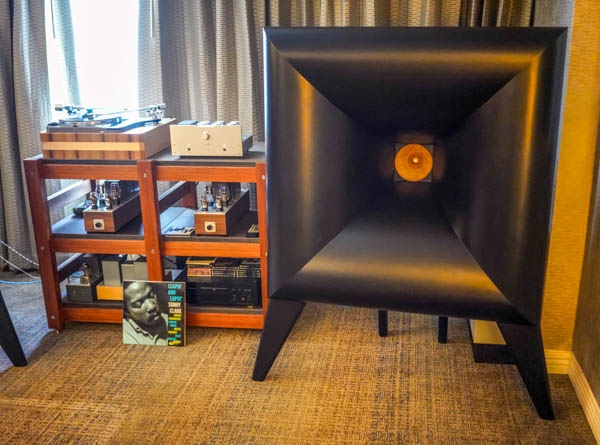
The borrowed pic shows a horn with field coil driver that took 240 hours to make. It is not cheap, but if you ask me, much more deserving of its price than the many machined and assembly line manufactured loudspeakers. Still, no, I'll stick with much cheaper horns...

I was surprised by the many Linear Array Loudspeakers (all very expensive). Given that my NYC friends who whole-heartedly embrace classic Infinity's and I have heard them to great effect, I am pleased.

I cannot help but notice that Ken mentioned some manufacturers refrained due to mask mandate. As a physician and a civically minded individual, I can only sigh. Yes, if this covid thing drags on (likely) it will polarize even the audio world! You have heard me. I was entertained also when I read that Ken was asked to remove his mask among friends who all have been vaccinated to share cocktails. Wonderful, but this also illustrates the tenuousness of "post-covid" (we're not quite there) contact. I personally regard wearing a mask as respect for others. Here in Shenzhen, we have currently no cases. When I am on the street I wear no mask, but when I enter a mall or shop I don one as a courtesy.

Anecdote: I have a personal connection to this Show. I have exchanged emails and spoken with Victor of VK Music many times, but to this date I have never met him. My friend Richard C, whose system and endeavors have been featured in this blog, who is an essential worker in NYC, went  to the 2019 show and met VK and took back an Elekit amp for me to play with (still, many thanks). Forward to 2020, a reviewer for a trade magazine encountered a minor hiccup in the system. After a barrage of phone calls, Richard C knew a technician nearby and helped solved the problem in no time. Rescues off the scene! Bravo, audiophiles

07 November, 2021

Books in China


Trenchant scene from Marjane Satrapi's Persepolis. Click pics to enlarge.


Letter from Shenzhen (21-16): How I Live, Part II, Books

"Aujourd'hui, maman est morte. Ou peut-etre hier, je ne sais pas...". I learned this at my third term French at Brooklyn College. I shall never forget it. To this day, I have a special fondness for Camus.

In previous episodes, I drew a crude sketch of the environment “I find myself in”, often examining myself in the mode of an “expat”. Just as Americans, and increasingly Europeans and many peoples around the world, who find the more they ask who they are, the more questions they have and the more they revolt against the status quo, it is the same for many people of Chinese origin, who are often not from “China”. It is also clear (to me) that the more we distinguish ourselves, the more we create subdivisions, the more fractious and unstable the world becomes.

A methodical expose of one’s current life is not possible. After contemplating writing more about basic amenities (its quirks here are actually interesting), which is honestly a bit of a chore, I chose to skip this time and touch upon a little a more ephemeral topic, some sort of spiritual fulfillment, which governs my routines.

The Power of Music
There are a lot of things that I miss. It is one thing to not have seen a bagel for a year, it's another of a completely different magnitude to endure being bereft of my substantial audio and LP collections (in NYC). Although I am satisfied with my humble systems here, I know there is a divide. But as I write, I'm listening to Bruckner (Hrusa, Bamberg, Accentus; loud, there is no other way) and I remain totally entranced by the master's music. Readers who have gone along with me during these covid times would know even in NYC I mostly streamed music on smaller systems than went through the ritual of FMJ on the big rig. So, in that respect, being in China is not that much different. Classical music as spiritual fulfillment (at least at home) is not a problem here at all (other genres too, as you wish). I can have, at will, as I prefer, Bach in the morning, Brahms or Bruckner when the light dims. Note: it is important that one finds one's own path; music knows no borders and is a life-long companion and spiritual nourishment. However, the average audiophile may be the last to know.

Of course, I’d prefer to listen to live music, and I have a few times here, chronicled in my companion blog. Problem is, given the super-strict protocols here, these seem to have disappeared recently. My favorite local orchestra, Shenzhen Symphony, has basically used their limited slots to support national and local interests, like concerts for young and emerging composers, which I both support but would not attend. Not much chance to hear Bruckner and whatever. But I also notice that in NYC concerts are happening at full capacity. Should I be in NYC, would I attend? I wonder, but personally I’d hesitate, as I cannot be assured of the vaccination status of everyone else (of course I am vaccinated), and we all know enforcement is difficult, even perilous. The brave new world...

Having less audio means more time for other things and that means I read more now. Given that this is China and that even in translation I prefer to read in English, finding the right books to read can be challenging, but it can be done.

The Library
As the libraries here are mostly open (QR Health Code always needed; with only occasional closings or capacity restrictions), I have resumed my habit of going regularly (true for my time in pre-pandemic Hong Kong and NYC).

In a way, the library is the most cosmopolitan, and international, place on earth, where one can read about all sorts of things. Would you not be curious what a library (or a bookshop) in a communist country looks like? Here's the gist:

Local Authors and Publications Books are of course in Chinese. Unlike the West, where publishing (aside from university presses) is controlled by a few international mega firms, China has a huge number of publishers, and each province (and many cities) has its own (sometimes several). Mind you, we exclude digital platforms here. Of course, given the government censorship, variety and true ingenuity, not to mention penetrating analysis and satire, are limited. One will not find any account of June 4th, 1989, nor will one find non-official-sanctioned biographies of government figures, even party idols. As monopolistic politics pervades everyday life, self-censorship takes a toll on creativity. Non wonder many innately talented political writers “choose” to take to analyzing ancient dynasties, particularly the Ming, when China was particularly prosperous. These historical reconstructions are ubiquitous, but perhaps they serve as a commentary on how writers circumvent censorship - if they cannot freely speak about the now, they can do more with the past. Overall, I’d say the quality of offerings, particularly in more strait-jacketed non-fiction, is a rung down from the best in the West. One other thing that I find utterly frustrating is the utter lack in English citation in things as simple as proper names, be it a city or a park. Let’s face it, English is a world language; at least its alphabets are familiar to everyone. Chinese pinyin word input uses alphabets and are universally taught, and that is why I learnt it and use it to write Chinese. Here in China, even the almost illiterate knows some alphabets. So it’s doubly frustrating to read in an otherwise fine article in a Chinese magazine only the Chinese transliteration for proper names. In most cases, I can re-construct it, but it can be exasperating sometimes, especially when it comes to Greek Gods (often seen in school texts) and exotic little towns mentioned in travel mags (given the rise of middle class, a thriving sector) that one wants to know about.

Books in Translation Ever since the toppling of the last Qing dynasty, in 1911, translations of western books have never ceased. You will be shocked how many books in translation are available in the local library. A great number of authors, past and recent, of many nationalities, from Updike to Cheever to Oates, from Unamuno to Borges to Marquez, from Edna O’Brien to Ichiguro, to the many rather obscure Nobel laureates, are all available. I don’t usually choose to read these translations, which BTW are officially sanctioned. Even more amazing are the sheer number of “Classics”. In the USA, Romain Rolland’s Jean Christophe, modeled after Beethoven, is long oop. But in China, it has always remained in print in an ancient translation by Fou Lei, father of renowned pianist Fou T’song (who recently passed of covid in UK). I have a personal relationship to this work. In my youth, during the summer vacation, all the desirable books had been borrowed from the Hong Kong library. I was left with “classic” literature, foreign and Chinese (yes, they were not popular even then) and so I checked out Jean Christoph. Forward 10 years, in NYC’s great Strand bookshop, I chanced upon an oop Vantage paperback 3-volume edition, and I still have it. Needless to say, even the local Queens library does not have it and I still haven’t been able to finish it even having 2 chances. There are also tons of books by almost forgotten authors, like Somerset Maugham, which are likely not available in the average US library. Fiction books in translation seem to have as a safe haven, as it should be. I discovered the beautiful book Memoires de la rose, by Consuelo de Saint-Exupery, wife of one of my favorite writers, her famous husband Antoine (translated from the French). I read all the marvelous books of Marjane Satrapi (whom film buffs will know from her most famous work, Persepolis, made into an animated film; one scene above), with all the dialogues in Chinese!

Books in English The branch libraries have some bilingual children’s books. My local branch has no English books for adults, but does have the magazines National Geographic and, surprisingly, Time. Um, sorry, no New Yorker. The district Central Library has several racks of English books, a Hodge-podge of old classics and various trade books. This was where I got my Virginia Woolf’s Mrs Dalloway. If I have the determination, Proust’s Remembrance of Things Past is available.

Book Cities Aside from the library, there are 2 mega book cities near me. Each offer a whole lot of books (see pics below). I often browse for what I’d like to read, then borrow from the library.

One rack from the district Central Library's English Book Collection. I highly recommend
this book by obscure Emma Reyes, which I have read before.

If you haven't read the deadly serious, indeed "deadly" period, "comics"
 of Marjane Stratapi, you must. 


A lousy draft at the local Pizza Hut, reading Murakami's Killing Commendatore.


My Local Library. The Chinese magazine is one of my favorite for years.


A notice that a page from the Time magazine had been removed due to violations. 


Pics of the Local mega Bookseller Book City.


Books in translation: Romain Rolland's Jean Christophe.
Albert Camus' L'etranger, La Peste and a lot more.